Climate Primer #31: Impacts of Climate Crisis – 14. Deteriorating Health

To summarize, climate crisis is the defining issue of the century. Buildup of anthropogenic greenhouse gases (GHGs) in Earth’s atmosphere is driving global heating, while a convergence of global crises threatens to rupture key planetary boundaries. Although the human activities which drive these converging crises (for simplicity: the climate crisis) are diverse and complex, the Fifth Assessment Report (AR5) of the Intergovernmental Panel on Climate Change (IPCC) breaks down the sources of anthropogenic GHG emissions into five high-level sectors. Similarly, the impacts of climate crisis – in their variety and complexity – are almost impossible for an individual to grasp, but so far, this sub-series has covered: global heating, Arctic amplification, heat waves, droughts and floods, disruption of oceanic and atmospheric patterns, cryosphere collapse, declining oceanic dissolved oxygen content, sea level rise, fisheries collapse, coral reef die-offs, deforestation, water scarcity, and food insecurity. In the absence of dramatic global climate action this decade, climate crisis will likely spiral out of control, rupturing key planetary boundaries and endangering the future of organized human life on Earth.

There are many ways in which climate crisis will undermine (and is already undermining) human health, a number of which have already been touched upon in previous posts, but this AR5 excerpt does a nice (which is to say, terrible and alarming) job of summarizing:

Source: AR5 of the IPCC (page 69)

Here in New York City, the mosquitoes have been noticeably worse in recent years, even with the City’s extensive eradication efforts (which include the use of a number of toxic substances), and I’ve never seen mosquitoes as bad here as they have been this summer. As one would expect, New York’s mosquito season also starts earlier now and lasts longer than it used to (last year, into December), and as novel diseases (West Nile, Zika, chikungunya) spread and old diseases (malaria, dengue, EEE) re-emerge as threats, residents of the Northeast of the United States can expect vector-borne infectious diseases to resume a dread character in our consciousness that, during the 20th century, was widely imagined had been relegated to the annals of a pre-Modern history – although, of course, vector-borne illness is only one of the multiple human health threats outlined above.

As is broadly the case with respect to climate crisis and climate action, every day that passes is a day during which collective resources dwindle and collective threats mount. Basically, there’s always no time like the present for climate action, and it will take remarkable, lasting, mass movement to drive the necessary public action to address climate crisis, so I hope you’ve committed yourself to being part of the struggle.

Brief bonus material today on the roots of the CDC in malaria control efforts in the US South. We can hope that someday soon, the institution is restored to some semblance of serving its mission.

Climate Primer #30: Impacts of Climate Crisis – 13. Food Insecurity

To summarize, climate crisis is the defining issue of the century. Buildup of anthropogenic greenhouse gases (GHGs) in Earth’s atmosphere is driving global heating, while a convergence of global crises threatens to rupture key planetary boundaries. Although the human activities which drive these converging crises (for simplicity: the climate crisis) are diverse and complex, the Fifth Assessment Report (AR5) of the Intergovernmental Panel on Climate Change (IPCC) breaks down the sources of anthropogenic GHG emissions into five high-level sectors. Similarly, the impacts of climate crisis – in their variety and complexity – are almost impossible for an individual to grasp, but so far, this sub-series has covered: global heating, Arctic amplification, heat waves, droughts and floods, disruption of oceanic and atmospheric patterns, cryosphere collapse, declining oceanic dissolved oxygen content, sea level rise, fisheries collapse, coral reef die-offs, deforestation, and water scarcity. In the absence of dramatic global climate action this decade, climate crisis will likely spiral out of control, rupturing key planetary boundaries and endangering the future of organized human life on Earth.

Multiple previous posts have referenced or related to the risk of crop failures, reduction of arable land, and other threats (like the collapse of fisheries globally) to food security, but from a human standpoint, few concerns are more immediate than not having enough to eat, and, under climate crisis, the longstanding – and currently pandemic-exacerbated – global crisis of hunger stands, as AR5 outlines, to get much worse:

Source: AR5 of the IPCC (page 69)

The IPCC take is, admittedly, a little dense. As a plant lover and urban agriculture enthusiast, I think a lot about food, food systems, and what it takes to grow things, so I’m taking the opportunity now to share a number of different food-related resources, including: This Nature Climate Change article from December 2019 entitled “Changing risks of simultaneous global breadbasket failure”; this U.S. Right to Know piece entitled “Cornell Alliance for Science is a PR Campaign for the Agrichemical Industry” (and this related Columbia Journalism Review piece on the undue influence of the Gates Foundation on the media); this new study entitled “Glyphosate-based herbicide residues in manure fertilizers decrease crop yield” on another threat related to the growing (corporate-driven) ubiquity of synthetic toxins in the biosphere (and, on the same tip, a new PNAS opinion piece entitled “Neonicotinoids pose undocumented threats to food webs”); and, finally, to round it out, this piece – entitled “Neoliberalism ‘colonized the palates’ of Mexicans, left high levels of obesity” – from the Mexico Daily News.

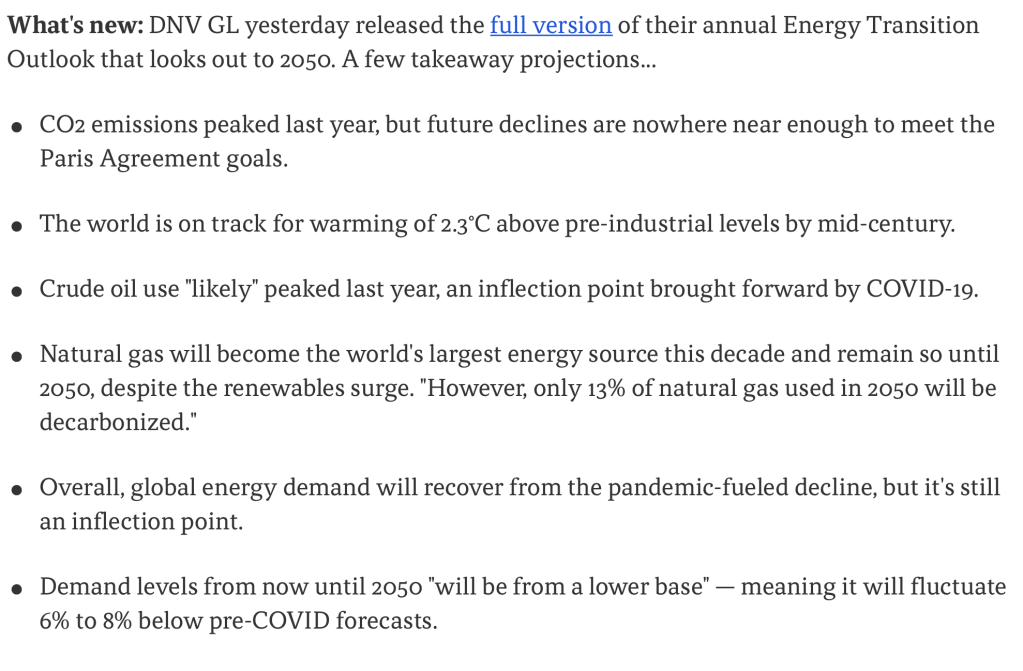
In thinking about our current warming trend and what it will mean for, among other things, food security, some bonus material courtesy of Axios and drawn from a recently released DNV GL report:

Source: https://www.axios.com/newsletters/axios-generate-7f41944b-ae99-4c63-8aab-5370b4276173.html?utm_source=newsletter&utm_medium=email&utm_campaign=newsletter_axiosgenerate&stream=top

Climate Primer #29: Impacts of Climate Crisis – 12. Water Scarcity

To summarize, climate crisis is the defining issue of the century. Buildup of anthropogenic greenhouse gases (GHGs) in Earth’s atmosphere is driving global heating, while a convergence of global crises threatens to rupture key planetary boundaries. Although the human activities which drive these converging crises (for simplicity: the climate crisis) are diverse and complex, the Fifth Assessment Report (AR5) of the Intergovernmental Panel on Climate Change (IPCC) breaks down the sources of anthropogenic GHG emissions into five high-level sectors. Similarly, the impacts of climate crisis – in their variety and complexity – are almost impossible for an individual to grasp, but so far, this sub-series has covered: global heating, Arctic amplification, heat waves, droughts and floods, disruption of oceanic and atmospheric patterns, cryosphere collapse, declining oceanic dissolved oxygen content, sea level rise, fisheries collapse, coral reef die-offs, and deforestation. In the absence of dramatic global climate action this decade, climate crisis will likely spiral out of control, rupturing key planetary boundaries and endangering the future of organized human life on Earth.

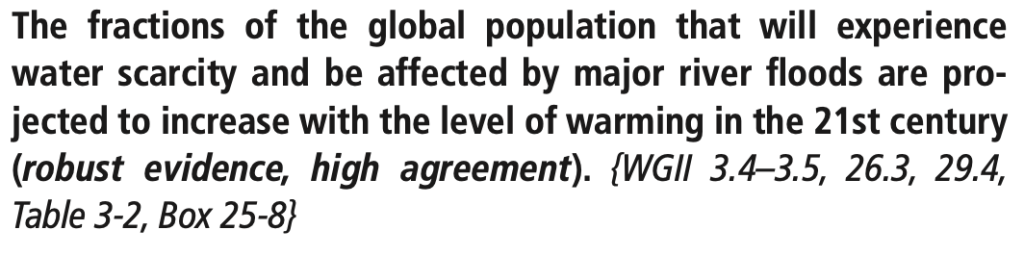
A previous post highlighted freshwater consumption as a key planetary boundary; unfortunately, multiple intersecting aspects of climate crisis are now converging to reduce the availability of safe drinking water across much of the world, including in heavily populated parts of South Asia, North Africa, and western North America. As AR5 puts it:

Source: AR5 of the IPCC (page 67); obviously, there’s a cruel irony in simultaneously increasing risks of both water scarcity and major floods.

And further:

Source: AR5 of the IPCC (page 69); note, that, unfortunately, most of Earth’s human population does not live at high latitudes.

At the risk of redundancy, this sentence from the second excerpt above stands out: “The interaction of increased temperature; increased sediment, nutrient and pollutant loadings from heavy rainfall; increased concentrations of pollutants during droughts; and disruption of treatment facilities during floods will reduce raw water quality and pose risks to drinking water quality”; although New York City is fortunate to enjoy access to ample freshwater for even its massive population, events in recent years have shown how aging infrastructure combined with negligence and lack of public funding (lead), corporate malfeasance and regulatory capture (PFAS), and extreme weather events (Superstorm Sandy) can threaten access to safe drinking water even in a place like New York. As I’ve noted previously, I think it’s correct to claim that all 14 of NYC’s wastewater treatment facilities are at risk from rising sea levels and storm surges.

Climate Primer #28: Impacts of Climate Crisis – 11. Deforestation

To summarize, climate crisis is the defining issue of the century. Buildup of anthropogenic greenhouse gases (GHGs) in Earth’s atmosphere is driving global heating, while a convergence of global crises threatens to rupture key planetary boundaries. Although the human activities which drive these converging crises (for simplicity: the climate crisis) are diverse and complex, the Fifth Assessment Report (AR5) of the Intergovernmental Panel on Climate Change (IPCC) breaks down the sources of anthropogenic GHG emissions into five high-level sectors. Similarly, the impacts of climate crisis – in their variety and complexity – are almost impossible for an individual to grasp, but so far, this sub-series has covered: global heating, Arctic amplification, heat waves, droughts and floods, disruption of oceanic and atmospheric patterns, cryosphere collapse, declining oceanic dissolved oxygen content, sea level rise, fisheries collapse, and coral reef die-offs. In the absence of dramatic global climate action this decade, climate crisis will likely spiral out of control, rupturing key planetary boundaries and endangering the future of organized human life on Earth.

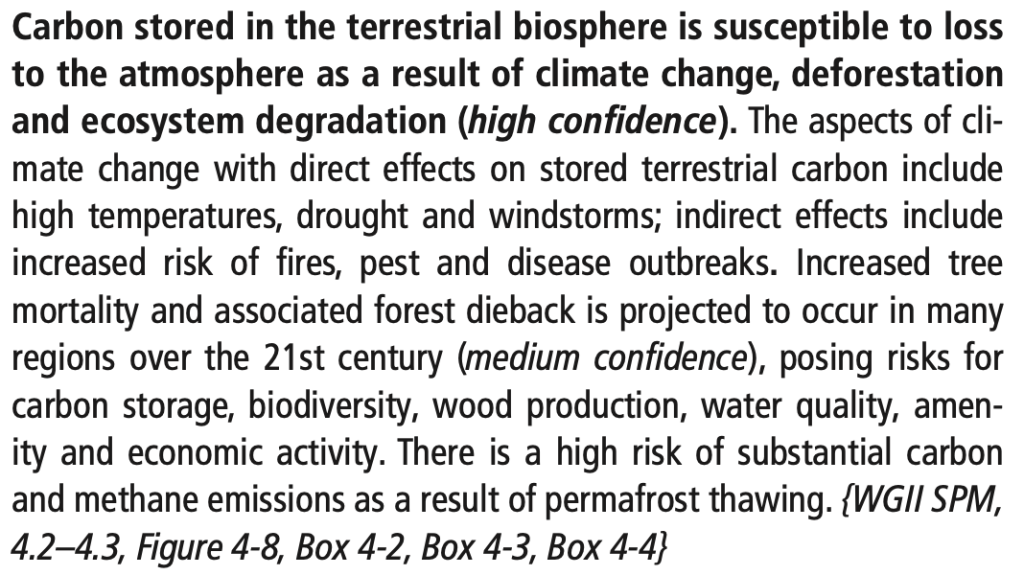
Previous posts have already hinted at the threat to Earth’s forests posed by climate crisis, but it’s important to note – as the following excerpt from AR5 does – that climate crisis will bring an “increased risk of fires, pest and disease outbreaks,” in addition to the threat of habitat loss from changing climate (that is, many regions of the planet getting hotter and/or drier) and the damage done by logging, development, and other ecologically unsound human land-use practices:

Source: AR5 of the IPCC (page 67); note that while my post focuses just on deforestation, this excerpt addresses the broader risk of “loss to the atmosphere” of carbon stored in Earth’s terrestrial (that is, on land) biosphere.

I’ve written elsewhere about the catastrophic 2019 fires in Australia, the Amazon, and California. Less attention is paid to the Boreal forests that ring Earth’s northern latitudes, but in 2019, ~25x as much area burned in Siberia as burned in California. (For context, although the oceans hold the vast majority of the carbon stored in our planet’s biosphere (~15x the amount stored in the terrestrial biosphere, which in turn exceeds that which is held in Earth’s atmosphere), of the terrestrial carbon, just shy of 50% of it is contained in Earth’s forests.) And, of course, for anyone with feelings, forests are much more than carbon sinks.

Climate Primer #27: Impacts of Climate Crisis – 10. Coral Reef Die-Offs

To summarize, climate crisis is the defining issue of the century. Buildup of anthropogenic greenhouse gases (GHGs) in Earth’s atmosphere is driving global heating, while a convergence of global crises threatens to rupture key planetary boundaries. Although the human activities which drive these converging crises (for simplicity: the climate crisis) are diverse and complex, the Fifth Assessment Report (AR5) of the Intergovernmental Panel on Climate Change (IPCC) breaks down the sources of anthropogenic GHG emissions into five high-level sectors. Similarly, the impacts of climate crisis – in their variety and complexity – are almost impossible for an individual to grasp, but so far, this sub-series has covered: global heating, Arctic amplification, heat waves, droughts and floods, disruption of oceanic and atmospheric patterns, cryosphere collapse, declining oceanic dissolved oxygen content, sea level rise, and fisheries collapse. In the absence of dramatic global climate action this decade, climate crisis will likely spiral out of control, rupturing key planetary boundaries and endangering the future of organized human life on Earth.

Today’s post centers the risk posed to coral reefs from the combination of warming, acidification, and deoxygenation of the oceans. To quote from Chapter 3 of the IPCC’s “Special Report: Global Warming of 1.5ºC“: “Even achieving emissions reduction targets consistent with the ambitious goal of 1.5°C of global warming under the Paris Agreement will result in the further loss of 70–90% of reef-building corals compared to today, with 99% of corals being lost under warming of 2°C or more above the pre-industrial period.” So the struggle (at this point against all odds) to limit warming to 1.5ºC is a struggle to preserve something like 10 to 30% of extant coral reefs, whereas, should warming reach 2ºC, the IPCC predicts 1% or less of existing reefs will survive. Given that these are some of the most diverse and productive ecosystems on the planet and anchors of many marine food chains, the ecological and economic impacts (before even factoring in tourism) of such reef losses stand to be immense, but there is also the profound tragedy of human (as always, read: largely corporate) actions leading to the destruction of something so vital and beautiful. Through our collective action (and inaction), we are impoverishing the Earth.

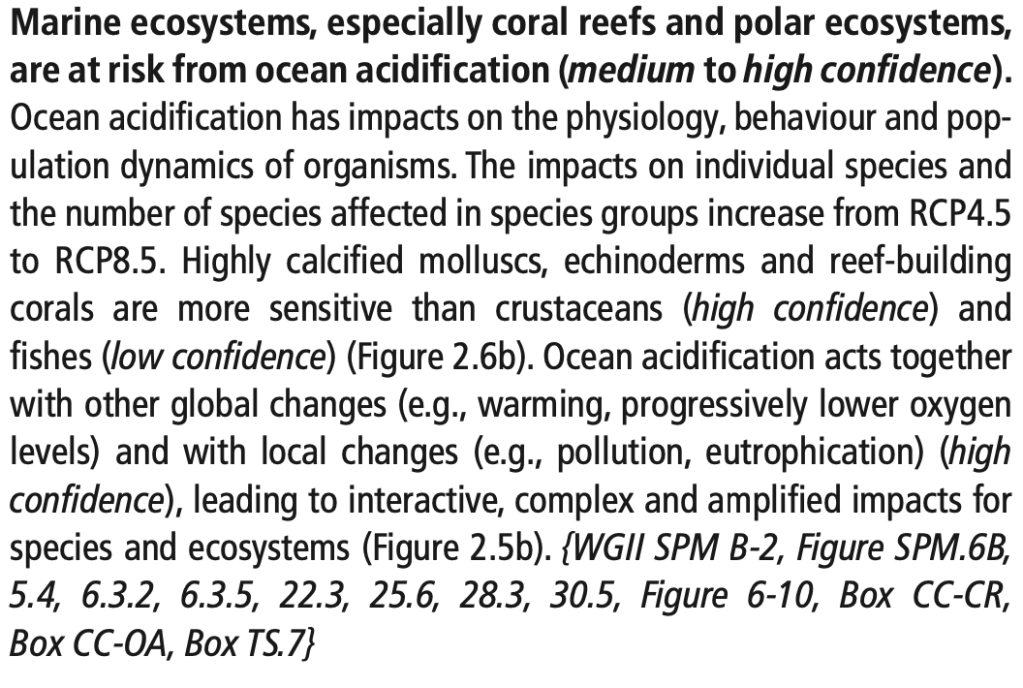
For readers interested in going deeper on the sensitivity of corals to threats under climate crisis, here’s a recent Nature Climate Change article that I found really interesting. And for all, here’s a little of what AR5 had to say about coral:

Source: AR5 of the IPCC (page 67)