Basically, many dry regions stand to get drier, many wet regions stand to get wetter, and many land masses that already experience “extreme precipitation events” (see: wet microbursts, not a porn term) stand to experience “more intense and more frequent” such events than they have in the past. Recent catastrophic fire seasons in Australia and California have been tied to unusually hot and dry weather, while it seems like Houston hardly goes a year these days without a once-in-a-century storm. In New York City, our summer thunderstorms increasingly have the character of the above-mentioned microbursts, while on the other side of this colonized continent, the US Southwest is in the midst of its worst mega-drought in 500 years (here’s the relevant Science study), and, of course, the Gulf Coast was just hit by another record-setting storm (this one driving an “unsurvivable” storm surge). I’d proffer other examples, but I suspect you don’t need them.
Today’s post will center heat waves. As you’ve probably noticed, they’re becoming ever more frequent in the United States, Europe, South Asia, and many other places around the world (including in the world’s oceans, where massive marine heat waves have led to mass die-offs of marine animals and seabirds; here in New York City, a die-off of menhaden earlier this summer was linked to “Sewage, Heat, And Climate Change“). Here’s some of what AR5 had to say on the matter of heat waves:
Although they don’t always receive the same attention as hurricanes, wildfires, and earthquakes, heat waves are among the deadliest of natural disasters (increasingly, it is appropriate to say “natural disasters” or so-called natural disasters, as both the impact of anthropogenic climate change on these disasters and the ability of scientists to quantify that impact increase by the year). I won’t offer links to articles about the thousands of heat wave-related deaths across Western Europe or in Pakistan in recent years, but I trust that readers are aware of those regional tragedies, as of the growing risk that large parts of South and West Asia will become unlivable for humans by the end of this century if urgent action is not taken now to slow (and perhaps even reverse) global heating.
Postscript: For readers interested in the health of the Hudson River and its estuary in particular, Riverkeeper is an excellent resource and has been doing good work since the 1970s.
To summarize, climate crisis is the defining issue of the century. Buildup of anthropogenic greenhouse gases (GHGs) in Earth’s atmosphere is driving global heating, while a convergence of global crises threatens to rupture key planetary boundaries beyond which organized human life on Earth would be threatened. Although the human activities which drive these converging crises (for simplicity: the climate crisis) are diverse and complex, the Fifth Assessment Report (AR5) of the Intergovernmental Panel on Climate Change (IPCC) breaks down the sources of anthropogenic GHG emissions into five high-level sectors. Similarly, the impacts of climate crisis – in their variety and complexity – are almost impossible for an individual to grasp, but I’m at least going to highlight some of the key impacts in posts that will likely run for the next month or so. Yesterday’s post addressed the most obvious impact of climate crisis: global heating.
And here’s a piece from Yale Environment 360 from this June the title of which captures much the same message in plain speech: “Temperatures Exceed 100 Degrees F[ahrenheit] North of the Arctic Circle.” It takes no great act of imagination to conjure what impact such warming may have on sea ice, ice sheets, permafrost, Arctic ecologies and human settlements, among other consequences (including the opening of year-round trans-Arctic navigation which people like Mike Pompeo celebrate as “a wonderful economic opportunity“), but as future posts will likely explore those and other topics in more detail, suffice it to say for today that the Arctic is getting rapidly warmer, and that that Arctic warming is both part and parcel of the process of global heating, but also threatens rolling knock-on consequences, including some which could prove rather dire.
To summarize, climate crisis is the defining issue of the century. Buildup of anthropogenic greenhouse gases (GHGs) in Earth’s atmosphere is driving global heating, while a convergence of global crises threatens to rupture key planetary boundaries beyond which organized human life on Earth would be threatened. Although the human activities which drive these converging crises (for simplicity: the climate crisis) are diverse and complex, the Fifth Assessment Report (AR5) of the Intergovernmental Panel on Climate Change (IPCC) breaks down the sources of anthropogenic GHG emissions into five high-level sectors. Similarly, the impacts of climate crisis – in their variety and complexity – are almost impossible for an individual to grasp, but I’m at least going to highlight some of the key impacts in posts that will likely run for the next month or so.
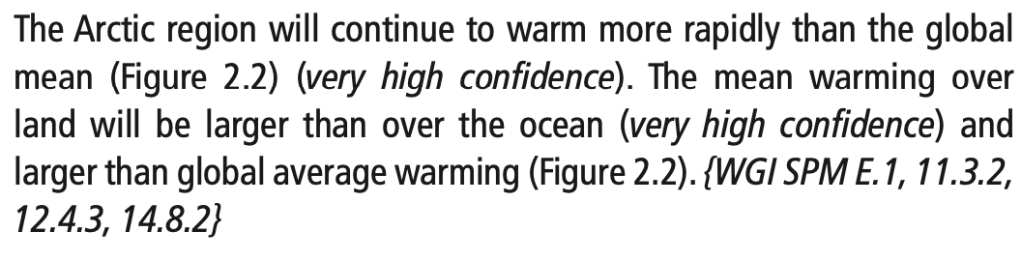
So, where to begin? Again, the overwhelming complexity and sadness of climate crisis are among the key barriers to the initiation of climate action at scale. To make this process easier on myself, I’m going to follow the same approach I have in previous sub-series and rely on a trusted source, in this instance, once again AR5 of the IPCC. Feel free to ignore the text in the following image if the jargon is too much for you:
To put it simply, in a best-case scenario, global mean surface temperature (GMST; the average global temperature) increase will be kept below 1.5º Celsius (which is the aspirational goal of the 2016 UNFCCC Paris Agreement) for this century. In less optimistic scenarios – as laid out in 2014 by the IPCC authors – GMST increase will likely exceed 2º Celsius. That may not sound like a big difference, but I think most of us now understand that – in terms of what it will mean for life on Earth – it is. Unfortunately, many rather level-headed sources are also now suggesting – as outlined in the excerpt which follows from Bill McKibben’s recent New York Review of Books piece – that without drastic action this decade, GMST increase this century could far exceed 2º Celsius:
Two degrees will not be twice as bad as one, or three degrees three times as bad. The damage is certain to increase exponentially, not linearly, because the Earth will move past grave tipping points as we slide up this thermometer.
You may be thinking: Didn’t the world leaders who signed the Paris climate accords commit to holding temperature increases to “well below” two degrees Celsius, and as close as possible to 1.5 degrees? They did—in the preamble to the agreement. But then they appended their actual pledges, country by country. When scientists added up all those promises—to cut emissions, to build renewable energy, to save forests—and fed them into a computer, it spit out the news that we are headed for about a 3.5-degree rise this century. And not enough countries are keeping the promises they made in Paris—indeed, our country, which has produced far more carbon than any other over the last two centuries, has withdrawn from the accords entirely, led by a president who has pronounced climate change a hoax. The En-ROADS online simulator, developed by Climate Interactive, a nonprofit think tank, predicts that at this point we can expect a 4.1-degree rise in temperature this century—7.4 degrees Fahrenheit. All of which is to say that, unless we get to work on a scale few nations are currently planning, Lynas’s careful degree-by-degree delineation is a straight-on forecast for our future. It’s also a tour of hell.
That’s probably enough for today. It’s obvious, but the clearest impact and signal of climate crisis was also the first to be named and reckoned with – global warming (or now, global heating) – and just as buildup in Earth’s atmosphere of GHGs drives global heating, global heating in turn drives many of the other impacts that will be explored in posts to come.
Today, another short piece, this once centering the fifth and final sector, according to the IPCC’s schema, namely, the building sector, which contributed ~6% of all anthropogenic GHG emissions in 2010. Because these posts do not follow an indirect emissions approach to GHG emissions attribution (that is, the emissions associated with electrifying and heating buildings are not attributed to the building but to the energy sector; were these indirect emissions attributed to the building sector, its overall GHG emissions contribution for 2010 would jump to 19% according to AR5), I believe it is correct to see this 6% figure as only representing the emissions associated with construction, demolition, and related activities. It is not clear to me exactly how extractive industries (for example, the sand mining, which provides a key ingredient for the concrete that is an essential ingredient of India’s building boom) fit into the IPCC’s schema, but I suppose emissions owing to extraction itself would be assigned to industry, while emissions owing to transportation of the extracted substance would be assigned to transport, and only the emissions owing to the actual construction process would be assigned to the building sector. Whether this supposition is accurate, I’m not sure.
Bonus material today is this new UNEP report – “Preventing the Next Pandemic: Zoonotic diseases and how to break the chain of transmission” – on the industrial/agricultural/economic roots of zoonoses. So far, I’ve only read the “Key Messages” myself, but I hope to look over the report in its entirety in the coming days.



 Climate / Change