A Faultline of History

The new issue of Logic magazine appeared on our doorstep like a message in a bottle from a very different near-past. As the editors decried, “It is taking too long to write this. We can hardly keep up with our push notifications.” And, indeed, it took too long to print and ship it as well, as this opening paragraph makes clear:

As we close this issue, COVID-19 case numbers are surging across the European Union, and if they are not yet as high in North America, it seems to be mostly for a lack of tests. Oil prices are plunging, the Dow Jones is plunging, and Ted Cruz is in voluntary self-quarantine. New York State prisoners are making hand sanitizer for $0.65 per hour. Passengers are disembarking from the Diamond Princess into the Port of Oakland.

How the world has changed in the last three months. It’s another beautiful, sunny late spring day in NYC, and so I’m going to lean heavily, again, on the words and ideas of others in looking to how the world might change in the coming three, and the months and years beyond.

First, some housekeeping though: FAIR continues to do great work holding the corporate media to account for its failure to hold governments and politicians to account; I recommend having a look at both “US Media Failed to Factcheck Sweden’s Herd Immunity Hoax” and “Newsweek Fails to Note That White House Reopening Guidelines Make Absolutely No Sense.” To quote briefly from the latter:

That’s because containing the virus is not the [White House’s] plan, and seems to have never been the plan. Instead, the strategy is to allow the virus to spread throughout the population, hopefully at a rate that will keep the healthcare system from completely collapsing [… because] the prime objective is to force workers back into the workforce as quickly as possible, regardless of the toll in lives […]”

Lots of great resources in yesterday’s Unsanitized newsletter including “Bad state data hides coronavirus threat as Trump pushes reopening” from Politico (which was mentioned on yesterday’s Democracy Now!); “Daily Deaths During Coronavirus Pandemic by State” from the Health Care Cost Institute, which looks at obituaries nationwide to estimate the actual excess mortality in the US due to COVID-19 (but – like this CDC page, which shows excess mortality estimates based on death certificates filed around the country – seems to have been designed for maximum inscrutability, perhaps out of fear of upsetting certain politicians by making clear that the actual national toll is likely tens of thousands of deaths higher than the official figure); from ProPublica, “A Closer Look at Federal COVID Contractors Reveals Inexperience, Fraud Accusations and a Weapons Dealer Operating Out of Someone’s House,” the title of which speaks for itself; and, on an issue close to my heart, by David Sirota, “INVESTIGATION: Cuomo Gave Immunity to Nursing Home Execs After Big Donations — Now People Are Dying.”

Back to the future though (that was intentional), I’ve been enjoying listening to Nouriel Roubini – famed for his 2006 prediction of the Global Financial Crisis – in his paywalled online lectures. He recently wrote a piece for the Guardian entitled, “Ten reasons why a ‘Greater Depression’ for the 2020s is inevitable,” which got my attention. Not sure I agree with him on everything, but he’s certainly deeply knowledge and offers unusually synoptic takes on the current global state of affairs. This video – entitled, “Medium and Long term consequences of the Coronavirus crisis” – cost $5 for unlimited views for a week. I only watched it once, but it still felt worth it. Long-short, Roubini foresees strong economies getting stronger; large firms getting larger (with the caveat that some industries – like the airline, hotel, and cruise industries – may collapse altogether); growing dominance of large tech firms as they further converge with national security states; perhaps the end of privacy; and the possibility that near-term victories for capital will force medium-term concessions to labor/social welfare. Let’s see. None of that’s earth-shattering, but he does a good job bringing things together in an empirical and dispassionate fashion, even if, ideologically, his assertions of what “will” happen must be taken with a grain of salt (and he, of course, points out himself that his predictions are all “speculative”).

Closer at hand, the latest webinar from the American Public Health Association and the National Academy of Medicine – “Mitigating Direct and Indirect Impacts in the Coming Months” – offers lots of great insights about challenges ahead for the summer, while on the issue of the US-China relationship, I found Alex Tom’s contributions to this episode of The Red Nation Podcast especially insightful for his engagement with the tension between righteous opposition to US imperialism and valid concerns about Chinese authoritarianism, and for his insistence on centering the people of both countries in looking for a path towards the creation of a international progressive movement. (He’s preceded by Amanda Yee, who had powerful things to say about the long history of US Sinophobia, and Tom’s comments start at the 46-minute mark, while Yee’s start at the 26-minute.)

Finally, in solidarity with MTA bus drivers and the union that represents them, here’s a VICE article – “NYC Bus Drivers Union Refuses to Transport Protesters for the NYPD” – on their solidarity with the protests against the police murder, in Minneapolis, of George Floyd.

Yesterday, I wrote: “Across the country and around the world, we’re witnessing (and participating in) the explosive convergence of pandemic, climate crisis, and the inequality and social fissures characteristic of the ~500-year-long history of capitalism, and exacerbated by the ~50-year’s of neoliberalism to which, I believe, we are witnessing the end.”

The title of today’s piece is drawn from Roubini’s lecture. As has been widely foretold, including by myself, there will be a pre-COVID-19, and a post-COVID-19 – a before, and an after. Be that as it may, right now we’re in the midst of it, and, against the backdrop of nationwide outrage and uprising, I feel the eerie calm that marks the eye of the storm.

Postscript: I wrote early today and without looking at social media. Videos coming out of Brooklyn from last night and this afternoon are fucking horrifying. The utterly excessive and unaccountable violence of the police, the gutlessness of our Mayor, and the viciousness of our President are colliding with the courage of demonstrators in frightening form and with alarming timing. I’ll try to address all this tomorrow, but will caution that viruses don’t make political exceptions, and, as I wrote yesterday, “It’s hard to socially distance in an uprising.”
The Beginning of the Middle

Across the country and around the world, we’re witnessing (and participating in) the explosive convergence of pandemic, climate crisis, and the inequality and social fissures characteristic of the ~500-year-long history of capitalism, and exacerbated by the ~50-year’s of neoliberalism to which, I believe, we are witnessing the end.

What comes next? Socialism or Fascism? Nationalism or internationalism? Certainly, the feudalism of the past (that still lingers in many quarters) was no model of justice, but we should hope yet to forge something better than what we inherited and what went before.

As Minneapolis burns, Louisville protests, Georgia mourns and demands action, and New York City shakes its head, Colorlines/Race Forward put it well:

Christian Cooper should not have to fear for his life on a walk through the park. Breonna Taylor should be alive. Ahmaud Arbery should still be with us. George Floyd’s life should not have been taken by police, and they all deserve justice.

Equality Labs issued a powerful statement – linking casteism and anti-Blackness – in solidarity with those rising up in Minneapolis, while The Onion has aptly skewered predictable emphasis from certain quarters (including from the President, whose battle with Twitter seems to be escalating, just as Mark Zuckerberg proves, yet again, how utterly without spine he is) on looting with respect to the demonstrations against the police murder of George Floyd, in an article entitled: “Protestors Criticized For Looting Businesses Without Forming Private Equity Firm First.”

Meanwhile, the Democracy Now! headlines this morning were a steady drum beat of bad news. Set aside the President – items included: Tear-gassing of demonstrators by militarized police; millions more US jobs lost; Pennsylvania Republican lawmakers knowingly concealing their COVID-19-positive status from their colleagues; bad news from ICE jails; bad news from meatpacking plants; bad news from Brazil; bad news from Haiti; and bad news regarding the escalation of tension between the US and China. All in all, a real gut punch, but what haunted me most was this story:

[Héctor García Mendoza, a] 30-year-old undocumented Mexican immigrant who sued Immigration and Customs Enforcement two weeks ago and was later quickly deported by the agency has officially been declared missing. […] García Mendoza reportedly hasn’t reached out to his family in Mexico or the U.S. His lawyers have contacted shelters in Mexico and immigrant advocacy groups in Texas, but no one has reportedly seen or heard from him. His family is also concerned for García Mendoza’s health, as in the days leading up to his removal, he complained of chest pain and shortness of breath but didn’t receive any medical attention from ICE.

Please, let’s hope that Hector is healthy and safe somewhere, but it certainly sounds likely that ICE intentionally sent him to his death as retaliation for his organizing.

Why was he suing ICE? To call for “the immediate release of all immigrants held at the Elizabeth Contract Detention Facility in New Jersey, where prisoners and staff have tested positive for COVID-19.”

It’s hard to socially distance in an uprising, just like it’s hard to socially distance during a natural disaster, and news from India post-Cyclone Amphan serves as a premonition of potential impacts in this Hemisphere with the approach of what’s predicted to be an “above-normal” Atlantic hurricane season. In west and central India, farmers are confronting the largest swarms of locusts experienced in decades – an evidently climate crisis-linked phenomenon – and in another Indian development with worrying resonances for our own US predicament, the COVID-19 pandemic is only exacerbating the shift towards a “communal-authoritarian” mode of rule.

This Curbed article by Alissa Walker makes the claim that:

San Francisco, a small but dense city, fared better than New York City in the fight against COVID-19 [… b]ecause San Francisco, where there is one billionaire for approximately every 11,600 residents, had purged most of the people who were most at risk from dying from COVID-19 to its surrounding counties long before the pandemic arrived.

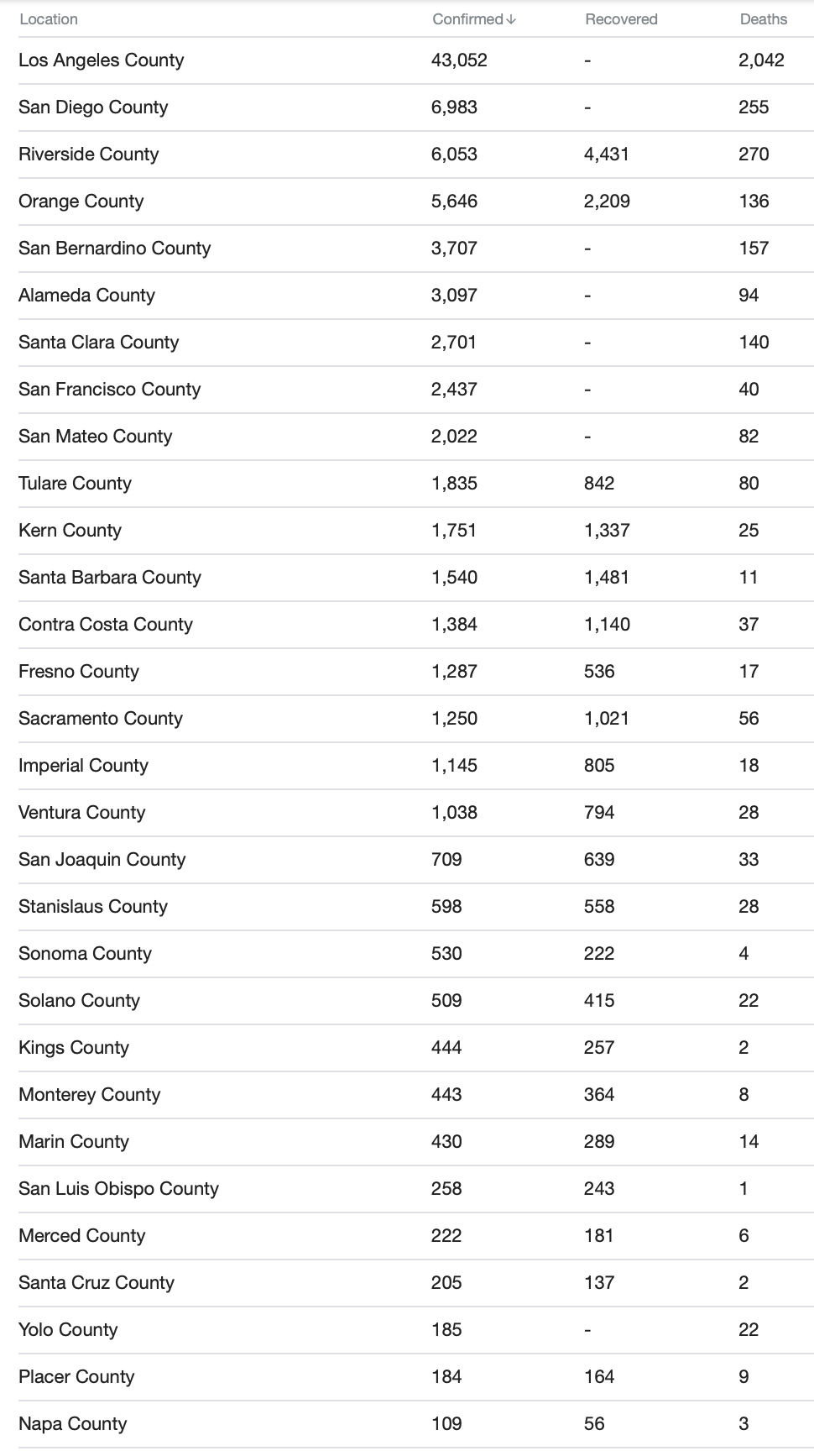
This was a take I hadn’t considered (although I’ve pointed out in private conversations that San Francisco is only one-tenth the size of NYC, and in certain other respects, is not exactly comparable to New York). Nonetheless, I felt Walker’s claim was worth investigating, and unfortunately, I don’t think it’s accurate. The nine Bay Area counties have a population roughly equivalent to that of NYC (7.4 million inhabitants to NYC’s pre-pandemic ~8.5 million and current likely ~8 million), but adding up the confirmed death counts for those nine counties (for a screenshot, see below) one finds a combined death toll of 436. The official NYC death toll is somewhere in the mid-20,000s at present, and the actual figure has likely passed 30,000 by now, so obviously San Francisco’s having “purged most of the people who were most at risk from dying from COVID-19 to its surrounding counties long before the pandemic arrived” doesn’t explain the difference in mortality. That’s not to forgive San Francisco’s obscene (even by New York standards) gentrification and income/wealth inequality, but this piece has been getting some attention, and I think it’s important to fact-check claims when they bear on the heart of our understanding of everything that went wrong. Different policy steps, not different demographics, explain the disparate outcomes in New York and San Francisco.

Circling back to Democracy Now!, Amy Goodman reported this morning:

Coronavirus cases are surging in Southern states including Arkansas, Alabama, and Mississippi. The increases came even as Politico reports that health departments around the United States have inflated testing numbers or deflated death tallies by changing criteria for who counts as a coronavirus victim and what counts as a coronavirus test.

No amount of moving the goal posts from frightened local bureaucrats, and no amount of vitriol from our unfit President can extricate us from this deepening disaster. In New York, much of the City continues to breathe a measured sigh of relief – even as the trauma and anxiety linger and mount, and the reality that the worst of the social and economic harm is almost certainly yet to come hangs heavily over our heads – but nationally, it seems the magical thinking persists. So long as we take none of the necessary political steps to control the pandemic (essentially foisting all responsibility onto private individuals, even as tens if not hundreds of millions of residents of the US are thrown into crises of basic survival), while at the same time failing to take action to protect the most vulnerable, we stand to suffer. Our society is seeded with prisons, jails, detention centers, nursing homes, homeless shelters, meatpacking plants, and warehouses and distribution centers, among other institutions which – problematic in their own rights – have served to spread COVID-19, and will continue to. Our uncontrolled national epidemic has now accelerated the global spread of the disease (as have our sadistic policies of deportation), and this morning’s news suggests that both nationally, and hemispherically, we are entering into months still grimmer than those just passed.

This can get a lot worse, and it is likely in the process of doing so.

Postscript: For posterity, the data follows.

Screen Shot 2020-05-29 at 1.36.55 PM
From Google’s data as of the early afternoon of Friday, May 29th, 2020. 

The Peeing Section

Some scattered thoughts today as we approach another weekend: My friend Evan pointed me to this study out of Yale on the use of “primary municipal sewage sludge” to identify a “leading indicator of COVID-19 outbreak”; I’ve previously mentioned studies and proposals related to the use of wastewater (that is, sewage) to detect the presence of SARS-CoV-2 in a population, but this paper clarifies that viral concentration in sewage sludge (in which pathogens are concentrated more densely than in the wastewater itself)  served as a reliable leading indicator of the epidemic trend of both cases (which it led by seven days) and hospitalizations (which it led by three) during the recent outbreak of COVID-19 in the Greater New Haven area in Connecticut. Even more than social media analysis – given that this method depends on the empirical presence of the virus, albeit not in human bodies – such wastewater/sewage-sludge-based surveillance, if it can be performed in real-time, offers the most promising tool for early detection of which I’ve yet heard.

Think I’m done with Bill Gates for now, but remember, my modest efforts made zero impact and he’s still out there, along with many of his fellow billionaires, doing exactly what he’s been doing for years: Trying to reshape the world order in his own image and favor.

Twitter finally fact-checked the President on one of his countless lies, so of course, vindictive man-baby that the President is, he’s now “expected to issue [an] executive order to restrict social media takedowns.” Just as with Gates and remembering that the struggle against oligarchy and plutocracy is generational, we have to resolve that it’s not enough to vote this President out of office; we have to thoroughly dismantle the system and order that made him possible. Like the pandemic, his is a presidency that never should have happened, and only by failing, for decades, to take seriously the consequences of allowing developers to legally despoil municipal, state, and federal tax coffers (and, in the case of the President, also to “inherit a real estate company [and] illegally dodge taxes, scam […] customers, […] refuse to pay […] contractors,” commit at least dozens of sex crimes, do business with the mob, etc.) did we end up in this sad state. (Readers interested in more background on the President’s history as a New York City real estate developer might appreciate Sam Stein’s Capital City: Gentrification and the Real Estate State.) The national embarrassment that is the man in the White House is a function, most immediately, of neoliberalism, and more broadly, of the failure, in this country, to reckon with the genocidal, slave-holding, white supremacist truths of our history. (Just arrived in my inbox, this Axios alert entitled: “Trump signs executive order targeting protections for social media platforms.”)

More from the Administration: The work of a crackpot “physicist-turned-epidemiologist” who has concluded that “there [is] no link between fine soot air pollution and premature death” a “finding […] drastically at odds with the consensus of medical researchers and with the evidence from nearly three decades of previous research” has “has helped provide the underpinning for the […] administration’s wide-ranging assault on environmental protection policy”; this pattern is exactly in line with the one outlined in Merchants of Doubt – the seminal book of science history by Naomi Oreskes and Erik Conway that examines “How a Handful of Scientists Obscured the Truth on Issues from Tobacco Smoke to Global Warming” – namely, that of a right-leaning physicist leveraging supposed scientific expertise to make unverified (and untrue) claims in a scientific field with which he (all the major denialist figures profiled by Oreskes and Conway are men) has no experience, claims which, in turn, are embraced by opportunistic politicians and policymakers looking for scientific-ish/scientistic cover for their deregulatory agendas. Such dishonest and destructive abuse of our apparatuses of science and government are exactly what we have to beat back in the coming years and decades. (Merchants of Doubt is also a film for those to whom that medium is more palatable.)

On a slightly lighter note, I’d been musing to myself since March that Andy Byford must have had a laugh about the timing of his departure from the MTA. What a loss it was to our mass transit system that our egomaniacal Governor drove one of the world’s most gifted (and beloved) transit administrators out of New York, but I’m happy for Byford that he’ll now be running Transport for London. (I’ve not been able to read this paywalled New York Mag piece on the current interim president of NYC Transit, Sarah Feinberg, but the vampy pic with which it leads leads me to doubt its integrity; in private correspondence I had with Feinberg – who, when she was still only an MTA Board member, made a big show on this Second Avenue Sagas podcast episode of how open she was to rider questions and comments – she denied that Byford was forced out of the MTA or that his departure was, in any way, political. A few days later, she – a Cuomo appointee to the MTA Board, which Cuomo controls, as he does the whole, beleaguered MTA – was appointed interim president. Strange.)

Finally, Vijay Prashad has a good piece out for People’s Dispatch on the geopolitics of oil as relates to Iran, Venezuela, and China. I found the two paragraphs which follow especially striking:

It is incorrect to see the “rise of China” as a threat to the preeminent power of the United States. There is no appreciable “decline of the United States” in our time, since the United States remains the most powerful military force and remains in charge of the main economic institutions (mainly through the power of the dollar as a world currency and through the control of the International Monetary Fund by the US Treasury). Nonetheless, the United States is not prepared to tolerate the arrival of China as a second major economic pole.

China continues to indicate that it does not want conflict with the United States. The government has said repeatedly that it has no interest in escalation, and that it prizes stability. China’s manufacturing sector has grown considerably, and it remains the most powerful industrial country in the world. Attempts by the United States to reorganize the global supply chain in the midst of COVID-19 by cutting out China will not work in the short or medium term; the world economy relies upon Chinese manufacturing, and many countries will not tolerate a long-term embargo on China’s factories. It is this reliance upon China’s industrial power that has inaugurated a new bipolar—rather than unipolar—world order.

I’ve been critical elsewhere of Prashad’s overly generous assessment of the Chinese Government/the Chinese Communist Party, but as we witness dangerous and alarming escalation between the US and China – fueled no doubt by pandemic-driven presidential desperation in both countries, but especially by the careless, flailing attempts of our utterly unfit Commander-in-Chief to deflect responsibility for his cataclysmic failure to address the pandemic in this country – it’s imperative that we all strive to understand what’s actually at stake in this relationship, and what dynamics are in play, lest we inadvertently make ourselves useful idiots in service to the schemes of China Hawks in Washington.

As for the title of this piece, it’s drawn from Mehdi Hasan’s interview with the Yale epidemiologist Greg Gonsalves. Gonsalves was quick to point out that credit for the memorable analogy belonged to “Carlos Del Rio from Emory,” but be that as it may, as Hasan put it:

You’ve said that trying to control an epidemic in one part of the country, while not controlling it in another, won’t work. You’ve compared it to creating a peeing section in a swimming pool, because there is no such thing. Obviously, it wouldn’t work in a pool.

Obviously. “It wouldn’t work in a pool,” and it won’t work in our country, either. Other than January 1st, or any day since, there could be no better day for us to get our national pandemic-response act together than today.

Call an Oligarch an Oligarch

Picking up on a theme from yesterday’s post, but looking to partially invert it, those of us on the left face a challenge in critiquing so-called centrists (that is, representatives of the right-wing neoliberal consensus) in that valid, systemic, materialist criticisms of the status quo can too easily be coopted by actors on the far right interested in exploiting attacks on any position left of their own (generally omnicidal) stances for their own narrow political purposes. While the Charles Koches and Mitch McConnells of the world are, in my view, beyond any possible redemption, the non-bot trolls and otherwise hoodwinked foot soldiers of the right’s war on life on Earth are, by and large, not irredeemable racists, xenophobes, and zealots. They’re mostly desperate people being manipulated by powerful actors moving in ways and at levels far beyond the comprehension of the exploited many. That’s not to say that many of these people don’t sometimes behave in racist, xenophobic, and frighteningly zealous fashions; it’s just that reducing people to their worst urges is probably not politically productive (it’s certainly not generous, though generosity is, perhaps, a lot to ask), and such reduction is likely to further serve the interests of the actors stirring up these hateful sentiments in the first place.

The partial inversion then, to which I’ve already alluded in previous writing, is that in this challenge – of the strange partial convergence of critiques, from the left and certain subsets of the far right, of the neoliberal order – there lies an opportunity. Not to embrace the insane conspiracy theorizing of the far right which I sought, yesterday, to deconstruct, but to chart a course out of the intellectual desert of such conspiracy theoretic social media discourses that will allow for new political alignments based on shared aspirations and material interests. This is what Occupy was after with the slogan: “We are the 99%.”

Is being the 99% (or the 90% or the 99.9% depending on how one cares to calibrate politically) sufficient basis for the formation of an effective, justice-oriented political movement? I don’t know. But it’s a question worth exploring in depth, and I’ve registered for this webinar that David Dayen will be moderating next week regarding “the assembly of a pro-worker, anti-monopoly movement.”

In yesterday’s Unsanitized newsletter, Dayen wrote:

Therefore Congress doesn’t have time to see what will happen with the economy. If they don’t backstop state and local spending we will have a depression. Period. Maybe it’ll be a short depression, or a protracted one where the lead weight of government spending cutbacks prevents recovery. But we will have one. And we have a few weeks to avert it.

Meanwhile, Congress is on vacation.

Also in Dayen’s newsletters were links to two helpful articles entitled, respectively, “Springfield Hair Stylist, Sick With COVID-19, Saw 84 Clients” and “How the coronavirus spreads in those everyday places we visit,” (I imagine you can see how the pieces complement each other…). I’ll only caveat that, while the latter article suggests, based on the case of the Wisconsin primary, that “[i]n-person voting either has a small or neutral impact on coronavirus spread when precautions are taken” because one team of researchers “found that coronavirus rates actually declined in the 10 days after the voting when compared to the 10 days before it” while another “looked at hospitalization rates as well, and also didn’t find any increase after the election,” the very fact that case and death counts in Wisconsin show a steady upward trend – with a noticeable uptick in cases two weeks after the primary – straight through the state’s lockdown does make one wonder both about the efficacy of the state’s now-court-quashed stay-at-home measures and about what impact holding in-person elections in the middle of the lockdown may have had on trajectories which one would, otherwise, have expected to show clear downward trends.

I’ve written elsewhere about the challenge of critiquing our hapless Mayor (who should resign) given the extent to which he is subject to vicious attacks from the right, and – although Andre Cuomo can hardly be called a left figure – similar dynamics are now in play regarding our Governor, with valid and deeply necessary critiques of Cuomo being mobilized by forces on the right to dismiss the “Blue State” problem of the pandemic (another of the many idiotic framings that have become, almost instantaneously, quaint, vicious anachronisms in recent months), but this week, I continue to feel compelled to focus my own attention on Bill Gates.

Why? It’s not because I think he’s using the pandemic to inoculate us all with mind-control serum. Or because I think he and George Soros are up to anything, other than the great many things which they are obviously, demonstrably, well-documentedly up to in the public sphere. Or even because I think he’s been especially bad on issues related to COVID-19. In my view, for a billionaire, he’s been especially good in that respect. Just look at Koch or Elon Musk by way of comparison.

I actually thought I’d bungled part of my earlier critique because, in searching up the puff New York Times op-ed praising Gates that launched me on this now protracted screed, I found, instead, a Seattle Times op-ed with exactly the same title. Had I been so careless as to mix up my papers? No. We just live in an era of media consolidation, and the exact same piece ran in the latter Times five days after it ran in the former.

To be honest, as previously hinted, I’ve made a point of not reading the Times piece. Its content is as intellectually irrelevant as its appearance is politically significant, and its re-publication did nothing to weaken my resolve; however, I did want to know something. Was the last name Epstein mentioned in Timothy Egan’s op-ed? It wasn’t. Interesting, because only six months ago, even the Times (of New York) was running pieces on the many meetings Bill Gates had with the late Jeffrey Epstein well after Epstein’s conviction on sex crimes charges.

I’m returning to Gates because multi-billionaires shouldn’t be able to launder their reputations through a pliant corporate media any more than powerful governors should be, and a self-respecting people shouldn’t allow someone’s wealth to blind them to that person’s substance. It’s been a pleasure starting to familiarize myself with the body of scholarship of the remarkable intellectual firebrand, Anne-Emmanuelle Birn, and I encourage you to take the time to read her Lancet article, “The Rockefeller Foundation and the international health agenda,” on how the former shaped the latter over the course of the 20th century; then watch this ~20-minute-long video, “Philanthro-capitalism and global health,” which builds on her analysis/critique of the Rockefeller Foundation in examining the ongoing role played by the Gates Foundation, globally, in privatizing public health and undermining public institutions and mechanisms of democratic accountability with respect to the same.

Bill Gates is not your friend (though he may have been Jeffrey Epstein’s), and the Gates Foundation is not, globally, a force for good. As the most well-capitalized private foundation in the world, the Foundation is an entity which serves certain class (and Gates) interests in predictable ways to which we should not allow ourselves to be blinded  by glad-handing editorials and concerted, well-funded reputation-laundering campaigns.

Speaking of concerted campaigns, thanks to Sharon Lerner of The Intercept for pointing out something else that seems increasingly obvious, in spite of categorical misrepresentations by the corporate media: Gilead’s remdesivir is not a particularly effective treatment for COVID-19, but it might be a particularly effective way for Gilead and its investors to make a lot of money.

Following up on the incident of weaponized whiteness I mentioned in yesterday’s piece, this from Gale Brewer made me laugh:

Along with so many others, I’m deeply upset about the dog-walking woman in Central Park’s Ramble who was recorded calling the police last night and invoking race in her call to 911. Walking a dog off-leash is a bad idea, and so is doing what she did.

Oh, Gale! Such plain talk is why you’re the Borough President. She (or her staffers) went on to write:

Manhattan is at its best when we respect each other and look out for one another, particularly in this pandemic. We must be mindful of the history of racial violence and how that continues to shape the experience of New Yorkers.

Here’s to that.

And to end on some truly good news, Gates may not be our friend, but one almost feels Jacinda Ardern could be, and I encourage you to watch this excellent two-part Democracy Now! interview with leading Kiwi epidemiologist, Michael Baker. Without idealizing New Zealand’s response, it’s remarkable, inspiring, and at the same time, crushing (given the current state of affairs in the United States, as in Brazil, India, Russia, and across much of the rest of the world) to see that New Zealand has evidently succeeded in – or is at least on the verge of – eliminating SARS-CoV-2 from within its borders. As with successes in China, Taiwan, Hong Kong (long live its free-spirited autonomy!), and elsewhere, the example of New Zealand is a welcome reminder of what is possible with strong leadership, functioning public health institutions, and collective buy-in for the implementation of (even drastic) evidence/science-based measures when necessary. As we continue to muddle through in New York, while much of the rest of the United States prepares for implosion, we can take heart that our present need not be our future as the benefits, which New Zealanders are now reaping, of timely and commensurate action make clear.

The Economy Is the Conspiracy

Those of us on the left find ourselves in a nasty bind these days – a bind characteristic of half a century of deterioration of left power and alternatives to neoliberalism (which, its name notwithstanding, is clearly an ideology of the right) – that makes it hard to critique the so-called center left, which is really well right of any reasonable definition of center, without immediately having to counter those from the far right who are critiquing the same center left positions/institutions/individuals through recourse to conspiracy theoretical, racist, and xenophobic tropes.

Case in point, Charles Koch though he may not be, Bill Gates is definitely not a friend to the aspirations of the global poor or left forces struggling for a more just and sane future. In response to a hagiographical New York Times profile of Gates, I wrote this piece over the weekend; however, no sooner did I publish it than I came across BuzzFeed’s Ryan Broderick’s article, “Bill Gates Conspiracy Theories Have Circulated For Years. It Took The Coronavirus Pandemic To Turn Him Into A Fake Villain.” I’ve followed – from the same distance I’ve followed the evolutions of the QAnon conspiracy theory – the news around Plandemic, and understand that a great many people (and perhaps even more bots) believe, at some level, that Gates, George Soros, and who knows which other “liberal” figures are conspiring to inject people with mind control devices, finally achieve world domination, etc.

I remember my own first frightening encounter with the deep well of YouTube conspiracy theories when, for about a week in the spring of 2008, I started to question if everything I knew about tap water and HIV/AIDS was horribly wrong. Thankfully, the red pilling didn’t take, but, in the process, I became deeply alarmed about what social media and online content were doing to people’s minds, my own included. (I encourage everyone to read Zeynep Tufecki’s excellent book, Twitter and Tear Gasfor a deep dive on strategies for and implications of use of social media for left organizing and social movements.) As with the geopolitics I wrote about yesterday, such “technosociology,” to use Tufecki’s term, is mind-bogglingly complex, and I won’t pretend to attempt a comprehensive analysis here. A key problem, though, has been the hysteria of liberals and centrists (see #Russiagate) around post-truth in the wake of the 2016 election. In fact, I’d venture that what post-racialism was to the media and pundit classes after Obama’s election in 2008, post-truthism has been to the last four years. We can hope that from Polyannaish thesis, to Chicken Little-esque antitheses, we may yet see a more nuanced and humble synthesis, but I’m not holding my breath.

Anyway, the problem, as my piece yesterday makes clear, is that this country’s elite military, political, and media institutions have been lying for centuries about our politics and history. Some might argue that the social media-fueled conspiracy-theoretical lies of both the hysterical center and white supremacist/fascist right are of a qualitatively different character than the lies of generations past, but in my view, such facile embrace of idiotic falsehoods – say of claims about Gates and Soros, or the “facts” outlined in the Steele Dossier – is not a new phenomenon when considered in view of the long history, in this country, of widespread belief of vicious lies. I’m thinking back to the witch trials; the noble savage-cannibal dichotomy; the whole constellation of racist myths about black people that were used to justify slavery; anti-Papist notions, the popularity of which accompanied rising rates of Irish migration to the United States; The Protocols of the Elders of Zion; a whole slate of Sinophobic and anti-Japanese stereotypes; and on to the contemporary stable of hateful inanities and false assertions that underpin much of our contemporary discourse around immigration (anti-Mexican), “defense” (Islamphobic), health (anti-Vaccine), etc., etc. (See “The Paranoid Style in American Politics.”)

But we can certainly say, as did Childish Gambino, about our current era: Because the Internet, and while the lies themselves may not be qualitatively different than lies past, the medium is such that – the telling and spreading of lies being, arguably, in impact, a nonlinear phenomenon – with the unprecedented speed and scale of the propagation of conspiracy theories and the like, we are dealing with a new phenomenon, even if the lies themselves are essentially old hat.

Coming back to the handwringing around the deterioration of trusted institutions and a common idea of truth: One, I don’t think this idyllic past ever existed, and two, to the extent that such institutional actors – say in our political and media spheres – are interested in “restoring” trust, a great first step would be ceasing to tell lies, mislead people, and generally betray their trust. Just this morning, here’s the New York Times reporting on “The Price of a Virus Lockdown: Economic ‘Free Fall’ in California” – this, even though, there seems to be growing evidence that not the lockdowns, but the pandemic itself and its direct consequences are the key cause of the economic devastation. Go ahead, the Times headline seems to imply though, reopen the economy already. To end the “free fall.” I dare you.

It’s idiotic, but this is what we get from our paper of record every day. This gutless hedging. This inane both-sides-ism. My friend Emily reached out this morning distressed about the incident of “white weaponizing 911” captured in a viral video taken in Central Park yesterday in which a black male birdwatcher – having apparently asked a white female person to leash her dog (in an area where it is clearly marked forbidden to have your dog off leash) – has the police called on him by the dog owner, who goes on to report over the phone, in hysterical tones, that “an African American man” is threatening her life and her dog.

“Please send the police, now!” she concludes. Something like that. All the while, the black birdwatcher does not move from where he stands, and his only words in the video are to ask her please not to come close to him, when she aggressively approaches, and then, at the video’s conclusions, a “Thank you,” which has now echoed around the country and the world.

To some stories, there are not two sides. Or, put differently, more or less every story is multi-faceted and multi-sided, but some perspectives and versions have more substance, merit, and veracity than others, and we should not engage in false equivalency in the face of divergent claims that can be objectively judged on their merits. When a white woman puts a black man’s life at risk by calling the police on him on false pretenses in a United States where black men have been lynched and murdered owing to just such false claims for centuries, this is not an instance of he-said-she-said. When people claim that this country is post-racial (which, strangely, they don’t so much anymore), that is not just an opinion. It is demonstratively false based on copious historical, journalistic, sociological, and economic evidence. When someone surreptitiously vaping on a bus flies into an unhinged rage at a stranger for asking him to stop vaping, that is not a simple disagreement between individuals, but reflects a profound ideological difference between valuation of public space and public goods, and devaluation of the same, and should be judged as such (though take this instance with a grain of salt, as I was the stranger).

Climate denialism and climate science are not two opinions on equal footing, and claims that drinking bleach will cure COVID-19 should not be covered with anything but derision.

And yet, the corporate media – including its must revered institutions – continue, on a daily basis, to engage in just the sort of obfuscation which lends undue credence to objectively meritless opinions/claims. More from the Times today: Headlines like “A Dozen States Show Uptick in Cases, as National Picture Improves” and one since revised that seemed to imply that the lack of data on employee illness, as meatpacking plants reopened, was not the responsibility of the meatpacking plants which are refusing to disclose the data.

Is it any wonder people doubt their ability to discern truth, or something approximating it, by reading such a paper?

But back to Gates and Koch for a moment. I wrote over the weekend that, although the two men, superficially, seem to be separated by significant ideological differences, both of them/their foundations have histories of donating to ALEC. Akela Lacy has this piece in The Intercept today which outlines that:

Senate Republicans’ top priority for the next coronavirus relief bill, which would protect employers that face lawsuits if their workers get sick or die of Covid-19 — the disease caused by the novel coronavirus — on the job, is the culmination of a decade-old effort by conservative groups like the American Legislative Exchange Council, or ALEC.

This is the sort of underlying alignment if interests and priorities that unites billionaires, of superficially divergent political orientations, like Gates and Koch. Meanwhile, it’s being reported by The Wire that, in India, an 11-year-old boy pedaled a tricycle cart 600 kilometers to get his disabled parents safely home during the lockdown. Such is the obscenity of the world in which we live.

I’ll end by quoting at some length from Danny Sjursen’s latest piece for TomDispatch, “The Coming of a Social-Distancing Version of War: The Future of Forever War, American-Style,” by way of following up on yesterday’s piece:

Most disturbingly, American social-distancing ways of war will likely operate smoothly enough without suppressing terrorist groups any more successfully than the previous versions of forever war did, or solving local ethno-religious conflicts, or improving the lives of Africans or Arabs. Like their predecessors, future American wars in cold blood will fail, but with efficiency and, from the point of view of the military-industrial complex, lucratively.

Here, of course, is the deep and tragic paradox of it all. As the coronavirus should have reminded us, the true existential threats to the United States (and humanity) — disease pandemics, a potential nuclear Armageddon, and climate change — will be impervious to Washington’s usual military tools. No matter the number of warships, infantry and armored brigades, or commando teams, none of them will stand a chance against lethal viruses, rising tides, or nuclear fallout. As such, the Pentagon’s plethora of tanks, aircraft carriers (themselves petri-dishes for any virus around), and towers of cash (sorely needed elsewhere) will, in the future, be monuments to an era of American delusion.

[…]

Moving forward, policymakers and the public alike may treat war with the same degree of entitlement and abstraction as ordering items from Amazon (especially during a pandemic): Click a button, expect a package at the door posthaste, and pay scant thought to what that click-request set in motion or the sacrifice required to do the deed.

We could all do with a little less delusion these days. In her book, Tufecki argues that a key strategy employed by state and corporate actors to undermine social movements is flooding media channels with junk information. Sometimes, to undercut collective action, it is sufficient to simply sow confusion and discord. From confronting the pandemic, to confronting climate crisis, to working to address the long-standing structural injustices that so disfigure the lives of so many around the world today, we should be striving to overcome the lies that are meant to divide us and drive us ever further into petty hatreds and bad fantasies, striving to find common ground in the obscene objective realities of the world as it is, obscene objective realities which no speed or volume of lies can obscure.