Bat’s-Eye View

Last night, I dreamt about bats.

As a child, I had a certain fondness for them, or at least a fascination. Once, in fact, while I was in kindergarten, I was severely chided for attempting to “rescue” with my bare hands a bat I found clinging to the plaster wall of a building in the Married Student Housing complex where we were then living in Austin, Texas. My mother was in a graduate program for Library Science at UT; my parents hadn’t yet divorced; and I interested myself in soccer, amphibians, reptiles, and bugs, in that order. I got poison ivy a lot, predictably, but my parents were generally tolerant of my rough habits; on that Hill Country morning though – imagine the sounds of doves and cicadas and a bracing humidity already beginning to bath you in heat – my father’s voice corrected me sharply as I reached for the frightened animal on the wall. A tone I usually associated with oncoming cars, dangerous heights, electricity, it stopped me cold, and only later, at home – after we’d returned to where the stranded little mammal lingered in broad daylight with a large glass jar, holes punched in its metal lid, and my father had carefully captured the pliant animal, promising me he’d deliver it to our family friend, a biologist, who could, in turn, do I would never learn what with it – did my parents jointly caution me in hushed, firm tones with that dread word: “Rabies”

One wonders if Austinites will feel differently, after COVID-19, about their famed Congress Avenue “bat bridge“; before ever finding that potentially rabid Mexican free-tailed bat on that wall, I’d been to see the millions of bats taking to the sky at dusk from the human-made bat cave, but until that balmy morning, I’d never actually encountered a bat up close, and I’m sure readers will relate to the simultaneous strangeness and familiarity with which the bat’s face confronted me.

It is, of course, our kinship with bats and other animals that underlies our susceptibility to zoonoses (and their susceptibility to anthroponoses), and although my parents – in warning me against the horrors of rabies: the long needles, the foaming mouths, the grisly deaths – did not warn me (and who could blame them?) that bat viruses, in jumping species to humans, could also cause global pandemics, after SARS – which redirected my life, in a certain sense – I suppose we all should’ve been mindful of that fact.

Now, bats make me jumpy. They get a bad rap, of course. At least in the US, they’re not significantly more likely to carry rabies than certain other mammals not marked with the same stigma, and yet, it is no doubt their flightedness, and the Addams Family-esque prospect of bat-in-hair that makes them uniquely frightening. In many countries, one might be at more risk of contracting rabies from a feral dog, but with dogs, one generally feels a degree of control, or at least awareness, whereas in their nocturnal flittiness, bats present as, uniquely, vectors the threat from which is characterized by no malice at all, but a high degree of randomness. A dog’s snarl warns, as does a skunk’s scent or a raccoon’s hiss. Rare, indeed, is it to hear of someone bitten by a dog without realizing it, but with bats? One often doesn’t even become aware of their presence until winged mammal has already swooped dangerously close to human nose.

And yet, speaking of noses, the unfairness to bats goes further than how they’ve come to signify in human movies, for as the devastation wrought in bat populations across North America by white-nose syndrome has shown, bats are – as can today be said of almost all vertebrates on Earth – at much greater risk from us than we are from them. Given that Elizabeth Kolbert popularized the concept of “The Sixth Extinction,” and that it was in her book that I first read of the fungus that has killed so many North American bats, it is fitting that mass bat mortality should be the fulcrum by which we pivot back to the mass human mortality of the present.

We’ve all been obsessed with the pandemic lately. How could we not be? For weeks on end, I’ve found myself consumed – with trying to understand, make sense of, strategize around, respond to the pandemic at many different levels – in a way I’m not sure I’ve ever been so consumed with any one thing in my life. I’m at home more or less all day, every day, and yet, strangely, I feel busier than I’ve been in years. Compared to some busy-ness I’ve experienced in my life, though, this, at least, feels worthwhile, in the sense that it feels deeply meaningful. It is unclear to me what else I would be doing right now, other than what I’m doing, unless I had skills I don’t or had not privileges I do.

It’s felt meaningful to be so fully obsessed with this virus, its global consequences, what it will mean for our friends and family in India, and most especially, what it is doing to our beloved New York. But as I’ve written elsewhere, my life’s work increasingly centers on confronting the climate crisis; “it feels like a lifetime ago,” as we’re all saying these days, but it was only in January that I sent an email to some close friends letting them know my intention to be focused “full-time” on climate work by the end of 2020, and that I planned to take the time between then and my birthday (in October) to figure out exactly what that would mean.

In the meantime, the pandemic has happened, but, in many respects, it feels clarifying. In spite of everything, it has felt good to be obsessively focused on what feels, to me, like it matters most at the moment, and although I’d like to breathe, and relax, and socialize, and lay in the grass a little more going forward – and to feel less sorrow, not out of numbness, but because there is less to grieve – I see nothing more compelling over the time horizon of this decade or this century than our increasingly desperate confrontation with global climate disruption.

I believe it was in this episode of Kate Aronoff and Daniel Aldana Cohen’s podcast that the idea of COVID-19 as a dress rehearsal for a century of crisis – something like that – was floated, and while I’ve written at length elsewhere about the connections between the crisis of the pandemic and the climate of the crisis, that struck me as an apt and ominous framing. So far, we’re not performing very well.

Cohen and Aronoff are two of the thinker-activists behind the Green Stimulus plan, and, along those lines, I agree with this piece from The Intercept that the “Coronavirus Has Given the Left A Historic Opportunity”; even the New York Times is getting in on the Green-New-everything buzz that is fermenting – impotently for now – left of fascist as Right-wing kleptocrats meanwhile scrap our country for parts. (The Times aside, this is nothing against Rhiana Gunn-Wright and her brilliant work, the likes of which I wish our paper of record would feature much more often.) We know that the same fascist and authoritarian forces currently plundering the US Treasury (and Federal Reserve) – and the neoliberal framework and complacent political establishment (including, in this country, the corporate Democrats) enabling these forces – are responsible for the disastrous deregulatory agenda that is at once driving us towards biodiversity collapse and climate regime shift, but also fueling further human encroachment of non-human animal habitat, thus setting the stage for further potentially catastrophic zoonoses.

We know that the same fossil fuel companies that sit at the heart of this global fascist project (with their private mercenary armies and parallel “state departments”) bear disproportionate responsibility for climate crisis, but also for the global crisis of air quality that endangers the health of billions of people – many of whom, their lungs already compromised, now find themselves more vulnerable to COVID-19.

We know that industrial agriculture – so many of the products of which are now being dumped, plowed under, or left to rot in the fields – is a key driver of both antibiotic resistance and zoonoses, while agribusiness corporations – like their counterparts in online commerce – care little for the working people whose labor is foundational to their outsized profits.

We know that visionless politicians will tell us that making even the most basic and necessary changes is not possible, while brazenly making changes both drastic and unnecessary.

In short, we know that – as US testing capacity actually declines, even as the number of COVID-19 cases in this country spikes; as the global number of confirmed cases passes 2 million, with nearly one-third of those in the United States; as the US death toll approaches 30,000 (no doubt, a drastic undercount), and New York acknowledges that – owing to the thousands of people who have died at home in recent weeks – its own death toll had been understated by ~50%; as New York still fails to account for significant unexplained mortality on top of the now-acknowledged at-home deaths, unexplained mortality which suggests that ~3,000 additional people probably died, unrecorded, from COVID-19 in the month since the first official death was registered (which would put NYC’s current COVID-19 death toll at ~15,000); but as our Governor – lauded as he is by the corporate media – maintains his strength through “Little sleep, ‘Tiger King’ and no booze” – in view of all this, and much more, either we seize this once-in-a-generation opportunity to confront the looming once-in-a-civilization crisis, or we don’t, we fail, and the rest will be history, which doesn’t have to repeat itself, but sometimes does.

Global Endemics

One way we fight fascism is by challenging the underlying logic which has opened the door to the global rise of Right-wing authoritarianism. On CNBC, a (controversial) venture capitalist opines, of billionaires: “Who cares? Let them get wiped out.” And goes very viral. In a blog post entitled “Capitalists or Cronyists?” – shared with me by my friend Scott – an NYU professor makes a similar case. The Financial Times features Arundhati Roy.

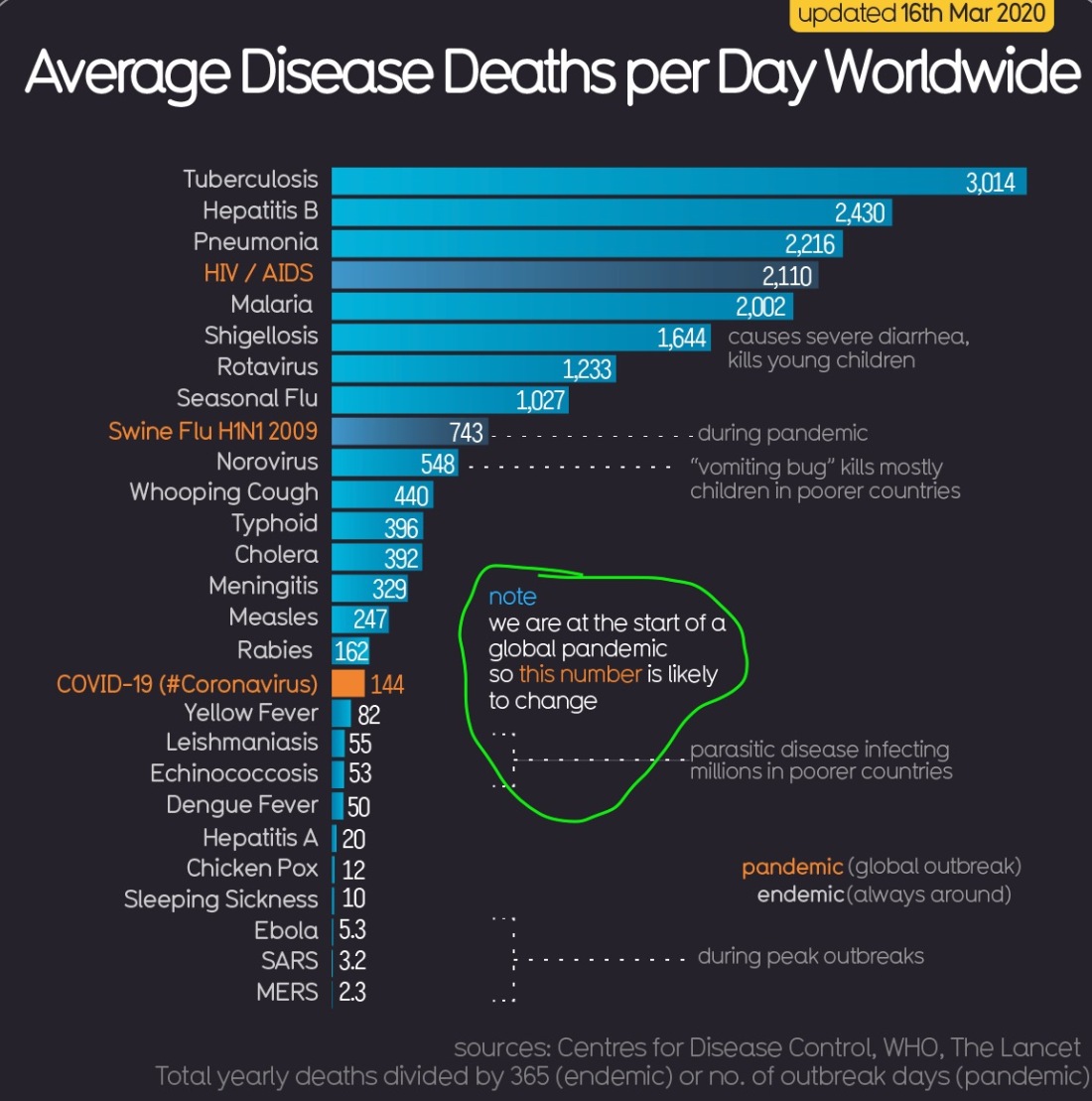
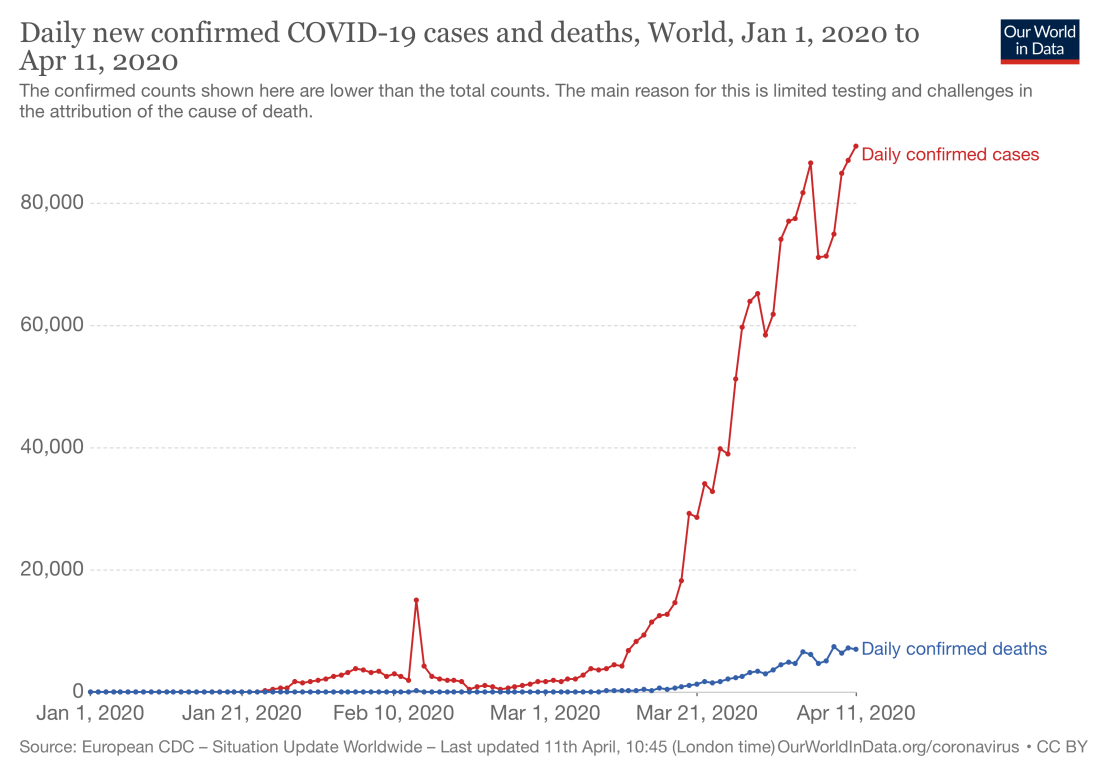
Clearly, the shock of this crisis is shaking (rich) people up. Data on death tolls leave no doubt that the pandemic is not “the great equalizer,” but neither are the rich sheltered from this as, largely, they are from other global scourges. Imagine, every day since March 28th, more than 3,000 confirmed COVID-19-related deaths per day have been recorded globally. That’s nearly three consecutive weeks of 3,000+ daily deaths caused by this pandemic (with the highest single-day global death toll coming on April 8th when it was recorded that nearly 7,500 people died of COVID-19). Okay, now imagine, more than 3,000 people have been dying, on average, per day globally every day from tuberculosis for years. Does anyone you know seem to care?

In my case, I can say yes – in part because I have many friends who are public health professionals and global health workers – but it should be clear to anyone paying attention that while pandemic disease – even this relatively mild one with which we are currently grappling – is a major cause of concern for the rich and powerful (if only belatedly), endemic disease, largely, is not. Certainly, the Gates Foundation pours a great deal of money into confronting tuberculosis, AIDS, malaria, and other major infectious causes of death to the poor, and through USAID and PEPFAR, the US government also supports some of these efforts, but relative to shutting down the entire global economy, have we ever really seen proportionate steps taken to address these leading global, infectious causes of mortality? Of course we haven’t – at least not since they stopped afflicting the parts of the world that are now rich.

And, yet, we’re told that the only way to build “affordable housing” is through “mandatory inclusionary zoning” – that is, by incentivizing private developers to build a small number of apartments for poor/er people and then giving those same developers tax breaks and the like while they build mostly new luxury condos. We’re told that the only way to “save” the US economy is by giving ~$5 trillion to major corporations, with no strings attached (not even one), while giving small one-time checks and a little additional unemployment insurance to working people, but that there is no money to save the United States Postal Service. We’ve been kept so desperate and afraid for so long that the possibility of an alternative feels almost impossible, so it’s always inspiring to see organizations, like the Rosa Luxemburg Stiftung, tell the truth about the sources of that fear and desperation in outlining the structural barriers to change that are the key accelerants of this crisis.

Short piece today. In an India stricken by “Fear of mass destruction and causality,” elders Anand Teltumbde and Gautam Navlakha face imprisonment – along with “nine other respected human rights activists and lawyers” – at the hands of Modi’s fascist Hindu-nationalist government. I encourage you to read their letters, linked above.

In New York, two recent reports make clear that a significant percentage of people giving birth at NYC hospitals in recent week have tested positive for COVID-19, and that, of those, a significant percentage were totally asymptomatic upon presentation (with most of those remaining asymptomatic throughout their time in the hospital). While the New York Times chose to highlight the feel-good story of one COVID-positive pregnant person who did not require an early emergency C-section, both its article and this letter to the New England Journal of Medicine from doctors at Columbia University’s medical center suggest that ~15% of birthing people at Brooklyn Hospital and Columbia’s affiliated institutions respectively have tested positive in recent weeks. While the Times is largely silent on the nuances, the doctors’ letter makes clear that of the ~15% of birthing people who tested positive, ~9/10 of them were asymptomatic. Almost 90%! Their conclusion was that universal screening is necessary, with which I agree, but I’d go further and say this makes very strongly the case that, in addition to screening, Alternative Birthing Sites are necessary under such circumstances to protect COVID-negative pregnant people, their partners/birth companions, and their care providers – a case that my partner has worked tirelessly to advance since mid-March in the face of political indifference in New York City and State.

Interestingly, one other potential inference from these two data points is that predictions from late March suggesting a solid double-digit percentage of New Yorkers were already infected with SARS-CoV-2 were likely correct. Excepting the fact that pregnant people are obliged to have more regular interaction with the healthcare system than are most individuals, there’s no clear reason why they would be infected at significantly higher rates than the rest of the population, but there is one very clear reason (birth!) why they would be tested at much higher rates under our current circumstances. I’ve been guessing that somewhere from 10-50% of New Yorkers have already, at some point, been infected, with a best guess putting the number at ~20%, and these ~15% figures seem to validate that guess to some extent.

My friend Frank – the adopted Brit – points out that there are some concerns with the reliability of serological testing, especially given that those who have been asymptomatically infected with SARS-CoV-2 may not build up enough antibodies to be detected by such tests. Guess we’re all now into the higher level classes at COVID University! Here’s hoping that we soon have a reliable way to determine at scale how many of us have already been infected as we chart a path forward.

Finally, both Rossana Rodríguez- Sánchez – on this episode of Doug Henwood’s Behind the News – and Daniel Aldana Cohen – on this episode of the Hot & Bothered podcast that he co-hosts with Kate Aronoff – pointed to the threat of natural disasters (in particular, Caribbean hurricanes) striking already pandemic-stricken populations, while this article – “COVID-19 and dengue fever: A dangerous combination for the health system in Brazil” – points to another of the potential catastrophic convergences which menace, disproportionately, the global poor.

Death to Fascism

History doesn’t have to repeat itself. The worst-case doesn’t have to be the case. Trained though we have been by Hollywood disaster flicks and sensationalized media coverage, crises can be averted or well-managed; people do not necessarily turn on each other in times of need (in fact, often, our response is quite the opposite); and possibility is not destiny.

Here in New York, we seem to have averted the most dire outcome foretold. We will not need more than 100,000 hospital beds at once (although demand on our healthcare system has certainly outstripped pre-crisis supply in recent weeks), and the data on deaths and hospitalizations for the weekend provide the first concrete evidence that – in the City, and probably the State – (this wave of) COVID-19 has peaked. That’s wonderful news; true cause for hope, if not yet jubilation; and also provides impetus for sober reflection on what comes next: The long, hard road to recovery, which, of course, will be long, hard, and political.

Our Mayor and Governor continue to predictably bicker, but I’m happy to see governors from across our region coming together to coordinate regarding what comes next. Hopefully such regional coordination creates opportunities to properly tax the very rich in the Northeast as one potential antidote to austerity.

I’ve extensively critiqued Governor Cuomo elsewhere, so will only add here that behind the facade of the marshal pandemic response which he has generalled, powerful interests have clearly been jockeying and maneuvering for advantage. For example, a friend with close ties to a major Manhattan hospital network mentioned the other day that, within the institution, it was well understood that the leadership’s near-term goal was to shift care for all COVID-19 patients to the various auxiliary facilities that have come up in recent weeks so that the network itself can get back to properly making money as soon as possible (the Wall Street Journal reports that New York hospitals are losing hundreds of millions of dollars per month “Battling Coronavirus”), and similar logic may explain the numerous political roadblocks encountered by my partner and other birth workers who called for the creation of Alternative Birthing Sites / Auxiliary Maternity Units: No matter that there are widespread reports of birthing people being provided no PPE at NYC hospitals; of their COVID-19 test results not coming back until after they’ve delivered; of their being sent home with no follow-up (which is to say, if they’d contracted COVID-19 while in the hospital, we would never know it). The point is to make money, and birth is very profitable for hospitals – the more medicalized the birth, the better.

The Brookings Institute – to which I link with reluctance – has a report out quantifying the threat to municipal governments around the country from the CoronaShock. It seems quite likely that, in the footsteps of the individuals, families, and small businesses currently suffering the brunt of pandemic-related financial hardship, we will soon see city and state governments follow. And yet US financial markets have rebounded significantly and had a good week last week. Why? Probably because the investor class now has confidence that they’ll be drinking from a firehouse of Mnuchin-distributed money for the foreseeable future.

Meanwhile, the national death toll has continued to spike. More than 2,000 COVID-19 deaths were reported in the US on a single day for the first time on Saturday, and there is ample evidence (as spoken to eloquently in this episode of Radio Open Source by Dr. Camara Jones) of the racial inequalities disease mortality is laying bare; COVID-19 is now killing more people per day in this country than do, on average, either heart disease or cancer (the two leading causes of deaths of US Americans), with Black people, in particular, suffering a highly disproportionate toll. A growing number of reports suggest that under-testing and inadequate disease surveillance are driving a significant undercount of COVID-19 deaths in the US, and while there can be little clarity regarding the geopolitics of information warfare surrounding the pandemic – with the South China Morning Post (the independence of which from the Chinese Government has increasingly come under question in recent years as Beijing has continued its attempts to strangle Hong Kong) referencing FAIR – the stalwart US-based media watchdog group – in critiquing anti-Chinese “propaganda” in the US media, while the CEO of the Morning Post does a TED Talk in which he is politic in balancing critique and praise of China’s COVID-19 response, and the New York Times, once again, blames Putin; no headline perhaps sums things up more succinctly than this one, from FAIR: “US Media Downplay Overseas Coronavirus Lessons to Focus on Easter Bunny” – that circumstances globally are increasingly fraught is beyond question.

It now seems clear that Japan’s pandemic response strategy has failed (the title of this BMJ article tells the story: “COVID-19: Japan declares state of emergency as Tokyo cases soar”), and the European Union looks ever more at risk of fragmenting. About the situation in China, I’ve acknowledged my own ignorance. About the situation in India, hopeful signs – like the work of my friend Naman – and humorous – like this baby actually named Covid (!! – for my piece, A Baby Named Covid click here) whose twin was named Corona – must be balanced against the heartbreaking: The suffering of migrant workers during India’s botched and ill-conceived lockdown; the persecution of dissidents; the predictable, incoherent scapegoating of Muslims for the pandemic; the spread of the virus in Dharavi, an early instance of the immense suffering to come in crowded informal settlements the world over.

I have dinner to make, so – as I often do – I turn now to the words of others. Arundhati Roy – who’s written more recently on the crises and opportunities brought on by the pandemic – has a powerful piece in The Caravan entitled “The Graveyard Talks Back” in which she observes:

As India embraces majoritarian Hindu nationalism, which is a polite term for fascism, many liberals and even Communists continue to be squeamish about using that term. This notwithstanding the fact that RSS ideologues are openly worshipful of Hitler and Mussolini, and that Hitler has found his way onto the cover of an Indian school textbook about great world leaders, alongside Gandhi and Modi. The division in opinions on the use of the term comes down to whether you believe that fascism became fascism only after a continent was destroyed and millions of people were exterminated in gas chambers. Or whether you believe that fascism is an ideology that led to those high crimes—that can lead to those crimes—and that those who subscribe to it are fascists.

In the latest newsletter from Tricontinental, Vijay Prashad writes:

Before the CoronaShock, on average 137 women across the world were killed by a family member every day. This is a shocking number. As Rita Segato put it, not only have incidences of violence against women increased in frequency since the CoronaShock; they have also increased in their cruelty, as neo-fascist ideas of female subordination eclipse more enlightened ideas about women’s emancipation. In Argentina, the slogan el femicido no se toma cuarentena, or ‘femicide does not quarantine’, clearly points to the violence that has been inflamed by the global lockdown. In every single country, reports come in of increased violence against women. Support lines are overflowing, shelters cannot be reached.

And:

It is one thing to bang pots and pans to celebrate these [healthcare] workers, and another to accept their long-standing push for unionisation, for higher wages and better working conditions, and for leadership in their sectors of work. Almost all administrators in the hospital field globally are men.

In a good piece in the Monthly Review – which last June ran an article entitled “Superbugs in the Anthropocene: A Profit-Driven Plague” which I highly recommend you read – called “Mystified Consciousness,” the author, Andy Merrifield, writes:

Like in the 1930s, whiffs of fascism are in the air. Demagogic chauvinism is thriving across the globe and tolerance has undergone core meltdown. Nationalism is alive and apparently well. Borders are getting staked out, walls erected, and mass media—especially social media—saturate us with misinformation morning, noon, night, and much of the time in between. Politicians now seem to have a free reign to engage in what Jonathan Swift long ago called “the art of political lying.” Telling the truth does not require great art, Swift warned, not like “salutary falsehoods,” which, he reckoned, need to be carefully crafted. The problem, the author of Gulliver’s Travels noted, is that a lie has to be believed only for an hour for its work to be done. Twitter helps. “Falsehood flies,” said Swift, whereas “truth comes limping after it.”

And further (of the French Marxist Henri Lefebvre):

He returned to France anxious about Hitler yet quietly optimistic that misery would prompt the German working class to do the right thing. International communists believed Hitler a passing phase, something destined to fizzle out, maybe as U.S. and British progressives think of Trump and Boris Johnson as passing phases, destined to fizzle out. Still, in 1932, Hitler received 30 percent of the vote, mostly from the petty bourgeoisie and rural sectors, but a lot of the more privileged workers voted for him as well. Rank-and-file Communists were urged at times by the Party leadership to put their opposition to Social Democrats even ahead of that to the National Socialists, weakening the left opposition to fascism. Social Democrat leaders, like Rudolf Hilferding, meanwhile, seriously underestimated the Nazi threat.2 Many proletarians displaced their angst rightward, acting counter to classical communist texts: once, they had nothing to lose but their chains; now, they had enchained themselves, seduced and manipulated by the National Socialists, betrayed by institutional leftism. “One needed to explain this fact theoretically,” Lefebvre said. Indeed, one does.

And – in this moment – hauntingly:

In our own times, this separation [between society and the self, between the collective and the individual, between public and private life] manifests itself as a glaring contradiction, as both a plague on the public realm and a denigrated notion of individuality—what Lefebvre terms “an individualism against the individual.”

But circling back, I’ll leave the last word to Roy (from her piece on the pandemic):

People will fall sick and die at home. We may never know their stories. They may not even become statistics. […]

But the rupture exists. And in the midst of this terrible despair, it offers us a chance to rethink the doomsday machine we have built for ourselves. Nothing could be worse than a return to normality.

Nothing. Or Almost.

Lockdown may make us crazy; even under this new abnormal, we may suffer from “normalcy bias“; but we must rember who drove us headlong into this disaster, and we cannot forget that, in 1932, the writing may have been on the wall, but no one truly knew that Nazis and Fascists would half rule the world for a time within a decade.

History need not repeat itself: Death to fascism, and here’s to the better world we’ll make.

Fool Me Once…

Another weekend day, another trip down historical memory lane.

I started this week by paraphrasing the illustrious George H.W. Bush in a title, so it feels only fitting to end it by honoring his war criminal son. (Don’t get me wrong: The elder Bush was also a war criminal – just not on the scale of the younger.) And today’s post will be about war, after a fashion – not the war against the virus we keep hearing about from our militarized-minded, public health-illiterate politicians, but the First World War and the devastating global pandemic that accompanied it.

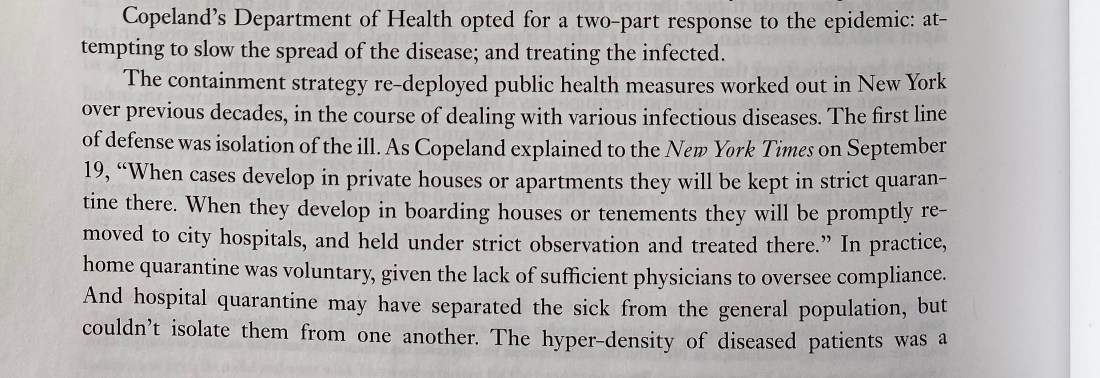
Here, as I did in my post on the first cholera outbreak in New York City (part of the second global cholera pandemic), I’ll lean heavily on the work of Mike Wallace. That previous post referenced Gotham – the monumental history of New York from colonization through consolidation (1898) upon which Wallace and his fellow radical historian, the late Edwin G. Burrows, collaborated – whereas here I’ll refer to Greater Gotham, Wallace’s own equally monumental history of New York from 1898 to 1919, from which all the images that follow are drawn (in particular, from pages 1008 through 1011 of that book).

With no further ado, the H1N1 Influenza Pandemic of 1918-1920 and New York City’s response thereto:

IMG_5313.jpeg
The Politicization of Contagion, Redux

Then, as now, as in 1832, we see naming and blaming at the foreground in disease response; perhaps different from today, New York City in 1918 had a Department of Health (more) prepared for the “onslaught” of pandemic disease. It’s unnerving to note the relatively even spacing of these three pandemics – of cholera, influenza, and coronavirus, respectively – although, of course, other pandemics and epidemics have occurred in the interim (and it is largely lost in the mix that we are currently in the midst of not one, but two pandemics, as the global crisis of HIV/AIDS rages ons; unlike COVID-19 – although this too is rapidly changing – AIDS has now become largely, if not exclusively, a disease of the poor, hence the fact that it killed ~770,000 people in 2018 did not register as a global crisis, whereas the 110,00+ deaths from COVID-19 to date most certainly have registered as one).

IMG_5314.jpeg
The Surge of Mortality

Then it was Calvary Cemetery; today, it’s Hart Island and freezer morgue trucks, but in both instances, we see the staggering and terrifying toll taken on the City’s population by a novel pathogen.

Screen Shot 2020-04-12 at 11.46.55 AM.png
The Safety Net Fraying

Both the fraying of our public “safety net” hospitals and the scramble to create ad hoc medical facilities should ring eerily familiar to those of us who have lived through the last six weeks in the City. Note that while our private institutions may have not conducted themselves quite so despicably this go-around, there have been stories quietly circulating that the intention of the major NYC private hospital networks is to shift the burden of COVID-19 care to the various temporary/swing facilities that have come up as soon as possible so as to be able to get back to the business of properly making money.

IMG_5315.jpeg
Mitigation and Care

We might be inclined to congratulate ourselves that the more public health-minded New York of a century past also struggled mightily to contain a pandemic, but we should remember that the H1N1 strain of 1918-1920 was roughly 10x more deadly than SARS-CoV-2 as a human pathogen; spread at a time when health systems were, obviously, far less advanced than they are today; and, unlike the virus we face now, tended to kill healthy young adults in large numbers.

IMG_5317.jpeg
Slowing the Spread

Slowing the spread is flattening the curve. Commissioner Copeland took more sensible actions a hundred-plus years ago than our elected and appointed officials initially took in March of this year.

IMG_5318.jpeg
Paternalism and Public Health

Then, as now, mistakes were made, and while Wallace is complimentary of Commissioner Copeland’s strategy regarding school closure (that is, not closing schools), this informative report – The 1918 Influenza Epidemic in New York City: A Review of the Public Health Response – comes to a somewhat different conclusion.

IMG_5320.jpeg
Prevention is the Best Medicine

Novel pathogens have humbled humans throughout the ages, and in 1918, as today in 2020, the case was and is no different. Likewise, the heroic and dangerous work of healthcare workers and caregivers connects our predicament today with that of our predecessors.

IMG_5321.jpeg
Coordination as a Hallmark of Effective Response

Governor Cuomo’s creation of a ” new hospital network Central Coordinating Team” to engender “a more coordinated and strategic approach among the state’s healthcare system in combating the COVID-19 pandemic” reflects a similar – if narrower – push towards coordination, and I have no doubt that, at the level of the Governor’s Office – through which all business in New York State currently runs – coordination similar to that described above is taking place.

IMG_5319.jpeg
And Just Like That, It Was Over

The power of exponential growth and herd immunity make for dynamics that – to the individuals experiencing pandemics – feel at once dizzying in their speed and ferocity and almost mystical in their passage. We all remember saying: “It just happened so fast.”

Soon enough, maybe we’ll all be saying: “I can’t believe it’s already over.”

Meanwhile, the role of global conflict and circulation of goods and people (at the culmination of World War I) in spreading the H1N1 pandemic will, I’m sure, be lost on no one.

IMG_5322.jpeg
The Worst Is Yet To Come

I concur with Wallace’s conclusion that “Global Flu” would have been a more fitting moniker for the pandemic past, and tremble – on reflecting upon the pandemic present – at the prospect that in 2020, too, “New York’s […] fatalities” may add “relatively few to the colossal totals that [ravage] the United States” as the national death toll here has crossed 20,000 (while that in the UK – our kindred nation in Anglospheric parochialism – has crossed 10,000). We can hope that my fear is misplaced though, given how colossally bungled was our response in New York City and State, and this time – unlike in 1918 – I think it’s safe to predict we will not see New York emerge as a leader in its (public health) response to pandemic, but we can hope that, from this vast collective trauma, we emerge with a redoubled commitment to public goods and redoubled spirit of public-mindedness.

Correction: A previous version of this piece stated that the first cholera outbreak in New York City occurred in 1817; while that was the year that the first global cholera pandemic started, the first cholera outbreak in New York didn’t occur until 1832 (during the second global cholera pandemic) as reflected in my previous piece here

Just a Little Coronaflu

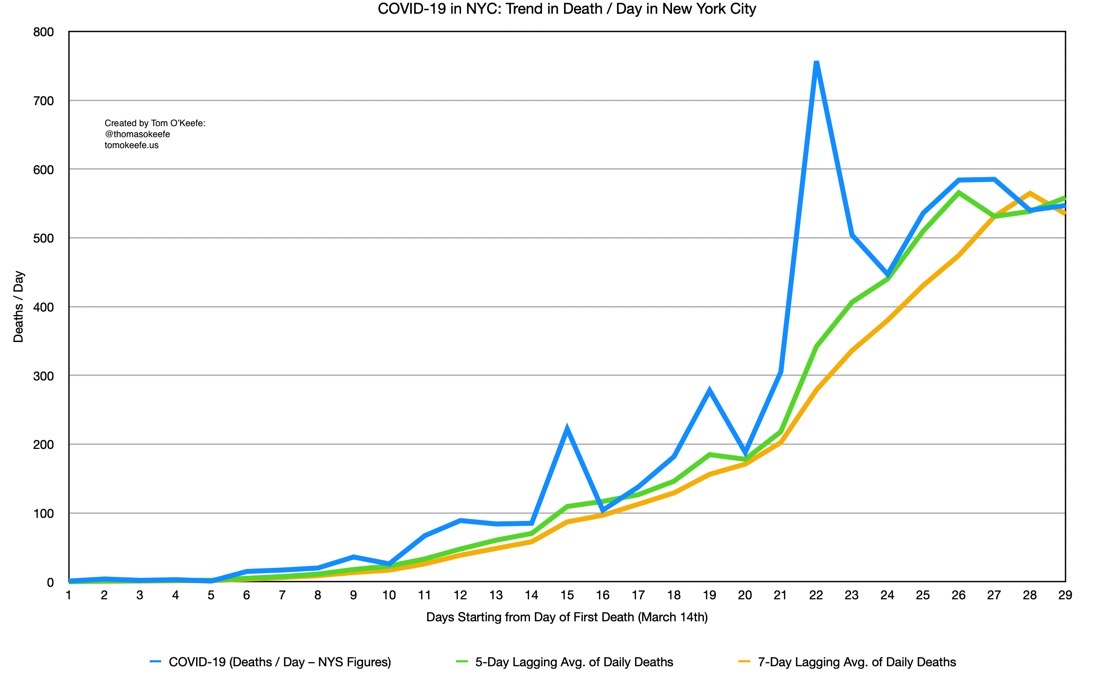
Whereas our Governor here in New York started talking around this time last week about “glimmers” and “flickers” of hope that the daily death toll in City and State were peaking (claims which were dutifully parroted by the media and promptly followed by significant spikes in daily deaths), I think we can now, as of Friday, start to talk –somewhat more meaningfully – about a plateau in our COVID-19 fatalities in what, for the time being remains the national epicenter of the disease, in the country which has now become the global epicenter of the pandemic. It remains my expectation that this gruesome plateau will extend roughly to the end of April, though I’ve been encouraged to read that daily hospitalization rates have leveled out. We may yet avoid the apocalyptic scenario for which we were all braced, although I think it’s been apocalyptic enough already in many of the City’s neighborhoods.

Image 4-11-20 at 3.34 PM.jpeg
As you can see, both the 5-day (green) and 7-day (yellow) lagging averages have started to level off in recent days, as has the announced number of daily deaths in NYC (according to NYS figures). The inexplicable spike in deaths that the State reported on April 4th likely reflects an anomaly in data collection rather than the actual number of deaths (the City’s graph showing deaths per day suggests as much), and, if not for the distortion in the lagging averages caused by that spike, neither would yet have actually peaked, though they would be showing signs of leveling. As explained below, none of these graphs reflect the hundreds of New Yorkers who have been dying at home each day in recent weeks.

Not that my complaints played any role, but the City has addressed a problem in their data reporting to which I’ve pointed of late, and the City’s official COVID-19 data portal now includes a note reading: “Deaths in NYC Reported by New York State,” after which the number – easily calculated by simply adding up the death tolls for the five NYC counties from the State’s official COVID-19 data portal – is shown. One wouldn’t have thought it would have taken quite so long to get some basic things right, but such are the many signs of how woeful was our unpreparedness for this crisis.

Of course, problems still abound with our data – chief among them, that neither the City nor the State had been counting the hundreds of people a day dying at home from COVID-19. Between March 20th and 31st, reporting by WNYC/Gothamist suggests that between 500 and 1,000 New York City residents died at home from the virus; since April 1st, reporting by the New York Times suggests that roughly 200 City residents have been dying at home from COVID-19 each day on average. In response to the former coverage, the City has announced that it “will begin to count suspected COVID-19 deaths of people who die at home,” but that doesn’t appear to have happened yet (at least not retroactively) as back-of-the-envelope calculations based on the above numbers would suggest that roughly 3,000 deaths had not been counted, and I’ve observed no such spike in City or State data. The inclusion of those missing 3,000 dead would put the total number of City fatalities already close to 10,000.

As always, it is helpful to contextualize these numbers. A few weeks ago, I shared this bar graph to which friends had pointed me (strangely, it is no longer available at Information is Beautiful although they have continued to update their COVID-19 Datapack). Less than a month ago, COVID-19 sat well outside the top 10 deadliest diseases in the world based on estimated deaths caused per day.

IMG_5218.jpeg

According to the graph below (from Our World in Data), every day since March 28th, COVID-19 has caused more deaths daily than tuberculosis does on average. Yesterday, April 10th, total confirmed deaths globally from COVID-19 exceeded 7,000, although the actual number of deaths the disease caused was likely significantly higher.

daily-covid-cases-deaths.png

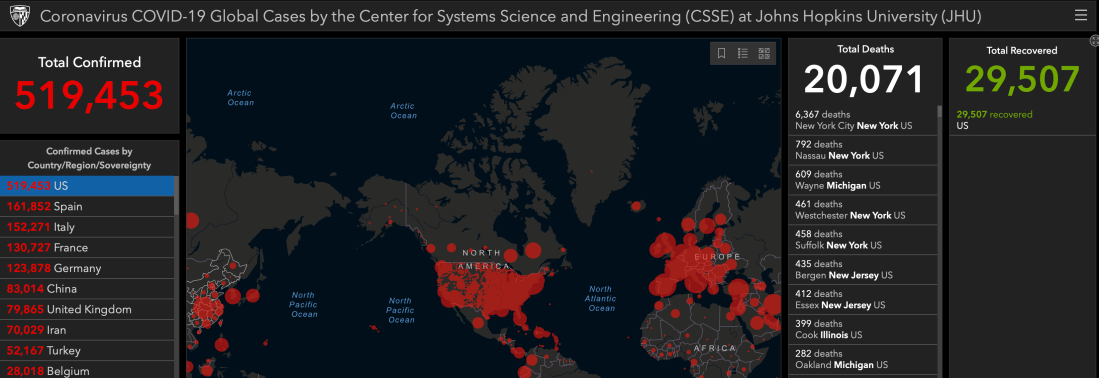
At the time of this writing, the Center for Systems Science and Engineering (CSSE) at Johns Hopkins University (JHU) tracker has the global death toll approaching 110,000.

Screen Shot 2020-04-11 at 3.56.08 PM.png

Again, according to Our World in Data, that would put COVID-19 (based on 2017 numbers) already into the top 30 causes of death worldwide for 2020, most of which causes are not communicable diseases. This does beg the question why we do so little – compared to shutting down the entire global economy – to address problems like AIDS, tuberculosis, malaria, road fatalities, or even cancer and heart disease (which, of course, get a lot of attention and have a lot of 5Ks run to “cure” them, but the root causes of which – caught up as they are in the power of Big Ag and multinational CPG corporations; Big Tobacco; the fossil fuel/petrochemical industry; the agrochemical industry; etc. – we are generally very reluctant to examine).annual-number-of-deaths-by-cause.png

In the United States, the CDC estimates that seasonal flu mortality has varied roughly between 20,000 and 60,000 deaths per year over the course of the past five years – with the estimate highest for the unusually bad 2017-2018 flu season, and somewhere in the middle for the flu season just ending. Already – again according to the Hopkins tracker – the US has recorded more than 20,000 confirmed COVID-19 deaths and, optimistically, Dr. Anthony Fauci (with whom I think we’re all familiar by now) has reduced his estimate for total US COVID-19 mortality to approximately 60,000 – down from the 100,000 to 250,000 range that had previously been floated (and the high-end estimate of more than 2 million deaths under a business-as-usual/no-action scenario).

Put differently, by shutting down the entire US economy and instituting shelter-in-place/stay-at-home orders across almost the entire country, we may manage to reduce mortality from COVID-19 to that of an especially bad seasonal flu season. We may – though, of course, if 20,000 is already the number of confirmed deaths, the actual toll must already be significantly higher. Based on the example of New York City, I don’t think it’s unreasonable to imagine a 50% undercount, which would put the actual number of COVID-19 deaths in the US to date at ~30,000.

Screen Shot 2020-04-11 at 5.03.06 PM.png

In New York City, according to NYC Health, “There are roughly 2,000 deaths each year from seasonal influenza and pneumonia,” a fact reflected in the graph below.

Image 4-11-20 at 4.53 PM.jpeg

You can see that, less than a month after the first official COVID-19 death in NYC, the disease has already killed more New Yorkers than all but the two leading causes of death (again, as in the world, so in the City: heart disease and cancer) kill each year. It is very likely that COVID-19 will be the leading cause of death for 2020 in New York City, and it has already killed between 3-5x as many people as generally die in the City from the seasonal flu. So much for the horrible claim that was rolled out by so many of our elected executives in justifying their own inaction.

In the end, we know that most elected officials don’t have an incentive to count any more of the dead than they have to, or alternately, that they have a strong disincentive to acknowledge any more deaths than they must. Politicians like Andrew Cuomo and Bill de Blasio – who bear much of the responsibility for our disastrous pandemic response in New York City – would likely prefer not to count people who died at home from this disease, and men like our President in the US, Prime Minister Bolsonaro in Brazil, and Prime Minister Modi in India – who consistently denied the seriousness of the pandemic and continue to spread misinformation about the disease while exploiting the crisis for their own narrow and vicious political ends – would be happy, one imagines, to simply let the poor of the ghettoes, favelas, and slums – that is, people’s neighborhoods – die of whatever they die of and be forgotten.

This must not be allowed to happen, and holding these politicians to account is a key aspect of the struggle for the post-pandemic future. Especially in this country, with what Noam Chomsky – in my view, rightly – has called “the most crucial election in human history” upcoming, people must not be allowed to forget that the President and his cronies brought this plague down upon us. The Washington Post video “How Fox News has shifted its coronavirus rhetoric” and Trevor Noah’s “Heroes of the Pandumbic” both point toward the type of not-forgetting that needs to be done right now, but we need a lot more of it and should expect this fight over who controls the past to be a constant feature of our effort to reshape the future. The truth must not be erased.

Postscript: Speaking of truth, the City has now released more clearly labeled graphs on it’s “NYC Emergency Department Surveillance Data” for “Influenza-like Illness and Pneumonia” suggesting that, contrary to my prior claim (one that was made widely in the media based on the City’s own data, although perhaps I should’ve known better than to link to the Wall Street Journal), there was no spike in emergency room visits and admissions starting on March 1st. I’ll continue to look for reliable sources on this front, but apologize if my claim turns out to have been mistaken.