Telling Time

If my piece yesterday was a meditation on historical remembering, today, I’d like to focus on the mechanics of our forgetfulness. It will be said, and perhaps rightly, that it is human to forget, to lose sight of past traumas, to stumble back into past errors, to repeat history, but beneath the surface of our amnesia lurks the malignant force of corporate power. Certainly, the Anti-Vax Movement could only have meaningfully taken hold in a population privileged enough to largely be sheltered from endemic infectious disease and multiple generations removed from the miracle that was Jonas Salk’s breakthrough. Yet, what lurks in the shadows behind the too-bright (and California white) veneer of the Movement’s conspiracy theorizing, are the entrenched interests, powerful almost beyond imagining, of the big agri-chemical companies. If I understand correctly – after ChemChina’s acquisition of Syngenta (2017), the DowDuPont merger (2017), and the acquisition of Monsanto by Bayer (2018 – there remain only four major such mega-corporations in the world (BASF being the fourth). It is a fact, hidden in plain sight, that the flooding of the biosphere during the Great Acceleration (that is, post-World War II to present) with toxic, carcinogenic, mutagenic, and endocrine-disrupting synthetic chemicals – chief among them herbicides and pesticides – is a root cause of the observed spikes in Autism Spectrum Disorder, auto-immune disorders, and digestive diseases in human populations to name just a few of the maladies that can be linked back to persistent toxification of the Earth, but, one imagines, the executives of such agri-chemical multinationals as those listed above have been all to happy to foment anti-vaccine sentiment (eg, through supporting debunked claims about the connection between the MMR vaccine and autism), even if that meant promulgating false science and smearing conscientious researchers whose conclusions aligned with the facts, but not with corporate interests.

We live in a supremely fucked up world, and corporate malfeasance (a generous word for the willingness to lie, cheat, steal, murder, and corrupt that is characteristic of global corporate culture in our era) generally shows its face when one digs deep enough into the misery. (This long, interesting article – shared with me by my friend Alex, who makes paintings like these – which I’ve still yet to finish, refers dismissively to “a simple “Scooby-Doo Marxist” exercise of pulling the mask off the villain to reveal that, yes, indeed, it was capitalism that caused coronavirus all along!”, and I’ll do my best here not to be guilty of any Scooby-Doo-ism.) I’ve linked previously to thorough analyses of the dynamics of industrial agriculture, urbanization, and neoliberal corporate globalization which have given rise to conditions ideally suited to the jumping species and rapid global spread in human populations of zoonotic diseases like COVID-19, but here, I’m thinking more about the immediate dynamics that have deepened the crisis of this pandemic in the United States. The greed, negligence, and short-sightedness of a corporate class and culture that is willing to lie, for the PR benefits, about paying employees during pandemic-related closures, and then to do the opposite; to expect warehouse workers to work through illness with no meaningful protections, then smear organizers who stand up for worker rights, while all the while lying publicly about the wonderful measures you’re taking to keep your workers safe; to tell grocery store workers that they can only be paid COVID-19 sick-leave if they test positive for the disease, knowing full well they’re unlikely to be able to get a test at all (therefore ensuring that those workers, desperate for income, come to work sick); to expect farm workers  – many of whom are already made vulnerable, beyond the shared vulnerability of much of the working class driven by the casualization of much of the US workforce, by immigration status – to work sick, with no protective equipment, and to provide them no information whatsoever about the threats posed by the rapidly spreading virus that has paralyzed much of the global economy.

As Janine Jackson put it on the latest episode of FAIR‘s CounterSpin: “Strikes going on around the country right now are an indication of how workers themselves are reacting to this moment, in which it’s being made painfully clear that they are deemed both essential and expendable at once.”

It’s an easy, intellectually-sloppy gesture to evoke the authoritarian surveillance state of the Chinese Communist Party in defense of American Exceptionalism, but how much does Chinese-style authoritarianism (terrifying as it is) really differ – save in scale and centralization – from the ambitions and ethos of “Corporate America”? Critics of China love to point to the Social Credit System as an example of actually-existing Chinese dystopianism, but what of the corporate “reputation scores” in fear of which US workers live or the panoptic workforce management softwares that drive employees to ever greater feats of productivity, self-injury, and dehumanization?

Anyway, lest I rant on here for days – or find myself accused of what-about-ism (relative to which, please bear in mind that I am attacking US-style surveillance capitalism, not apologizing for socialism with Chinese characteristics) –  let me come to the point: As our ignoramus President grows suddenly somber and “presidential” in the United States; as our blustering Governor thanks the billionaire owner of the New York Nets for his generous gesture of trans-national solidarity (in donating 1,000 respirators); as our shrinking violet of a Mayor largely recedes from the scene – his errors in the early days of the pandemic’s visible onset in New York City somehow magnified in inverse proportion to the Governor’s successful laundering of his own tawdry record; as all these elected executives scramble and prevaricate and attempt to re-write history, we should remember – and not forget – that this was a preventable tragedy. That better than fake solemnity from a vicious buffoon who has just (further) mortgaged our generation’s future in the name of corporate welfare; better than 1,000 respirators from China; better than suddenly brave words from a Mayor who Rolling Stone characterized as “Out to Prove That [the] GOP Have Not Cornered the Market on COVID-19 Ignorance”; better than all this would have been planning, preparedness, prevention, and a real, timely response to COVID-19. I would say a real response to the pandemic, but had such conditions as those I’m laying out been met – not just here, but around the world – we would have had no pandemic to speak of at all. We would have had only another successfully contained novel zoonotic disease.

Of course, better still would be working to undo the conditions – created by corporate capitalism – that are so conducive to zoonoses in the first place, but barring that unlikely development in the near-term, then, certainly, we must demand comprehensive public health measures and sane pandemic preparedness.

I’m happy to wear a face mask in public now that the CDC is (finally) calling for that measure, but just as we shouldn’t kid ourselves that perfecting our home recycling is a meaningful “solution” to the climate crisis, we need to recognize that these small steps we’re taking now mean that we already lost what I persist in pointing out is not a “war” against this virus. My privilege may allow me to find humor in having to don a bandana to cover my nose and mouth, but the optics of such a look are not lost on (and in fact discomfit) me, and it’s a sad commentary on our history and society that the following Twitter post  from @KieseLaymon needs no further explanation: “I had the Bane mask. Forgot I’m Black. And big. And ancestrally red-eyed. And of the United States. New mask is floral. Don’t shoot. Naw, for real. Don’t shoot.”

As is often the case, I turn to The Intercept, in which Jon Schwarz writes today – in a piece entitled “The Democratic Party Must Harness the Legitimate Rage of Americans. Otherwise, the Right Will Use It With Horrifying Results.” – that:

The political possibilities of this moment are different than anything we have ever experienced. We possess a once in a lifetime opportunity to make the United States a more humane country. But if we fail to seize it, we will face mortal danger from the right.

That’s not hyperbole. The anger of Americans, once they figure out what’s being done to them right now, is going to be volcanic. The fallout from 9/11 and the great recession of 2007-2010 will be imperceptible in comparison.

And to Vijay Prashad, who – with Sudhanva Deshpande – writes for Scroll.in to the soon-to-be-jailed Indian dissident and Dalit rights activist Anand Teltumbde: “You are being sent to jail because you are part of a tidal wave of dissent against this government and what it has done to Indian democracy.’”

The New York Times reports that “Italy’s Virus Shutdown Came Too Late.” The City [the publication, not the municipality] reports that “Bronx Residents [are] Twice as Likely to Die From COVID-19 in NYC“. Looking heartbroken, my partner lets me know, “Ten nannies have died” in New York thus far from COVID-19. A friend in New Orleans shares that her mother – a home hospice nurse – is considering quitting her job because she’s high-risk for the disease and being asked to care for people dying from it without adequate PPE. A friend in Brooklyn reports that his sister’s boyfriend “had to get a CT scan of [his] lungs” before he could even get tested for the virus, and is now “in the throes of battling COVID […] pneumonia” while in self-quarantine at home.

Our Mayor wanted to keep the schools open because he couldn’t see another way for New York to stay “open for business” and now, NYC public school teachers have started dying of COVID-19. Our Governor was slow to act, but now, in playing the hero, will much sooner cut funding for our schools and hospitals (!!!) than countenance a tax increase on the rich to address our our yawning state budget deficit. Our President really deserves nothing more than to be a cautionary tale for generations to come, but otherwise forgotten and erased from our public life.

The stories two paragraphs up are a result of actions – taken and not taken – by the men  in the paragraph above and their counterparts around the country and the world. (Literally, as I write this sentence, an email alert pops up from Axios informing me that Boris Johnson has been admitted to the hospital.)

These days, I’m telling time in lots of ways. By how long my unaccustomed beard has grown; how many pages of Boccaccio’s Decameron I’ve read; how much rice we have let; the comings and goings of the flowers on the trees in the world beyond our apartment into which I now very rarely venture. As we stare down the barrel of a corporate bailout that could see a wholesale (further) return to the Gilded Age with all its abuses, excesses, and horrors; confront the immediate crisis of the pandemic, and the almost-immediate crisis of global climate disruption; as we think about the world we want to (and have to) make, time-keeping, record-keeping, history-keeping – these are tasks to which we are all now called.


Against Authoritarians, Not Authorities

My grandfather survived, as a young child, the influenza pandemic of 1918 through 1920, and died, at the age of 95 from seasonal flu that escalated into pneumonia. At the time of his death, more than ten years ago, he was still living alone, still walking a few miles most days, still climbing the steep stairs to and from his second-floor bedroom in the house in Westchester County where – after spending the first half of his life in the City of his birth – he’d moved when my father and my uncle were young, part of the post-World War II wave of White Flight and suburbanization that had such dire racial, social, and ecological consequences for our country.

I loved my grandfather to death – it took years before I stopped reaching for my phone to call him – and in the midst of this pandemic which poses such a disproportionate risk to elders, I find myself thinking of him often. No one lives forever, but he was well and sound of mind to the end, and there was no reason he should’ve died from something so preventable, just as there is no reason – other than negligence and incompetence – that so many people today face mortal threat from COVID-19. This crisis was preventable, and it remains imminently end-able.

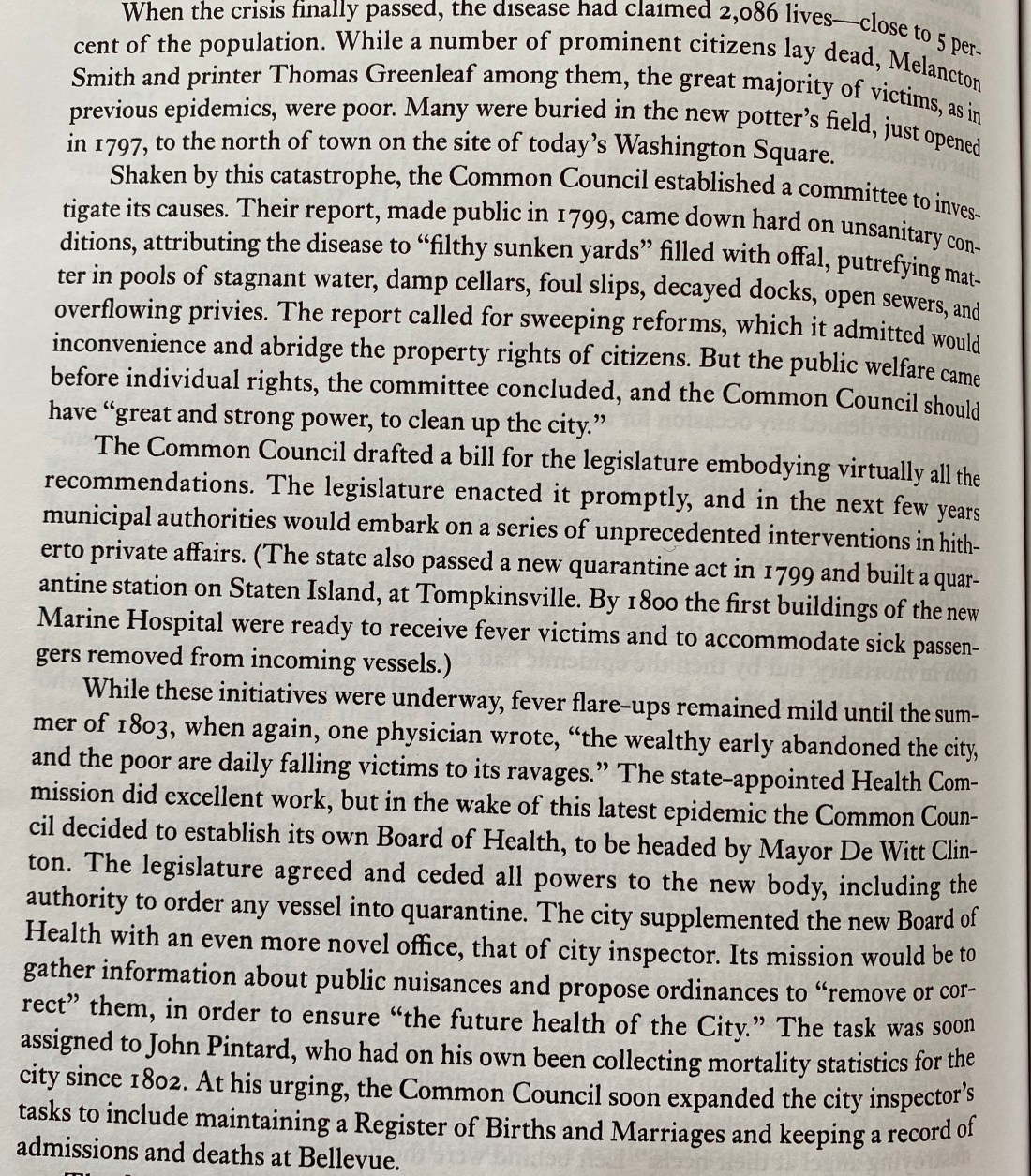
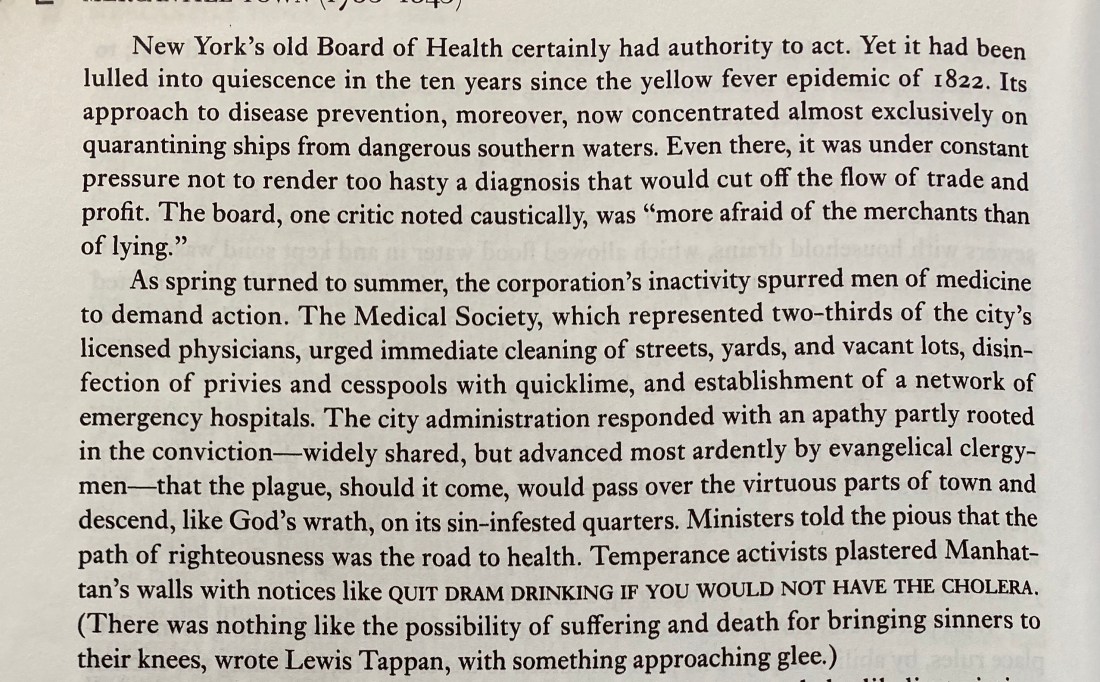
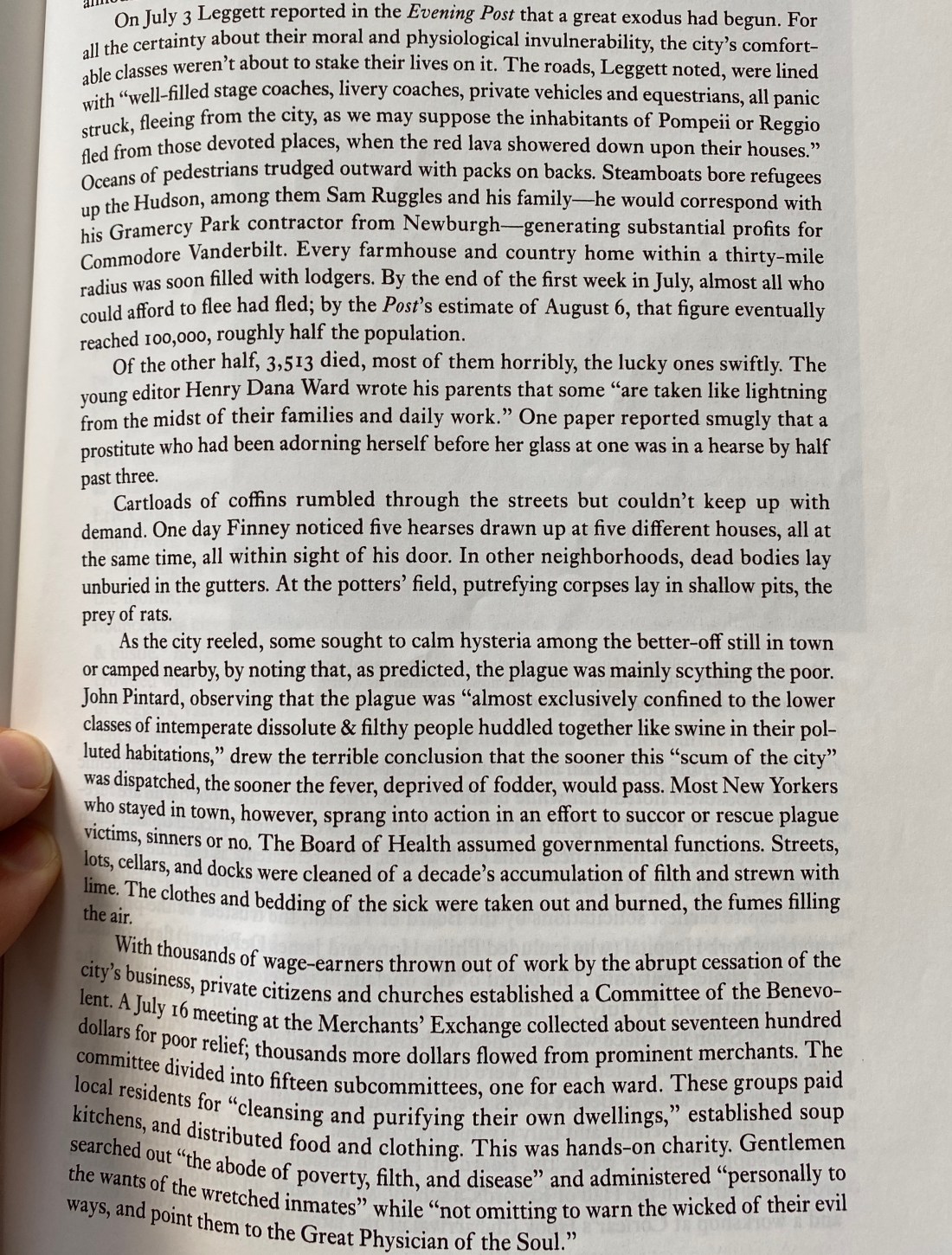
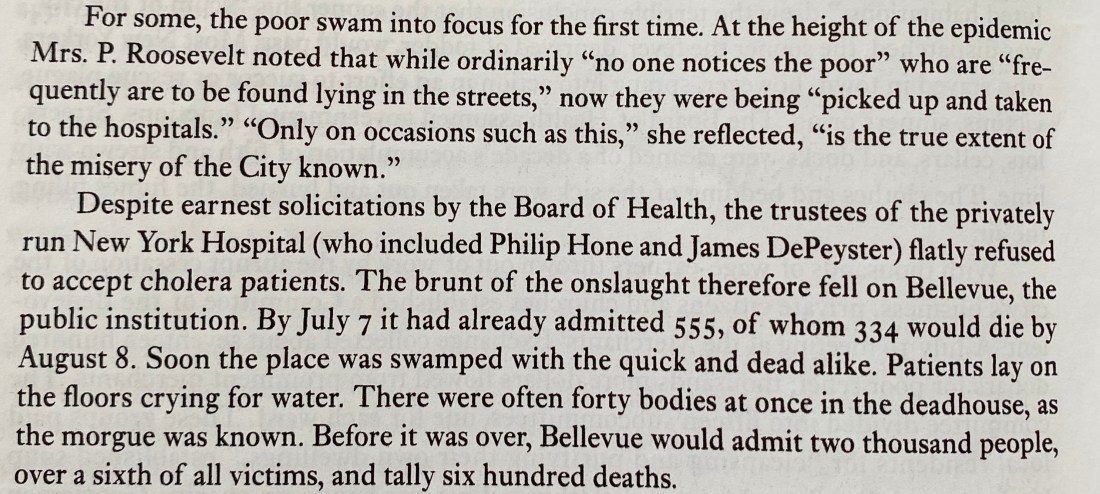
In the spirit of learning from our history though, and to explain my title, and because today, I’m trying to largely take an evening of rest with my partner, I’m going to lean heavily on the incomparable work of Mike Wallace and the late Edwin G. Burrows, legendary historians of New York City. As their work shows, sadly, we’ve been here before, and, in all likelihood, we’ll be here again. We don’t have to be back in this position any time soon though, but to avoid, in our lifetimes, a repeat of this colossal tragedy, we’ll have to learn the hard lessons now being taught us by this virus, and take concerted and lasting action to spare ourselves and those who come after us the unnecessary suffering we now endure. The excerpts which follow will mostly speak for themselves, though I’ll add in a few comments (below the excerpts to which they relate), and all images below are drawn from Burrows and Wallace’s magisterial and compendious history of New York, Gotham (specifically, from pages 356-359 and 589-594 of the paperback edition). They are the type of authorities – like the health authorities whose advice too many of our elected officials wantonly ignore – to whom I think we should all be looking to better understand the world which we share.

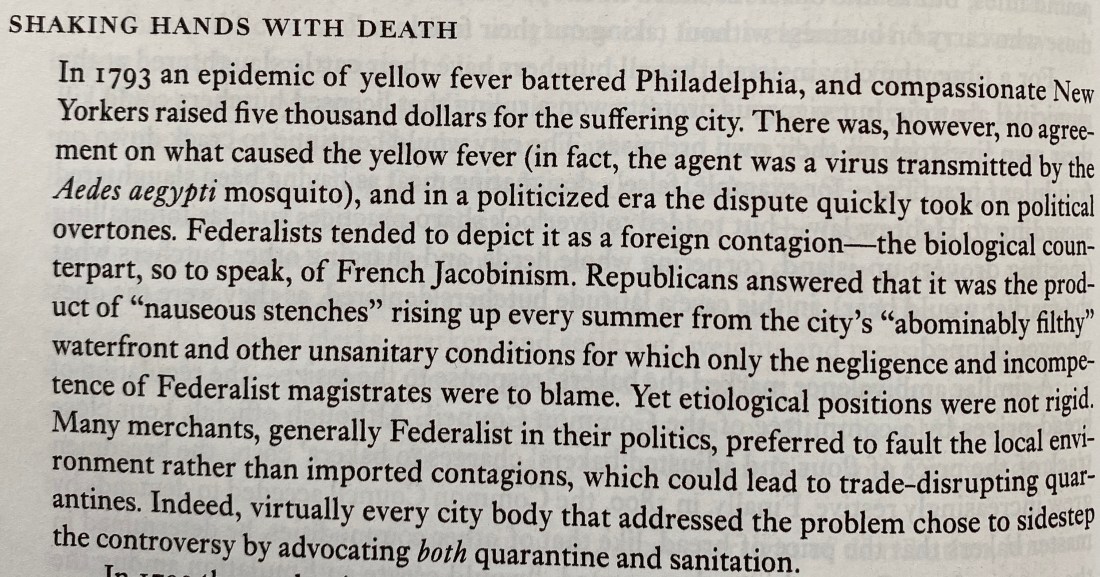
IMG_5253.jpeg
The Politicization of Contagion

Obviously, the contours of our politics have shifted radically in the more than two centuries of our country’s history, but not that radically, and disease – fundamentally biological – continues to be mobilized for often vicious political ends.

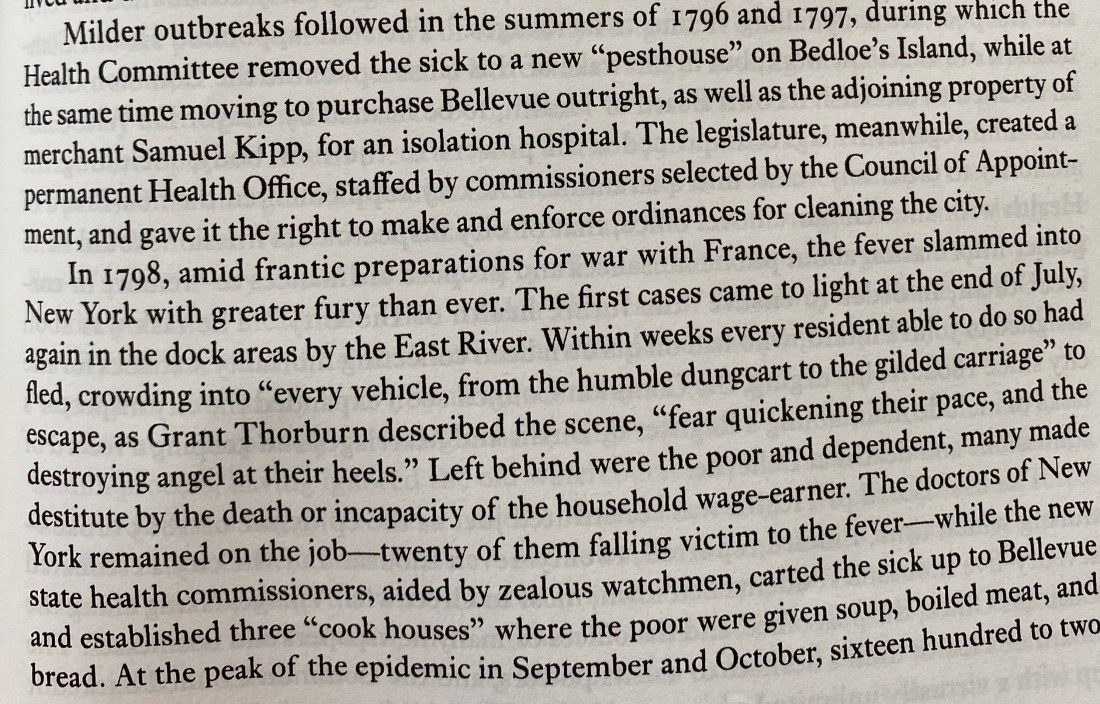
IMG_5254.jpeg
Flight from Pestilence

In this account of events from the early days of our settler-colonial Republic, we should recognize the same pattern that has led to Instagram influencers “retreating” to the Hamptons and COVID-19 cases spreading rapidly in the vicinity of Idaho’s exclusive resort town, Sun Valley.

IMG_5255.jpeg
The Creation of a Board of Health (that is, a public health authority)

Infectious diseases scare people, and after outbreaks, epidemics, and pandemics of such diseases, political will often surfaces to take meaningful action to curb their future spread.

IMG_5257.jpeg
The Power of Public Health

And even when people don’t especially understand what they’re doing (eg, in the above instance, where they lacked the Germ Theory of Disease), collective and public actions can make a significant impact in improving health outcomes for all. There are many things we don’t understand about COVID-19 today, but we are fortunate – relative to New Yorkers of the late 18th and early 19th centuries – to have the benefit of more than 200 additional years of advancement in science and technology, and we certainly understand enough – political will and collective commitment permitting – to stop the spread of this disease in its tracks.

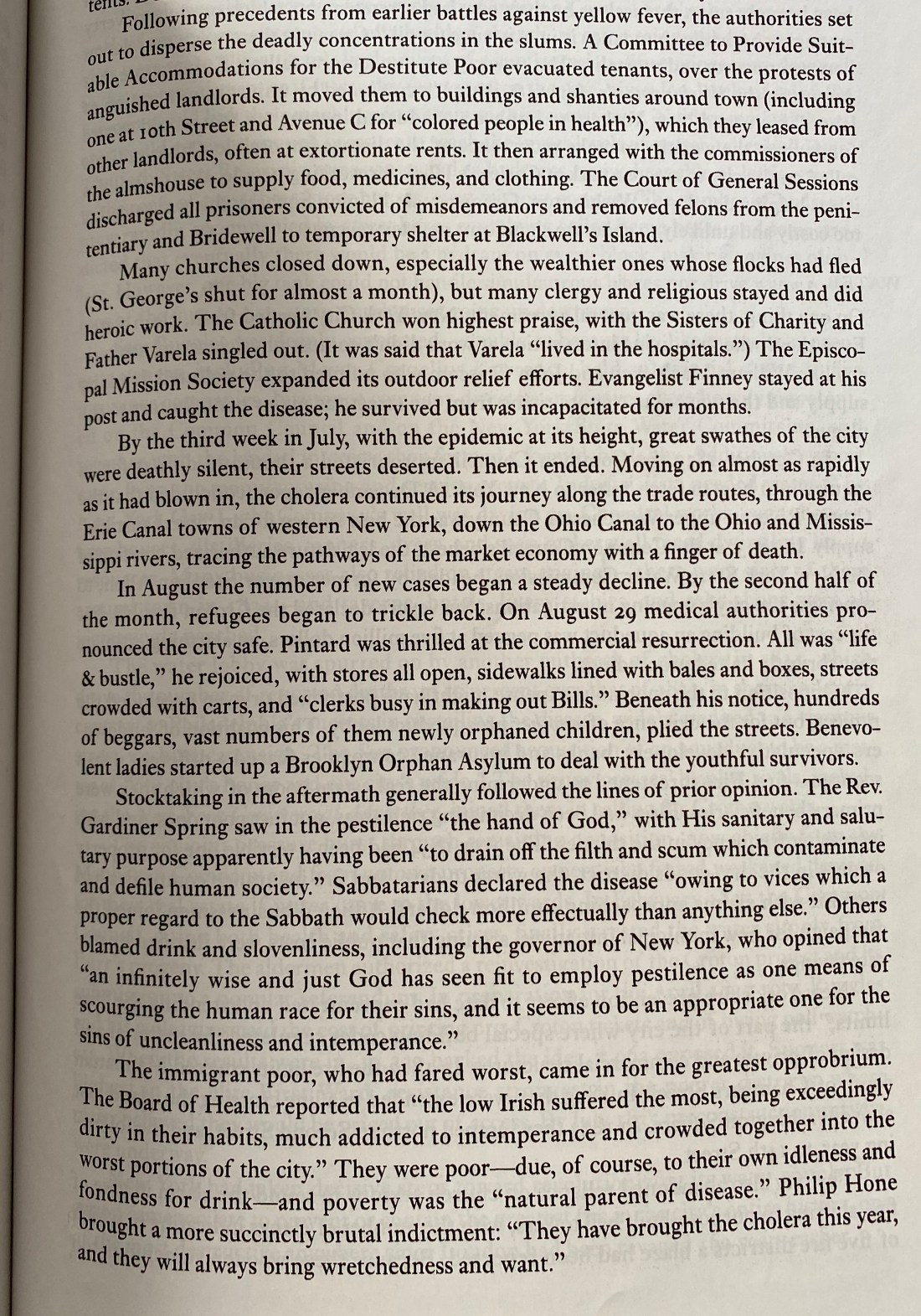
IMG_5258.jpeg
The Lapsing of Vigilance

Unfortunately, people also have short memories, and by 1832, New York City once again found itself vulnerable to epidemic contagion, this time in the form of cholera (which is not caused by lack of Christian piety or religious fervor, but the spread of which – as the genocidal Saudi-Emirati war on Yemen, which our government continues to back, shows – can certainly be fueled by violence and social and infrastructural breakdown).

IMG_5259.jpeg
Profits and Paternalism

Then, as now, the poor paid the highest price. (Today, in the United States, people of color, and especially Black people, are at greater risk from COVID-19 owing to a confluence of underlying structural factors all rooted in white supremacy.)

IMG_5260.jpeg
The Invisibility of the Poor

Then, as now, as well, the sudden visibility of the poor (say, today, in the form of suddenly “essential” workers of all sorts) did little to reduce the disproportionate burden for their care that fell on under-resourced public institutions (like Elmhurst Hospital).

IMG_5261.jpeg
Deathly Silence

Just as despicable people – like the President’s son-in-law – always look to profit off / in the midst of calamity, so too, people with hate in their hearts always look to scapegoat the most marginal for failings that are fundamentally social and political in character. Such failings, of course, can lead to the temporary paralyzation of entire cities.

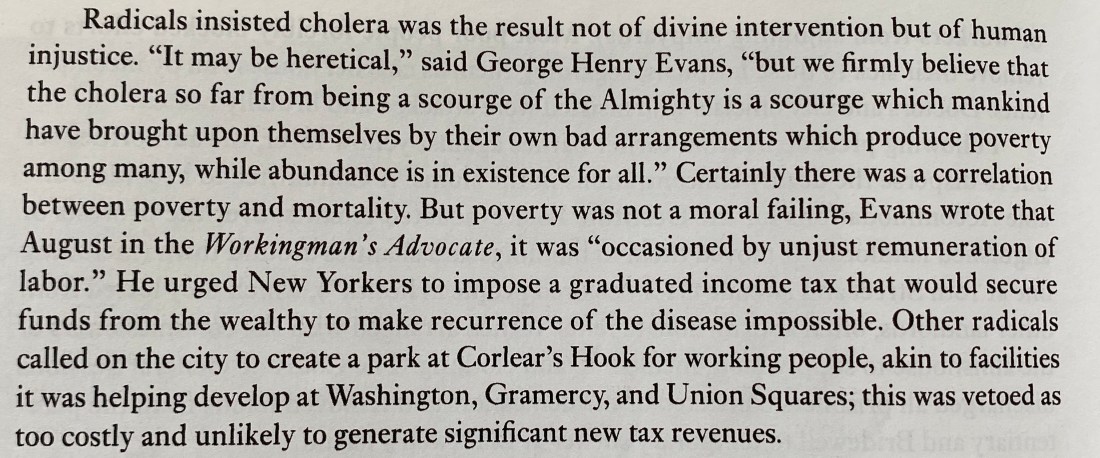
IMG_5262.jpeg
The Wrath not of God, but of Injustice

But as has been the case since well before the time of Jesus Christ – whose purported resurrection our self-worshipping President was so eager to see people die to celebrate – courageous individuals (such as the above quoted George Henry Evans), generally of the working class, have never failed to speak truth in the face of injustice. To repeat Evans prescient words: “[T]he cholera so far from being a scourge of the Almighty is a scourge which [hu]mankind have brought down upon themselves by their own bad arrangements which produce poverty among many, while abundance is in existence for all.”

This is the meaning of the “private sufficiency, public luxury” for which George Monbiot regularly calls, and this equation is as much the solution to the crisis of this pandemic as it is to the global crisis of our climate that threatens to consume us all.


Think, Beast

I haven’t been outside at all today, which is making it a little hard for me to think. Like Beckett’s Lucky though, I’m going to do my best to try.

We had Zoom dinner last night with friends who live in Brooklyn; they’ve both been mentioned in these posts before, but out of respect for privacy – something Zoom itself is, unsurprisingly, learning all about of late – I’ll just say this time that they’re lovely, thoughtful, and between them, have some unique topical insights into our current national and global predicament.

(An aside on the subject of Zoom: The revelations about the company’s flawed encryption, ties to China, etc., etc. are, of course, all worrying given that many of us have now become dependent upon Zoom or its equivalent to conduct many aspects of our personal and professional lives. As usual, The Intercept’s reporting on this matter has been excellent; however, in pointing to Signal as a secure Zoom alternative, I believe they inadvertently perform some sleight of hand. Yasha Levine has done good investigative journalism looking into Signal and Tor, and, unfortunately, his conclusions suggest that – like a one-time presidential candidate the people of these United States may still vaguely recall advised, in what he despicably called “the Richard Nixon Lesson” – we may simply, still, have to embrace a policy around digital privacy encapsulated in three words: “Don’t record it.” Easier said than done, of course, when many of our lives have migrated almost entirely online and we’re increasingly surrounded by ubiquitous surveillance devices, but, be all that as it may, the issue of surveillance, in turn, brings me back to the subject at hand: The pandemic.)

Without going into full news-round-up mania, I’m going to briefly touch on some recent developments that relate to surveillance, economic meltdown, and the ongoing end-ability of our national crisis. First, surveillance: A leaked memo shows that Amazon – the company, not the forest; and no stranger to surveillance – conspired to smear Chris Smalls, a manager at the company’s Staten Island warehouse who was fired for organizing his co-workers to demand basic steps be taken to protect their health; according to TechCrunch, “Google is now publishing coronavirus mobility reports, feeding off users’ location history”; The Intercept reports that, “The U.S. Navy has taken the extraordinary step of relieving the captain of the U.S.S. Theodore Roosevelt of his command […] after he wrote a memo sounding the alarm on an exploding coronavirus infection on board […] his ship” (a story the reporting on which has troubled me for the utter lack of attention generally paid to the Guamanian people and what the disembarking of all those sailors may mean for them); also from The Intercept, coverage of how the “NYPD’s Aggressive Policing Risks Spreading the Coronavirus”; Democracy Now! has a feature today entitled, “As Virus Spreads in Philippines, So Does Authoritarianism” about President Rodrigo Duterte’s brutal and ineffectual approach to confronting the pandemic (though, like India’s similarly draconian measures, I think they can fairly be considered effectual to the extent that they advance the underlying authoritarian agendas of the men enacting them); and the Thomson Reuters Foundation headlines, “World risks ‘sleepwalking into surveillance’ with coronavirus controls.” Generally, not a very cheery picture.

On the subject of economic meltdown, it’s bad and – like the pandemic itself – getting rapidly worse. A thoughtful and well-informed neighbor opines – in view of the devastation being wrought – that we have to “reopen” as, already, “We are entering Great Depression territory. ” CityLab has up what I found a mind-numbing piece against rent strike (the argument of which is predicated on the indispensability of mortgage-backed securities to the US economy; though, to be fair, with its author, I share the conviction that Keynesian-style stimulus, including direct cash transfers to individuals, is a sensible approach to our current grim economic circumstances); and ever-perspicacious Doug Henwood breaks down, graphically, how bad our economic situation already was pre-pandemic, and how much worse it has gotten in the very short time since COVID-19 hit New York, and the financial markets – and our national economy along with them – imploded.

Finally, in some brighter news, the end-ability of our national crisis: It is imminently endable. Just ask Dr. Rishi Desai who marvelously baffled a Fox News host in slamming the US’s “very weak response” to the pandemic and praising South Korea’s “really strong” one; or look to Dr. Jason Wang – “former project manager for Taiwan’s National Health Insurance Reform Task-force [and] now the director of the Center for Policy, Outcomes and Prevention […] at Stanford University” – who was interviewed on Democracy Now! today about how Taiwan has, thus far, managed to largely suppress COVID-19 in spite of its close proximity to and deep ties with China (ties that included, at the time of the initial outbreak, a number of direct daily flights between the island and Wuhan); or turn back to The Intercept, which reports “Privacy Experts Say Responsible Coronavirus Surveillance Is Possible” (one of the six key pillars of which “Responsible […] Surveillance” is, according to the piece, to “Beware of Attempts at “Reputation Laundering” like those of Google mentioned above, or of Israeli spyware firm, NSO Group, which have been widely reported on today).

To come full circle to the Zoom dinner with our friends (in which we can hope no hackers or malicious state actors took any interest), one of them highlighted that he’s been consistently trying to point to the fact that solutions exist, which they do. This is not an unsolved or unsolvable problem. It’s just an un-enacted solution. I’ve made the same point on a number of occasions myself, but in the past few days, have been leaning more heavily into trying to prepare people (myself included) for that to which we’ve already committed ourselves as a country. Under the absolute best-case scenario going forward, we’re in for a painful, catastrophic mess of an April. Truly, the cruelest month. But it need not also be a catastrophic May, June, and July, though under our current not-leadership from DC, it is, in fact, shaping up to be a catastrophic August and beyond, as well.

This is where I respectfully disagree with my neighbor though; there’s no question we have to stanch the economic bleeding, but I believe the type of wholesale reopening which our President, until a few days ago, was advocating – timed to commemorate the rising of Christ about which and whom our President couldn’t give two shits – will lead not to less economic suffering, but much more of it. If every healthcare system in the country collapses more or less simultaneously because we reopened the economy without having Singapore, or Taiwan, or South Korea-style preventive / public health measures in place, there will be no option but to return, in even worse shape, to the measures which are now causing so much economic and social suffering – that, or we actually go the path which I’ve regularly pilloried in recent weeks, of just accepting that a great many people will die, that our hospitals will be overwhelmed, our healthcare workers will get sick (many of them gravely so) in very large numbers, and then we do our best to simply go about our business – everything just business-as-usual – in spite of the systemic collapse. That is, in fact, an option, though in my view, not a very humane or good one.

As for our ability to confront the crisis of our healthcare system head on, so much for the “Herculean” efforts of which our Mayor (a Mayor who must be doing some deep thinking about how long he chose to keep NYC public schools open in March after the death, yesterday, from COVID-19 of “Beloved Brooklyn Teacher Sandra Santos-Vizcaino“) has been speaking here in New York, the efforts which I, just yesterday, called “nothing short of incredible“: The Javits Center facility, which was supposed to be for COVID-negative patients only, is already being converted into a COVID-19 treatment site as the surging number of very sick people outstrips our healthcare system’s ability to treat them; ProPublica reports that, “In Desperation, New York State Pays Up to 15 Times the Normal Prices for Medical Equipment”; and, of the USNS Comfort – the 1,000-bed Navy hospital ship now docked at Pier 90 on the Upper West Side, the New York Times quotes “a top hospital executive” as saying, “blunt[ly]”, “”It’s a joke.””

In fact, hard to believe, but just now, I received an Amber Alert-style Emergency Alert on my phone which reads, in part: “Attention all healthcare workers: New York City is seeking licensed healthcare workers…”.

If we “reopen” now, I believe it will be a disaster. Closed, now, as we are, it is already a disaster. Call it a rock and a hard place. But one of the hardest places of all to be right now is in detention, and inspired by the work of a friend, I donated today to this GoFundMe to support the efforts of Al Otro Lado, which “works to release asylum seekers from Immigration and Customs Enforcement (ICE) detention.” If you’re able to, I encourage you to do the same thing.

I’m still yet to do the deeper look at hospital capacity that I was hoping to, but I see plenty of more well-resourced and credible outlets doing that work, so I’ll simply share a few basic resources that I found useful: This Washington Post article on ICU bed capacity across the US; this Wiki on hospital bed capacity by country; and, especially, this interactive “predictive model” from the Institute for Health Metrics and Evaluation at the University of Washington (to which I came through another one of Manhattan Borough President Gale Brewer’s helpful newsletters).

Hope you’re staying healthy, sane, and kind out there. We come through this with love, strength, and in solidarity with those closest to the knives.

Merely a Flesh Wound

A city is not a body. The body politic is an illusion. And yet, in imagining a city as a body, it would seem natural to equate the healthcare system of the one with the immune system of the other. We even use the same word – system – to categorize both; however, for my own convenience, here, I’m going to imagine that the healthcare system of New York City is the foot of this not-body politic.

What then? I’m coming to the fundamental error into which we lapsed – anyone familiar with the chemistry concept of the limiting reagent already understands it well. Imagine a person – an actual body – has become ill. The foot of the body of this person has become gangrenous after a long-festering wound became infected, and in visiting the doctor, this person learns that the foot will have to be amputated, lest the gangrene prove fatal.

Now imagine the person’s response is: “Oh! But thank goodness there’s no threat to my head from this infection.”

Can we amputate the foot that is our healthcare system? A body can live without a foot, after all, if not so well as with one, and as we started off by acknowledging: A city is not a body, and yet such is the fallacious, exclamatory thinking into which we entered – and perhaps here, I should say they, because I’m talking primarily of the people who saw no risk in this pandemic to themselves and so carried on business-us-usual (as some of them still do) as the crisis deepened – when we committed ourselves to a path that guaranteed the implosion of our healthcare system. Water systems, food systems, energy systems, sanitation systems – these are the truly foundational infrastructures which we can’t live without, at least not well and not for long; healthcare, essential as it is when you need it, remains somewhat secondary, which is exactly why millions of people across the City, State, country, and world who have the privilege of sheltering safely in place in relative comfort (myself included) can largely go on living our lives as usual, save for the adjustment that we no longer go outside. If any of the four listed systems – food, water, energy, or sanitation – failed us, however, (if the hardworking people who keep these systems running ceased to keep them running), most of us would very rapidly cease to enjoy the luxury of staying at home.

They haven’t failed us, though, and – at least in New York City – I don’t foresee they will, but because a city is not a body, and even if it was, we couldn’t amputate the foot that is not its hospital system, we arrive at our current impasse. Like the person with potentially fatal gangrene condemned to lose an appendage, we’ve been wounded – if not mortally, then quite deeply – as a metropolis, and if we rejoice in the fact that the head, gut, and torso which constitute our “essential” systems remain intact, then we celebrate the sort of not-even-Pyrrhic victory that was won by the Knight from Monty Python, a paraphrase of whose famous declaration gives this piece its title.

In a pandemic, the healthcare system is the limiting reagent, and here in New York, ours is rapidly running out. Still, it is nothing short of incredible to see the resources being mobilized to shore it up as it falters. The Army Corps (which, I recently learned, relies entirely on private contractors for its construction work) has built a 1,000-bed hospital in the Javits Center with another 1,500 beds coming; the USNS Comfort (1,000 beds) is docked off the Upper West Side; the 11 NYC Health + Hospital facilities around the City are adding beds (~750) and converting existing beds to ICU beds (~3,000);  a good-sized field hospital is coming up at the Billie Jean King National Tennis Center in Queens (350 beds); an NYC Health + Hospitals facility on Roosevelt Island is adding beds (350, but unclear if this is included in the ~750 total above); a fundamentalist Christian organization is setting up a small field hospital (68 beds) in Central Park; and to top it all off, the City recently announced plans to convert rooms in 20 hotels into ~10,000 additional beds (which may also help prevent these hotels from lapsing into insolvency, and echoes my partner’s Plan for Alternative Birthing Sites in NYC During the COVID-19 Pandemic, which I encourage you all to read and throw your support behind). Rounding, it seems that all of the initial efforts will add around 5,000 beds, bringing the total, including hotel hospital rooms, to 15,000 new beds in all. (Not sure exactly where NY1 gets the much higher numbers referenced in this article, but they may know something I don’t.)

The Mayor (who is still around) has been saying that from our city-wide baseline of ~20,000 beds (I think the actual number may be closer to 18,000), we are projected to need ~65,000 beds at “the peak,” though, obviously, these numbers have been moving targets, and no one actually knows – the experts included – exactly how this will play out. We only know that it will play out badly.

This may not be quite Arsenal of Democracy- or Chinese Communist Party-level mobilization of state power, but it is impressive, and should serve (along with the recent massive bailout-disguised-as-relief-bill from DC) as a reminder of our governments’ immense capacities for action when there is will to act. The claim regarding public impotence has always been a canard, but – as our Governor’s simultaneous willingness to “move mountains” when he deems it necessary, and his utter unwillingness to consider raising taxes on the rich in view of a projected state budget shortfall of billions (perhaps even tens of billions) of dollars makes clear – the power of the state is not mobilized for just anyone. The crisis must be confronted, but it will be our schools and, shockingly, our public hospitals, which will eventually pay the price.

Say that the United States does succeed in defending its citadel to some extent though – that New York is spared the worst of this catastrophe through a mobilization of City, State, and Federal resources that almost beggars belief: What, then, of the rest of the country? As I’ve written previously, it’s highly likely that the months of April and May will witness New York-style crises (our crisis itself having been a Lombardy-style crisis which followed in the path of the initial crisis in Wuhan) unfolding simultaneously across much of the United States.

Governor Cuomo has valiantly declared on Twitter, in calling for healthcare workers to come to New York’s aid: “We will return the favor in your hour of need.”

But, numerically, even a populous and powerful state like New York simply does not have the resources or person-power to come to the aid of dozens of other states simultaneously, especially when New York State and City alike will be dealing with the long tail of our own crises for months to come. In this sense, we are lucky to have been the first / most prominent to have already slid into this morass. One need look no farther than Louisiana to understand what I mean.

There is little doubt that Mardi Gras celebrations in February were the proximate cause of the COVID-19 outbreak centering in New Orleans; just briefly comparing numbers, we see that Louisiana has 9,150 confirmed cases and 310 confirmed deaths, while New York State has, at last count, 92,381 confirmed cases and 2,373 confirmed deaths. Computing a case fatality rate (one of the many concepts we’ve all learned at COVID U. in recent weeks), we can see that Louisiana’s is ~3.4% while New York’s is ~2.6%. This spread could be explained by many factors – including underlying differences in the health of the populations and the environmental risk factors to which they’re subjected (eg, proximity to Cancer Alley) and differences in the states’ approaches to and capacity for testing – and, indeed, the spread is a relatively modest one. Both states, in fact, deserve credit for having ramped up their testing capacities significantly, and both are currently among the national leaders in COVID-19 testing rates (this graph is dated, but using numbers from the COVID Tracking Project and the two states‘ populations, I calculated that both states have currently conducted ~10,000 tests per million residents with New York having only a very slight edge); however, while immense resources and attention have been brought to bear in and on New York, I don’t believe the same can rightly be said of Louisiana. As a New Yorker, my attention is also disproportionately focused here (in particular, in my apartment, which I rarely leave), so I’d welcome reports and evidence to the contrary, but fear that, as situations deteriorate across the country, we’ll see a sharp divergence in outcomes between richer and poorer states, cities, and areas.

Already, the United States has more than twice as many confirmed cases as the next country (with, at the time of this writing, ~240,000 to Italy’s ~115,000), and yet Italy has recorded ~14,000 deaths, while the US has, so far, recorded less than 6,000. Perhaps the Italians are simply older, sicker, and more susceptible to this disease than we are here (or perhaps it’s their single-payer healthcare system, which Joe Biden so shamefully and dishonestly critiqued on multiple occasions, that made them so vulnerable to this horrible disease; he’ll have to eat those words soon enough if he lives through this), or perhaps we should be very, very afraid about what we’ve already locked in for our immediate futures.

New York City was laggard in sharing, publicly, data on the pandemic’s impacts here, but it has now, at last, created a COVID-19 data portal, and to complement this, a number of news outlets, big and small, are providing useful resources. Most striking, in my view, is the map that the City released showing confirmed COVID-19 cases by ZIP Code: It reads like a wealth map of the City, because, in a way, it is. The west side of Prospect Park looks very different than the east, and Far Rockaway stands out like a deep purple bruise at the tip of that otherwise pale barrier island. There are exceptions, of course, but the pattern is striking, and it is in the patterns that we can hope to discern the truth – multiple truths, in fact, about who is most at risk from this virus and what the future of the country holds. Social distancing is a privilege, as are self-isolating and working from home / taking time off.

It is the poor – the global majority – who are most threatened by COVID-19, and yet, it seems, increasingly, that it is the rich –business travelers and vacationers, from or transiting through Europe on transcontinental flights – who bear the deepest responsibility for the disease’s spread (if we can talk, without causing undue harm, of the responsibility of mostly unwitting disease vectors), just as it is primarily the rich who have sought to profit off this crisis – say, through the aforementioned bailout or the export, in the midst of pandemic, of critical medical supplies.

We have to look to the patterns to make sense of where things are headed, at the probabilities and statistics. In New York City, it’s not uncommon to hear sirens, and perhaps for that reason, it took a few days for me to register that it had been days – perhaps a week even – since I’d been out and not heard them. My walks are short, but the sound of sirens has become a constant. For a few days, it hardly felt like a break from the familiar pattern at all, but now each wailing ambulance registers as another sign of the new abnormal into which we’ve entered.

I’d hoped to talk a little about hospitals and hospital capacity here, but haven’t found the time; I’ll try to do that tomorrow. In the meanwhile, I was moved by what Jeremy Scahill’s podcast, Intercepted, is doing, and am copying verbatim below from their website:

“If you or someone you know needs emotional support or is contemplating suicide, resources include the Crisis Text Line, the Suicide Prevention Lifeline, the Trevor Project, or the International Association for Suicide Prevention.”


COVID University

On one short walk recently, I heard at least four (and possibly as many as six) ambulances. Walking back past the freestanding emergency department on 7th Avenue yesterday, I saw a news crew set up beneath the Memorial in Rudin Management’s public-private AIDS Memorial Park with the tent-truck chimera in the background and masks on some, but not all, of their faces. While I was out, some scattered clapping and whooping broke out from the windows above, and for a second I felt bashful and confused: Were they cheering for me? Of course, they weren’t, these people in their kitchens and living rooms: This was for the healthcare workers, and it was, at once, moving and our own form of kitsch. To repurpose Koolhaas, New York feels quite delirious these days.

In Brazil, people have been banging pots and pans from indoors to protest against (and call for the resignation of) Jair Bolsonaro. In India, Prime Minister Modi (who welcomed Bolsonaro – only two short months ago, but in a very different world – as Chief Guest at India’s Republic Day observations) has cleverly moved to co-opt any such potential expression of popular outrage by encouraging mass pot-and-pan banging to honor the “heroes” of India’s bungled pandemic response, and here in New York State, our canny Governor has done much the same thing.

I think we’re all dealing with information overload these days. No doubt to the annoyance of actual epidemiologists, a lot of us feel like we’ve completed crash courses in epidemiology in recent weeks. COVID University is probably what Falwell’s Liberty should now be renamed, but I’m using it – in a nod to the Kanye of the noughts (and slightly after) – to acknowledge, in gentle self-effacement, the process by which we’ve all become such experts in the past month.

Image 4-1-20 at 11.24 AM.jpeg
Speaking of information overload, to the extent that you’re not interested in the math, please feel free to just look at the image and then continue reading! For those who are interested, I’ve updated this graph from yesterday and am sharing here some background on its creation; it shows the trend in daily deaths from COVID-19 in NYC from March 14th through March 31st (the two line graphs) versus the average daily death rate from the three leading causes of death in NYC (heart disease, cancer, and influenza + pneumonia) and average total number of daily deaths in the City (~130). Data on average daily deaths was extrapolated from the City’s vital statistics for 2017 (the last that are readily publicly available via Google search) which show 545.7 deaths per 100,000 for that year. In 2017, the City’s population was ~8.6 million (I use 8.623 million), and by multiplying 545.7 * 86.23 (the number of 100,000s that are in 8.623 million), we arrive at 47,056 as the total number of deaths in NYC in 2017. Dividing by 365 yields 129 death/day. Figures for three leading causes of death were drawn from this City data for 2012-2014. In 2013, NYC’s population was ~8.5 million (I use 8.459 million), so by taking average deaths per year and multiplying by 8.623/8.459, we can get a rough estimate (which assumes, rightly or wrongly, that these death rates remain constant from year to year) of deaths per year form these causes in 2017. NYC population has come down slightly since 2017, so, if anything, I’d guess that these values represent slight overestimations for the City in 2020. All of this would be easier if City data were more easily accessible, but to the City’s credit, it has finally launched a COVID-19 data portal, which fact is reflected in the presence of the green line graph above. 

I’ve been skimming over the latest publications on LitCovid each morning; it’s fascinating to see the immense profusion of knowledge being generated about this disease, its spread, and the ramifications thereof, but also hard to keep up with. It seems that COVID-related knowledge production, too, will follow an exponential curve (for first sharing this meme with me, I have to give credit to our friend Aashna). Paywalled at the link from LitCovid is an article entitled Alcohol consumption in the Covid-19 Era – of course, I was curious! That Magnolia Bakery remains, still, open strikes me as an outrage against both decency and sense, but that the wine and liquor stores still have their neon signs lit up, a matter of necessity. Of course liquor stores are essential! I think there would be few more expeditious ways to spur insurrection than closing them. The people must have their pots and pans to harmlessly bang away at and their numbing booze to drink.

Speaking of rising up, DiEM25 has a good and funny conversation up between Slavoj Žižek and Renata Ávila in which Žižek opines that the people most terrified by the pandemic are actually those in power. I guess this is what I have in mind in hoping that the global mass protest movements of 2019 will reemerge with ferocity once the pandemic is quelled. The video of Brooklynites singing Biggie out their windows on lockdown may have been fake (and actually filmed on the Upper West Side), but the caged energy and longing it speaks to are very real, and the anger and confusion in our society today, both growing and tangible.

As a friend put it: “It’s scary to see how few resources are at our disposal when this house of cards start falling. Wild that the healthcare and economic vitality of this city have come down to a day-by-day scenario.”

Truer words never texted. Even more real are the efforts of workers at Amazon, Whole Foods (obviously now owned by Amazon), Instacart, UPS, and many other major US corporations to have their health and safety respected as they undertake often low-wage but now-clearly-essential labor. Chief among the workers we should be standing with are, of course, healthcare workers, and I think it is lost on no one, at this point, what a national scandal it is how helplessly and hopelessly under-resourced and under-prepared our healthcare institutions are, and the price our healthcare workers are now paying as a result of how “lean” (and hence profitable) these institutions have been made in recent decades in preparation for their current implosion.

As Žižek points out at the very beginning of the above-linked conversation – and as most thoughtful commentators of the now-homebound-class reflexively point out when the subject of sheltering-in-place arises – it is, of course, a privilege to be able to stay in. Prisoners on Riker’s Island are being offered six dollars an hour and PPE in exchange for digging mass graves on Hart Island (an interesting, sad place to visit under different circumstances than these); rural and tribal communities are fighting the ongoing construction of the KXL pipeline in this country; the Wet’suwet’en are fighting the ongoing construction of the Coastal GasLink pipeline in Canada; the IDF haven’t stopped raiding Palestinian communities (although, like ICE in the US, are now going about their brutal work with PPE/wearing hazmat suits); and as the Indian Government continues to use the pandemic response to further its authoritarian and communalist (read: anti-Muslim) agenda, “[f]ear grips” residents of Bombay’s informal settlements where “safety measures to prevent coronavirus infections are an unachievable privilege”; meanwhile in this country, Mehdi Hasan warns against the possibility that the President may try to use the current state of generalized confusion and distress to launch a war with Iran and, following his chief medical advisor on all matters coronavirus, that same schizoid President warned yesterday about hard days and large death tolls ahead, causing the public markets to once again tank. A 1,000-point drop in the Dow now feels like nothing, though somebodies out there must be benefitting from these wild fluctuations.

In the US, our pandemic response looks increasingly militarized – in no small part because the US military is one of the very few public institutions in this country that hasn’t been starved of resources by decades of neoliberal austerity – but as we look around the world, we can see clear examples of alternatives. I will keep repeating: It need not have been this way, and it need not be this way ever again.

One of my bright spots from yesterday almost immediately went dark as, according to The Intercept: “In near record time, the 5th U.S. Circuit Court of Appeals temporarily halted a lower court order that would have protected access to abortion in Texas amid the Covid-19 crisis.”

As New York was just starting to descend into this madness, a friend asked me over the phone, “Will this be the thing that finally spells an end to our civil liberties?”

I said, no, but clearly there are those – including many of those in power – who would like to see things turn out otherwise.

On the one hand, there’s so much we don’t know about this disease and this virus; it would be nice if we could simply coordinate all our efforts and energies towards care, education, and necessary action to address the suffering and stop the pandemic. On the other hand, forces of reaction are daily on the march, and we have no time to spare and are fighting with one hand tied behind our back (our both of our hands tethered to our computers as we sit locked indoors). Not everyone is inside though, and part of how we at once address the pandemic and head off the political crisis of more-than-looming and increasingly muscular global fascist/authoritarian movements is by standing with those people who remain at work, in the streets, keeping New York City’s lights on and its trash collected, its people (myself included) fed, and its sick (in increasingly staggering numbers) cared for. This is the organizing that we can do now that checks all three of my boxes: 1) reducing the harm done by the pandemic; 2) meeting people’s needs in the present; and 3) planning and strategizing for a better future.

Our friends at Green Top Farms are among the many great folks out there working to check all these boxes at once; they’re now accepting charitable donations (through an affiliated 501(c)(3) that was set up to support getting healthy food into NYC schools) and the proceeds go to feeding some of the City’s healthcare workers. This model is an elegant one as it at once allows Green Top to keep their amazing team employed through this crisis, while also ensuring the people at the heart of our pandemic response are getting fed delicious, nutritious food (from the one and only Chef Anup Joshi), and at the same time, sustaining Green Top’s good work as part of the Real Food Movement, which looks to reimagine and rework the broken, industrial food/agriculture system that – as Josh, one of Green Top’s founders often puts it – “is killing the planet.”

I encourage you to donate to Green Top today to support their great work as a small part of this immense city-wide, national, and global effort. It’s also Census Day, so – if its relevant for you – no harm in completing the Census as well while you’re at it. Do one, the other, or both, and I hope your spirits are lifted and resolve strengthened for the long fights ahead.