I started 2019 by calling for it to be The Year of the Train. Reflecting back, perhaps it was the year of the bus instead. As we look to the future, and confront deepening uncertainty and accelerating effects of the global climate crisis, we will be forced to make tough decisions and heartbreaking trade-offs. Retreat was one of Grist’s “words that defined our planet in 2019” – I hadn’t planned to start this year by calling for prevention of war with Iran, and as I cover in my first planned post of 2020, the 2020s must be the decade during which global action on the climate crisis finally becomes commensurate with the scale of the problem.
Still, perhaps it will prove untenable to defend our much-maligned subway system, with its immense underground (and hence flood-menaced) network of tunnels. I love the New York City Subway, and certainly hope not to see it be among the things from which we are forced to retreat, but in celebrating the victory on 14th Street and the model of the 14th Street Busway, we should be looking to a future free of personal automobiles in which buses, bikes, pedestrians, scooters, one-wheelers, and all the rest move freely, safely, (and ideally, respectfully!) through public space.
Contemporary New Yorkers inherit 150 years of automobile-centric infrastructure, and from the Brooklyn Bridge to the region’s vast network of roads, highways, and expressways, we should be looking to reimagine, repurpose, and dismantle as needed in service to a vision of a just and sustainable New York.
The 2020s must be the most transformative decade in human history (in a good way), or we’ll confront the near-inevitability that the decades of the 2030s, ’40s and beyond will each, in turn, outstrip the previous as the most transformative in a bad. When even BlackRock and McKinsey are signaling that the climate crisis will be the defining issue of coming decade, there can be little doubt about the extent to which our world has changed. Great recent reporting from The Intercept on plastics / the petrochemical industry, the current US Administration’s deregulatory agenda (The War on the War on Cancer), pesticides, and how US companies are undermining progress in “healing” the ozone layer point to the complexity of the interlocking nexus of interests / challenges we face as we work to move rapidly towards climate / ecological sanity and justice.
I’ve previously outlined (in The Time for Climate Action is Now) a “spectrum of actions – ranging from the strictly personal to the more broadly institutional and political” which people committed to climate action might take. Foundational to almost any climate action though is simply being informed, so as you consider what your role will be in this defining struggle of our age, I urge you to make getting, being, and staying informed about climate issues a priority: The Intercept, Democracy Now!, The Guardian, and InsideClimate News are all great starting points.
For my part, I’ve resolved to make climate work my central focus in the coming years, and will be devoting the next nine months to figuring out exactly what that means. To that end, I imagine / hope that the way in which I’m using this blog / newsletter will evolve.
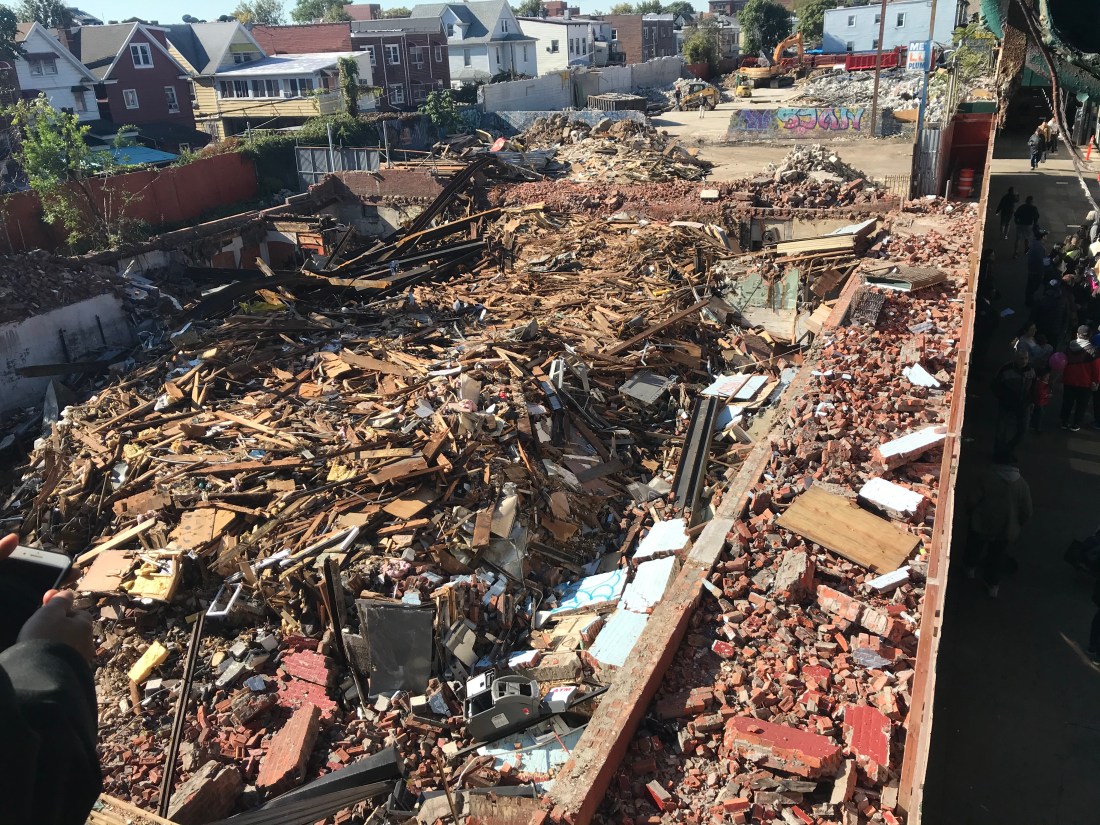
Destruction, another
After all, we’ve been given a small gift. Generally, when asked to count to 10, a person starts with one, but although the online debates about whether a new decade has or hasn’t started have now mostly died down, the fact remains that there are roughly 11 years from now until the end of 2030. In the end, the atmosphere, the ocean, and the soil obey their own laws, and thresholds breached and tipping points passed can’t be argued back into equilibrium by appealing to IPCC reports, but to the extent that we’ve set an arbitrary goal of “by 2030” (and I’m giving us until the end of 2030), we have one year to gather ourselves and ten to act.
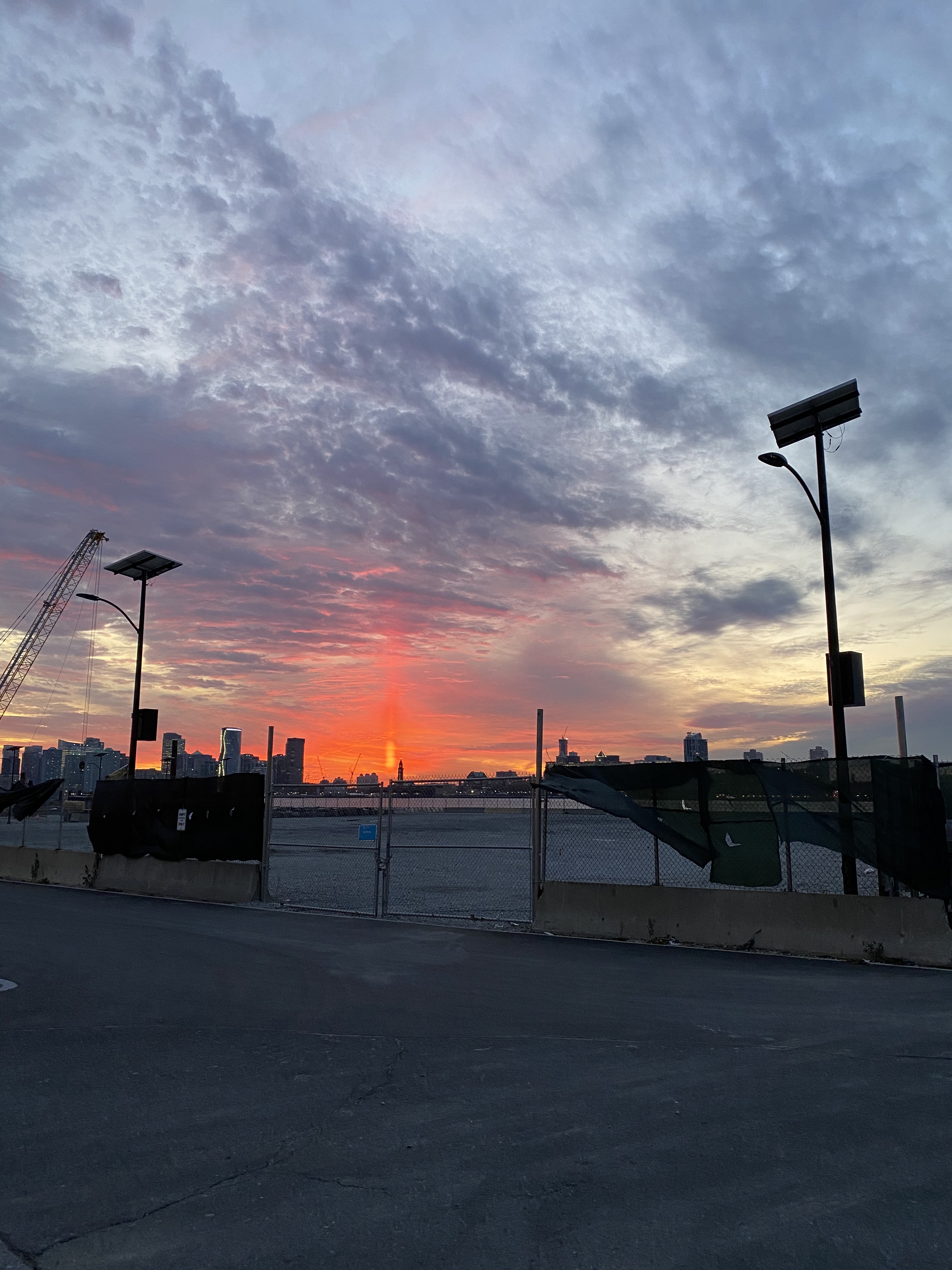
Destruction of beauty, perhaps the greatest of all, so in honoring the legacy and immense courage of Dr. Martin Luther King Jr., here’s to flowers in winter (when they’re meant to be; prunus mume, I think), hope in the dark, and a new world growing to replace the old
Those of us who lived through the attacks of September 11th, 2001 should remember the lies and manufactured hysteria that were used to justify the disastrous invasions (and ongoing occupations) of Afghanistan and Iraq. We should be wise enough to recognize when history threatens to repeat itself.
Imagine: Someone punches you in the face; you slap the hand that punched you; and then that person who punched you threatens to cut your head off.
Imagine: A US Secretary of Defense openly flies to Canada on a commercial flight to meet with the Canadian Prime Minister and, upon leaving the Toronto International Airport, is assassinated by a missile the launch of which was ordered from Tehran. (In the aftermath, Iran criticizes American aggression throughout the North American region.)
Imagine: That in 1953, the US toppled the democratically-elected government of Iran; that, thereafter, until the Iranian Revolution in 1979, the US propped up a brutal dictator in Iran; that, heroically, as Ben Affleck has shown us, the US opposed the Iranian Revolution in Iran; that having failed to reverse it, the US underwrote Saddam Hussein’s nearly decade-long war on Iran during which Iraq extensively employed chemical weapons and more than a million Iranians died; that shortly before the end of the Iran-Iraq War, the US shot down a civilian Iranian airliner, killing all 290 people onboard; that the US has worked for decades, employing a strategy of hybrid war – including covert operations and devastating sanctions – to undermine the Iranian government and destroy the Iranian state; that after the remarkable breakthrough embodied in the JCPOA (or Iran Nuclear Deal), the US withdrew from the Deal in barely more than two years’ time in spite of the fact that Iran had been, and continued to be, in compliance with the Deal’s terms; that the US continues to subject Iran to some of the harshest peace-time financial sanctions in modern history; and that after all that, the media in this country still has the audacity to characterize the recently-assassinated General Soleimani as a “bad guy,” as if that somehow served as a justification for extrajudicial killing via drone bombing of a senior official of a major world power.
Imagine. Then act: We have to prevent a war with Iran.
The stakes – for the Iranian people, the people of the United States, the rest of the world, and for desperately needed global climate action – could not be clearer, so I’ll simply urge you to remain critical in the face of the US corporate media’s drumbeat for war. Iran did not so much strike bases “where US troops were stationed” as target bases that were understood to be connected with the US drone war across West Asia while warning in advance that they intended to do so. There have been no casualties, and there need not be any further escalation. This is not a defense of the Iranian government, but a plea for rejection of further escalation and business-as-usual US militarism at a moment of profound global historical urgency.
We should be ashamed what has been done in our names. We should take courage from the people’s movements challenging corrupt and unjust regimes all around the world. We should reject false narrative and bald-faced lies being propagated in the media.
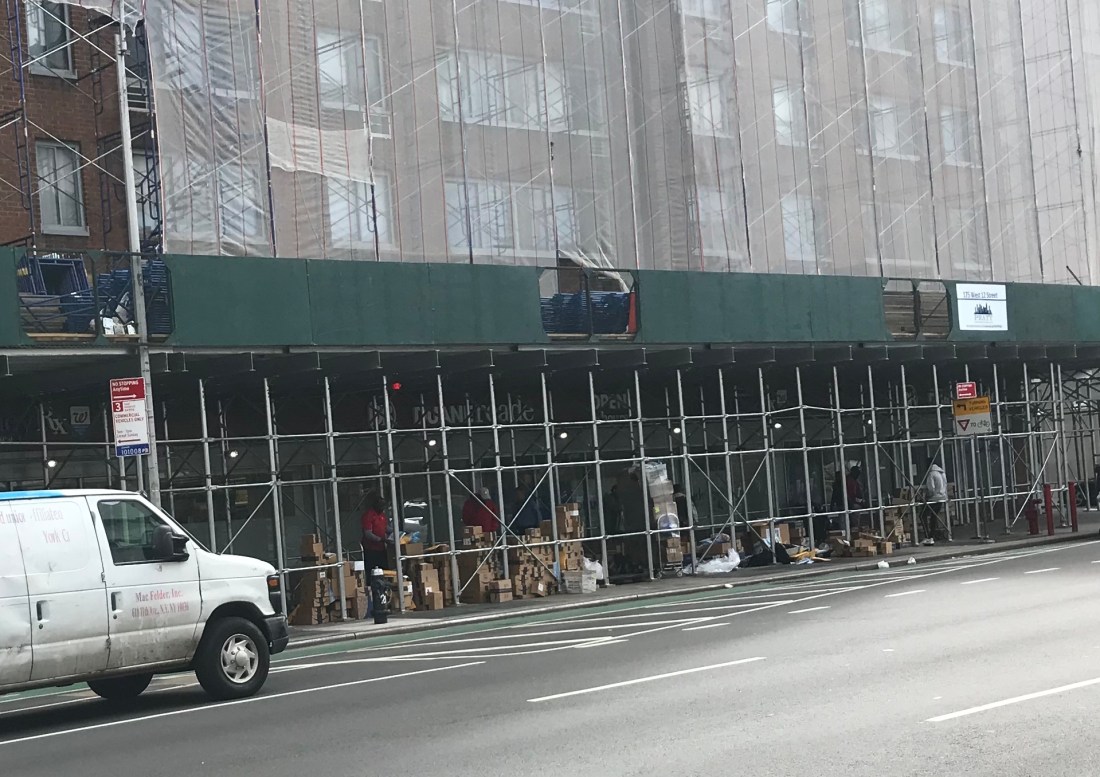
Beneath the scaffolding in front of a now-shuttered Duane Reade, an impromptu Amazon logistics hub
It’s the holiday season in the United States which means, among other things, even more frenzied hyperconsumption than usual, and no single company is more synonymous today with this country’s unique brand of consumerism than Amazon.
That Amazon. The one, it seems, that almost everyone in the US uses these days. The sprawling paragon of surveillance capitalism. The defense contractor extraordinaire (the CEO of which recently proclaimed, of his company’s relationship with the Department of Defense, “We are the good guys.”) The cloud platform that hosts/dominates much of the contemporary Internet. The online retail behemoth that has clogged US streets with its deliveries and US landfills with those deliveries’ detritus.
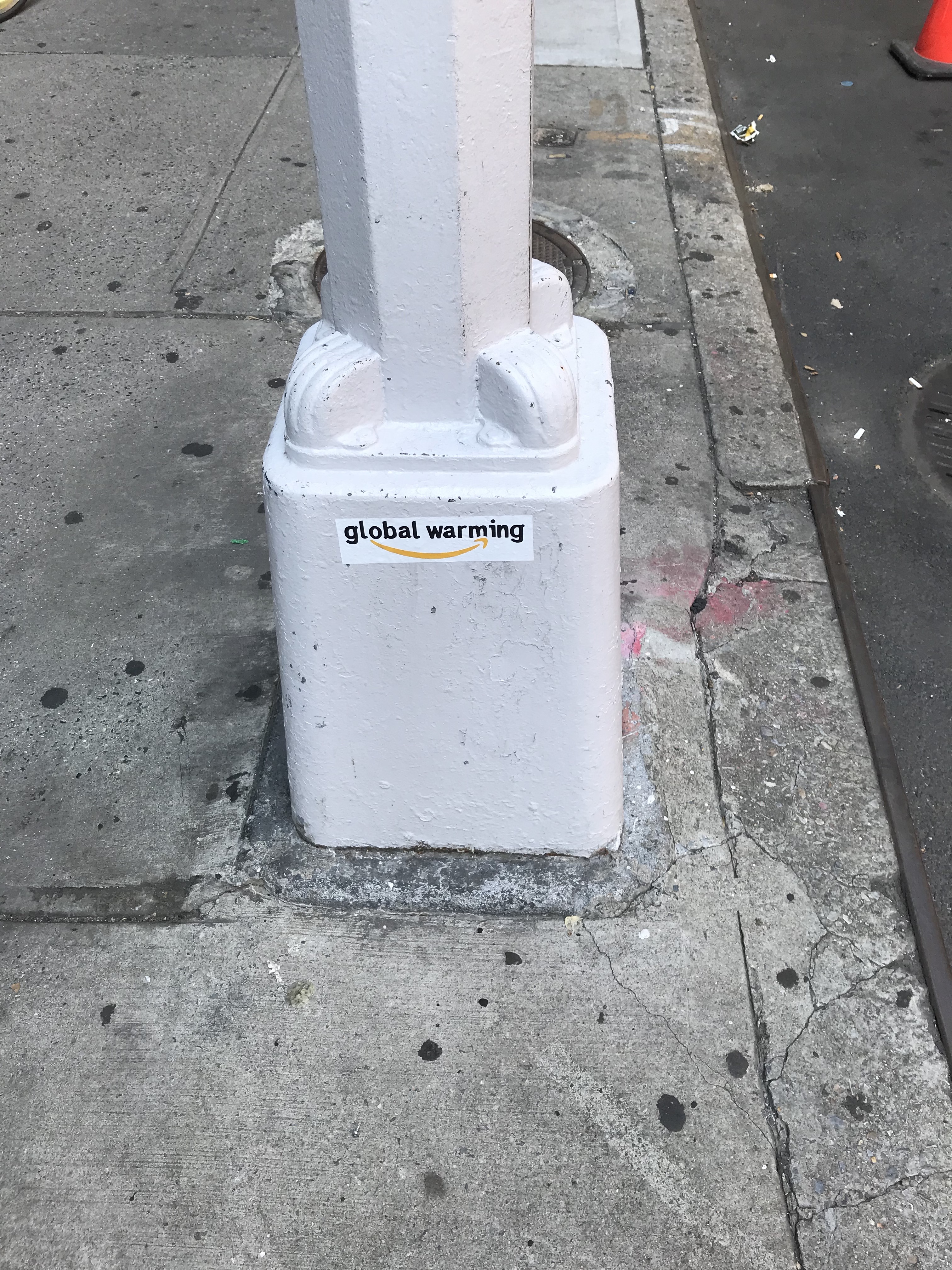
Amazon: Isn’t it about time you stopped using it?
Bezos is not your friend and the company’s business model is driving us towards panoptic dystopia and global climate crisis.
But as LeVar Burton used to say: Don’t take my word for it.
Here’s Reveal’s piece, Behind the Smiles, on how “Amazon’s internal injury records expose the true toll of its relentless drive for speed”.
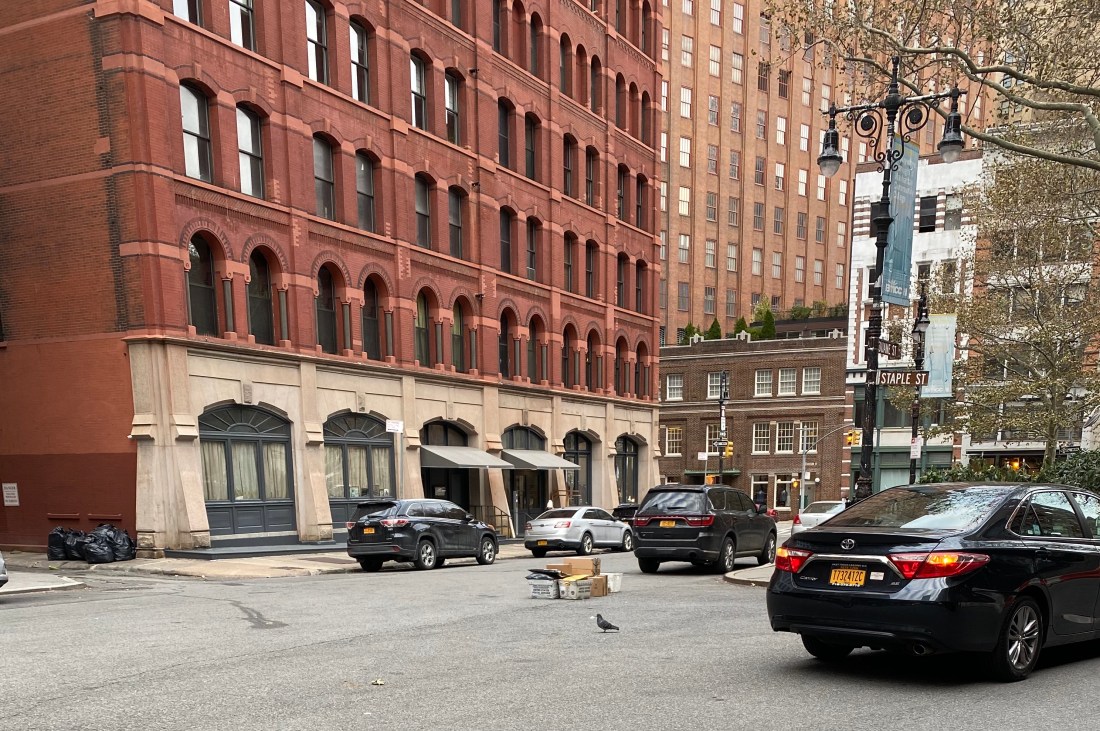
For the Bird: Love the USPS, but can Amazon has public space for free whenever Amazon likes?
As for the purchases, you don’t need all that crap, at least not most of it, and neither do your friends and loved ones (and acquaintances and colleagues). Here in New York, we’re lucky to still have locally-owned businesses, and if we don’t want to see them destroyed, we ought to patronize them. Slight differences in convenience and price should easily be offset by the value of human relationships and functioning communities.
It’s Thanksgiving in New York. Approaching five hundred years ago, the first historically-documented European passed through the waters of what is now known as New York Bay and encountered the region’s Lenape inhabitants. Approaching four hundred years ago, the first permanent European settlement was established in what is today New York City. New York was among the earliest significant outposts of the European settler-colonial project in North America, and yet our American History textbooks are largely silent on the early history of New York City (perhaps owing to its Dutch roots) and the genocidal roots it has in common with the colonies at Jamestown and Plymouth. Only in studying the start of the Revolution War do most schoolchildren in the US first begin to read about the City that for more than two centuries has been at the heart of US power and imperialism, and for approaching one century has been the/a center of the global order which is now trembling.
Three years ago, in confronting a manifestation of that order – the Dakota Access Pipeline – water protectors at Standing Rock injected the phrase that gives this post its title into global consciousness. Water has been central to the history of New York City: its preternaturally excellent natural harbor and strategic location at the heart of the colonial Atlantic Seaboard positioned New York to emerge as first a mercantile and commercial and then financial hub; the vision (and perhaps greed) of its elites in the early 19th century allowed New York to capitalize upon (and drive) the westward thrust of US imperialism through the construction of the Erie Canal and the cementing – by capture of Great Lakes trade on top of that of much of New England – of New York’s premier position among North American cities; even the consolidation of its five boroughs, in 1898, into one vast megacity had to do with water (as well as the growth of rapidly burgeoning Chicago), though in that case, with its bridging and tis lack, for, although New York is blessed in many ways – and before the devastation of colonization and industrialization, was evidently blessed much more with a natural wealth that was, to the first European visitors, truly staggering – as the City expanded, polluted, and despoiled, it ran up consistently against limitations in the availability of potable water.
Beset again and again by outbreaks of cholera and other water-borne diseases (no coincidence that the purview of New York City’s Department of Environmental Protection (DEP) encompasses both Drinking Water and Wastewater), only in 1842, with the opening of the first Croton Aqueduct, did the City, at last, secure a steady source of clean drinking water; commentators at the time believed it would be generations before the City required a greater supply, and yet such was New York’s greed for (and profligacy with) water that within a few decades, the City was once again pushing up against the limits of its water supply.
Fast forward to today, and the vast majority of New Yorkers give basically no thought to the source, security, or infrastructure underlying the availability of their water, and yet New York’s water system is one of City’s most remarkable infrastructural accomplishments (and perhaps one of the world’s). To quote from the NYC DEP‘s own New York City 2018 Drinking Water Supply and Quality Report:
The New York City Water Supply System provides approximately one billion gallons of safe drinking water daily to more than 8.6 million residents of New York City, and to the millions of tourists and commuters who visit the City throughout the year. The water supply system also provides about 105 million gallons a day to approximately one million people living in the counties of Westchester, Putnam, Orange, and Ulster. In all, the New York City Water Supply System provides nearly half the population of New York State with high-quality drinking water.
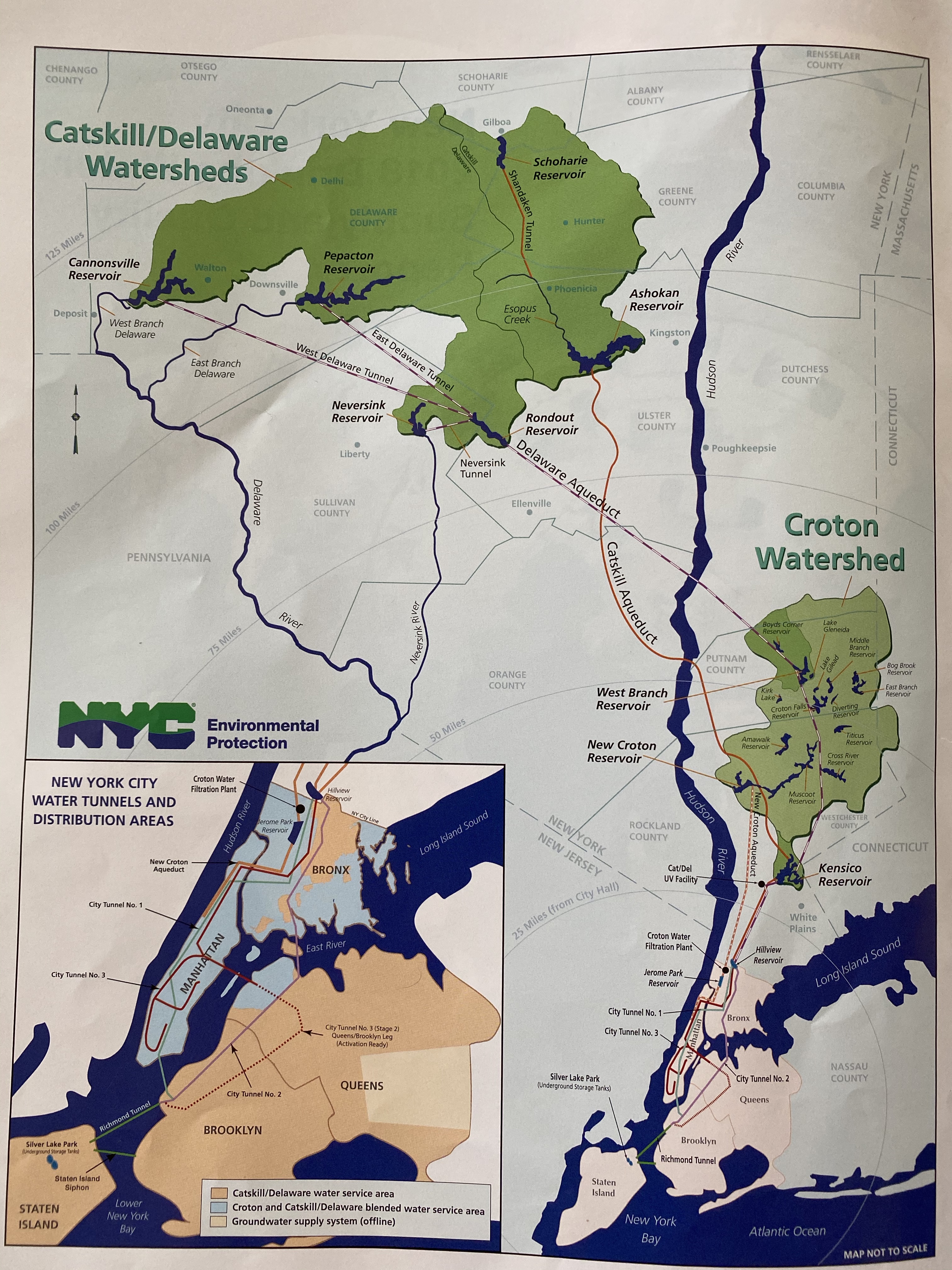
New York City gets its drinking water from 19 reservoirs and three controlled lakes spread across a nearly 2,000-square-mile watershed. The watershed is not located in New York City, but rather upstate, in portions of the Hudson Valley and Catskill Mountains that are as far as 125 miles north of the City. The New York City Water Supply System… consists of three individual water supplies called the Catskill/Delaware supply… the Croton supply… and a groundwater supply in southeastern Queens… [from which water] has not been delivered to customers in many years.
In 2018, New York City received a blend of drinking water from the Catskill/Delaware and Croton supplies. The Catskill/Delaware supply provided approximately 94 percent of the water, and approximately six percent was supplied by Croton.
The Report, which I encourage New Yorkers to read in its entirety, includes basic information (for example, about treatment of New York City’s water supply; see image below for more details) and remarkable facts (for example, that the 85-mile-long Delaware Aqueduct – currently undergoing repairs which themselves reflect the technical sophistication and capacity of the system and those maintaining it – is the longest continuous tunnel in the world). Readers who are interested in system maintenance, water quality testing, watershed preservation, and water conservation efforts will find the report an accessible and concise summary, and those in New York and looking to learn more might also enjoy paying a visit to the Queens Museum which has a fascinating, if dated, topographic map showing the extent of the City’s water supply (along with the famous Panorama of the City of New York, which offers – in view of rising sea levels and climate crisis-driven extreme weather – a sobering perspective on New York’s future relationship with the bodies of water which have defined it).
Again, Miss Frizzle covers all of this in the above-mentioned primer
Given that my own time has been limited this fall, I’ll leave it at that – more of an invitation to those who might be interested to dig deeper than an attempt at (or pretense of) offering anything more comprehensive. For readers looking to go deeper, Ted Steinberg’s Gotham Unbound and the incomparable Gotham (by Edwin Burrows and Mike Wallace) and Greater Gotham (by Wallace alone) offer treasure troves of historical perspective on their common theme (that is, Gotham, the origin of which name may have something to do with goats), while Nick Estes recent Our History is the Future offers both further insights regarding the ongoing struggle at Standing Rock and a necessary corrective to (even excellent) histories which fail to center indigenous experiences in making sense of how we came to be where we are.




 Climate / Change