April Showers Bring April Flowers

IMG_3740.jpeg
Year by year, spring is springing earlier and earlier

Lots of news in New York City, around the country, and around the world – refreshingly much of it positive – so where to begin?

In the US, I remain cautiously optimistic that we are witnessing a slow sea change around questions of climate and ecological action and justice. Hard to guess what the future holds for the Green New Deal (GND), but we need it, or something like it, and the thing to remember is that the true critique of the GND is not that is too sweeping, but that it may not be ambitious enough.

On that front, perhaps nothing feels more urgent and potentially transformative right now than the direct actions being taken by Extinction Rebellion. From what I gather, it is a sort of radical, ecstatic circus of dissent that is looking to make business as usual impossible (most notably, in London, at the moment) until real and commensurate action is initiated to address the global climate emergency. Amazing to note that not only Extinction Rebellion, but also the Sunrise Movement here in the US have taken inspiration from the courageous actions of a single teenager, Greta Thunberg. Sometimes – if you’re feeling despondent or paralyzed by indecision in view of the scope of the climate crisis – it can be helpful to remember that we generally don’t appreciate what the impacts of our actions will be. Of course, global climate change epitomizes negative (somewhat) unforeseen consequences of human action, but isn’t it about time we contributed to some positive unforeseen consequences?

Here in New York City, we’re seeing fits and starts of climate progress. Congestion pricing for lower Manhattan has passed, but already, the political jockeying has started around exemptions, and not everyone is convinced that it will prove the sweeping transportation fix that it’s been billed. Additionally, the City Council recently passed a landmark piece of climate legislation mandating significant energy efficiency improvements for major buildings in the five boroughs, and there is talk that the Council may officially declare a climate emergency in the coming months, thus requiring that all actions at the level of city government in New York take into account climate realities and climate ramifications. This would be a real step towards sanity.

What can you be doing, then? I’m at least considering joining Extinction Rebellion myself, but am not sure I’m ready to deal with the potential legal consequences. If you, too, are finding yourself shy of taking radical direct action, you can at least be working to change your own mind, and in the process, to change the minds of those around you. (Here’s my climate action primer from a few months ago as a starting point.)

An aside: there is a popular and alluring notion that nature has ended and that we are living in an era of natural-social hybridization owing to the global ascendance of humankind. According to this view, there is no nature anymore, and everything is shaped by human influence/the social. This reflects the pinnacle of hubris. The earth is but a tiny speck in the vastness of the universe, and the universe is ruled by natural laws which function beyond any possibility of human intervention. Our climate system is but the tiniest microcosm of our solar system, our galactic system, and the universal system within which we sit. This is not New Age abuse of language, but an attempt to precisely state facts. If we neglect fundamental laws of the universal system – not as a transcendental abstraction, but as the overarching frame of our reality – we do so at our own peril, as it is not so much the Earth that is under threat right now, but humans and all our fellow living beings on the planet, and the climate system and the natural laws of which it is a function are beyond indifferent to human discourse.

Anyway – coming back down to Earth – urgent action is necessary in view of the above, and thankfully we find ourselves in a moment when it is increasingly possible to imagine new and better futures, futures different from the dystopias and post-apocalyptic cli-fi which we’ve so long been fed by the mass media. Case in point, here‘s an encouraging – if quite basic – video from from AOC, Molly Crabapple, Naomi Klein, and others at the Intercept. Check it out.

We need a Green New Deal, not as an end point, but as a starting point, and I hope you’ll commit yourself to imagining a just and sustainable future and becoming an advocate for the transformations we need to undertake to make such a future possible. This encouraging piece from Douglas Rushkoff – entitled Selling the Green New Deal With Positivity – might be a helpful jumping off point.

What I’m Doing

One action item only this month – stopping the Williams Pipeline:

  • I’ve been regularly calling the Governor (at 518-474-8390; I encourage you to ring through to speak to an operator rather than leaving a voicemail, but every call counts) and other elected officials, signing petitions, joining demonstrations as I find time, and generally speaking out against the construction of the Williams/NESE Pipeline under New York Harbor, as well as against any and all fracked gas infrastructure in New York State. National Grid is threatening a moratorium on new gas hookups if the State does not approve the project by May 15th (have a look at this 350.org report for the case against National Grid’s claims regarding the need for this pipeline), and it is urgent that you make your voice heard on this matter. Want to make your voice heard on other fracking-related matters as well? Here‘s a really helpful map from the Sane Energy Project – called the You Are Here Map – that “allows users to see the big picture of the shale gas network statewide, then zoom in on their own region, learn the current status of a project, and connect with the local group that is fighting it. “

What I’m Reading

Renewable Energy – short, accessible, and optimistic primer on renewable energy technologies that is well worth reading if you’re looking to better understand the progress of and challenges to renewable energy generation.

A Broken Land: Ecological devastation in the American heartland – on fracking.

A Green New Deal for Agriculture – actually still working through this long piece (by Raj Patel and Jim Goodman) myself, but it’s been engaging so far; if your daunted by the long read, you can also listen to this interview with the authors by Doug Henwood (which starts around the 1-minute mark).

Mapped: historical public transit systems v their modern equivalents – this, courtesy of Aaron Gordon of Signal Problems (which he is sadly discontinuing because he has taken a full-time job writing about the future of multimodal transit for Jalopnik), which offers clear visual insight into how much public transit we lost in the era of the automobile.

Protect the whole city, not just one neighborhood – a brief piece from Costa Constantinides and Nilda Mesa on why Mayor de Blasio’s $10-billion “climate” plan for Lower Manhattan is a bad idea.

USDA orders scientists to say published research is ‘preliminary’ – and the monthly reminder of what we’re up against.

Bonus

As someone who loves the water around New York City, I’m thankful the City Council has taken action against this eyesore of a business model.
 

Mass Transit Mass Movement

E75CD8B4-D448-41B0-B2BB-C89A758880DF.jpeg
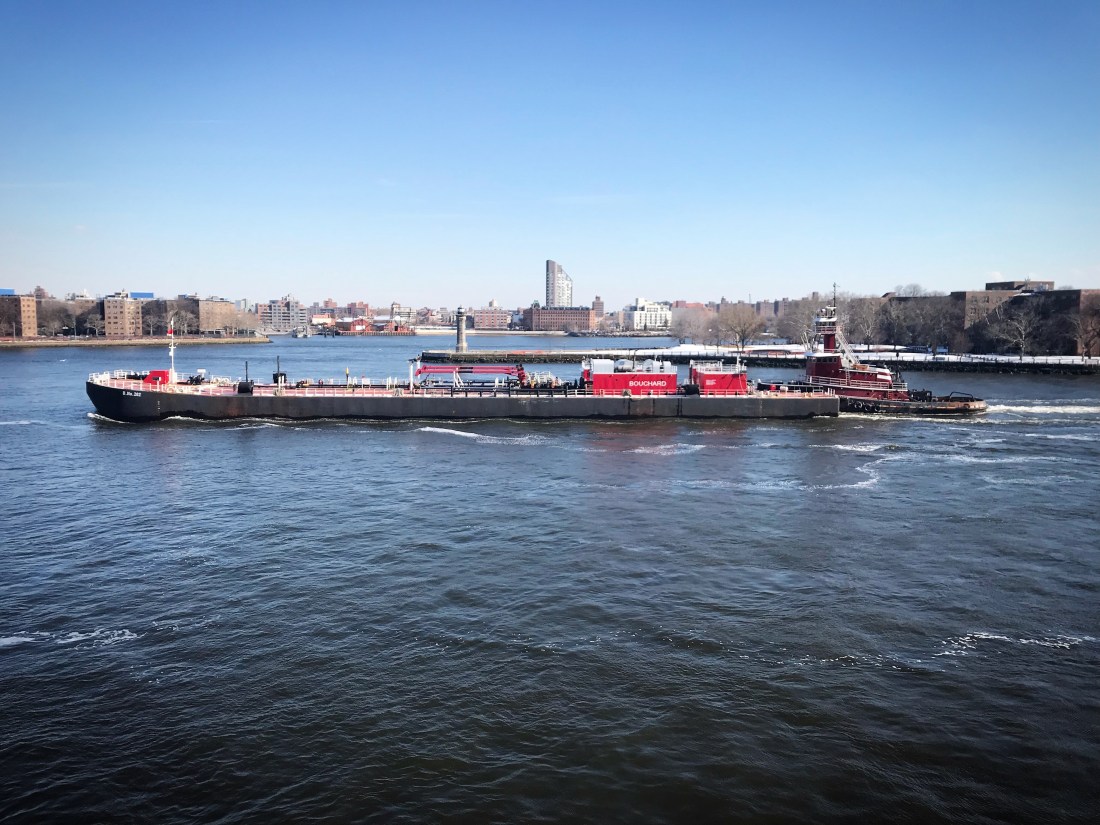
Spotted – from Carl Schurz Park – this tank barge carrying “Clean Oil” up the East River

As developments around the Gateway project show, it can be impossible, or nearly so, to pursue certain necessary undertakings without Federal support. On the flipside, concerted public resistance to the Williams Pipeline points to the fact that, sometimes, popular action can be enough to block even the most concerted efforts of corporations and political officials.

Shortly after our return from India, a young man asked me what I thought about the Green New Deal (GND). I said I supported it wholeheartedly, and he blurted out in reply:

“But don’t you think it’s a little extreme?”

Upon inquiring what exactly he meant by that, I came to learn that he was under the impression that the GND would entail all Americans becoming vegan and giving up all air travel. Now, of course, moving to a plant-based diet and reducing air travel are both sane and rational choices in view of the global climate crisis, but I wouldn’t say that mandatory veganism and an air travel ban represent key pillars of the GND as I understand it.

Of course, there is humor in this, but also a deep lesson to be learned. In this profound moment of urgency, we can’t afford to be victims of our own defensive and reactionary urges and the propaganda of climate change deniers which is designed to prey on just those insecurities. I have now adjusted my position on the GND so as to preemptively shift the terms of discussion. The GND is insufficiently ambitious and too-little-too-late, but it is also by far the best option we have in our national discourse around climate, and we should all be throwing our wholehearted support behind developing a robust plan from what is currently only a bold proposal. The devil may be in the Republican Party, but it is also in the details.

Much the same can be said about Corey Johnson’s new plan for NYC’s mass transit. The devil will certainly be in the details, but it reflects a welcome breath of fresh air. Given that I started the year calling for “a mass people’s movement to demand restoration and renewal of New York’s mass transit“, I was pleased to read, in the transcript of the Signal Problems interview with Johnson and a few of his staffers, Johnson’s own assessment of the current stalemate around mass transit governance and accountability:

“Do I think people give up power willingly or in a happy-go-lucky way? No. And that’s why it’s important to build public support and build a movement around this. And I think, hopefully that’s what we’ll do.”

Johnson echoed a similar sentiment in his interview with Benjamin Kabak on the first episode of the Second Avenue Sagas podcast:

“You can only get big things done if you get public, broad-based support from the people it affects the most.”

I recommend that you read/listen to both (and consider becoming a subscriber to Signal Problems, as the full interview with Johnson is paywalled, but makes for interesting reading for those of you who are concerned about the nitty-gritty).

I’m still waiting for my hardcopy of the 103-page report, so my own assessment of it will have to wait until April, but for the time being, I’ll just echo this notion, that what we need is a mass movement of informed and engaged citizens demanding sane and just policies around transit, and around climate, for the future of our City, as of the country and the world.

What I’m Doing

Just two things this month:

  • Thinking long and hard about my ongoing failure to transition away from Chase in view of its long-standing role as the leading financier of fossil fuel companies and projects globally. For context, have a look at this (short) report – all the major American banks are major culprits and nearly $2 trillion have flowed into fossil fuel projects since the signing of the Paris Agreement.
  • Continuing to urge my friends, relatives, neighbors, and fellow New Yorkers to get educated about and get involved with efforts to block the Williams Pipeline. We absolutely do not need fracked gas flowing under New York Harbor. Or anywhere in New York State. Or the country. Or the world.

What I’m Reading

My New Plan to Climate-Proof Lower Manhattan – Bill de Blasio’s ambitious, vague, and in my opinion, confused proposal to “push out the Lower Manhattan coastline as much as 500 feet” so as to defend all that real estate.

‘A lot at stake’: indigenous and minorities sidelined on climate change fight – Guardian article for which the title says it all.

An Ecosocialist Green New Deal: Guiding Principles – some thoughts from the DSA on the GND.

An open letter to all people and organizations working to combat global warming and Open letter to 1Sky from the grassroots – an open letter and an open reply to it that give some interesting insight into what has changed and what hasn’t in the last decade or so.

The Green New Deal can’t just be a bill or two. It needs to be the framework for politics for the next few decades. –  Jacobin series on the GND.

Bonus

I bumped into our friend Harry from the Greenwich Village Society for Historic Preservation the other day, and he recruited me to join for what turned out to be a photo shoot in defense of the White Horse Tavern. I wouldn’t call us “Angry”, per se, but that’s another story…

Mass Train-sit

IMG_3585.jpeg
The “outskirts” of Hyderabad, one of the many megacities in Asia which are largely unheard of in the US

I’m delighted to declare victory in my campaign to make 2019 The Year of the Train! Thank you to Governor Cuomo, Mayor de Blasio, and all the other courageous politicians who made this momentous victory possible.

Jokes aside, a lot has happened related to mass transit in NYC in the last two months. We spent the month of February in India, and I’m personally still digging back out from a backlog of correspondence and chores, so hence will keep this brief. It’s always jarring to travel between India and the US, and the contrasts cast in stark relief the challenges and opportunities in both countries, not least of all related to mass transit. (Incidentally, it is especially jarring to transit between South India and the Northeast of the US at this time of year. We went from 37 degrees Celsius to 37 degrees Fahrenheit in a day!) And, of course, the hypocrisy of writing about the need for urgent climate action and my own elective transcontinental air travel in the same paragraph is not lost on me, although I’m not alone in grappling with such contradictions.

On mass transit in NYC, I was thrilled to see Corey Johnson’s sweeping plan, though haven’t yet had time myself to do it full justice. Its release followed close on the heels of the release of the Governor and Mayor’s joint plan. I recommend readers have a look at the Second Avenue Sagas roundup of Johnson’s ambitious plan and the Sagas and Signal Problems breakdowns of the joint gubernatorial-mayoral plan as well. (This piece from Sagas on Mayor de Blasio’s utter failure to address mass transit issues is also worth reading.)

All of these developments have me now questioning the viability of my own #CuomoDeBlasioFixTheSubway proposal, and I’ve been reflecting on what practical steps everyday New Yorkers can be taking to support sane, just, sustainable mass transit policies for the 21st century. For now, I’ll continue to reflect, but hope to write more on this by month’s end.

In the meantime, here’s:

What I’m Reading

The Subway Action Plan is not making the subway better. Here’s what is. – Illuminating piece from Aaron Gordon of Signal Problems on how political pressures distort narratives and practical action related to/by the MTA.

The MTA as a Worker – Great piece from an MTA worker that appeared in the NYC DSA’s newsletter.

Powerless: What it looks and sounds like when a gas driller overruns your land. – Powerful reporting from ProPublica on the abuse of eminent domain in the expansion of the fracking industry in Appalachia.

COP24: Developed Nations Continue to Dictate Terms of Global Climate Action – From December. Title says it all.

What I’m Doing

This month, just one action item:

  • Support efforts to block the Williams Pipeline. We don’t need this fracked gas pipeline running beneath New York Harbor and just off the coast of the Rockaways. You can sign petitions and submit comments via this website as a starting point.

And a…

Bonus

Actually three bonuses:

First, here’s some welcome, if quite serious, comic relief from the halls of Congress regarding the impact of seismic airgun tests on whales.

Second, this month’s sobering reminder about the scale and direness of climate change, courtesy of NASA.

Third, and finally, a humbling reminder of the courage of activists and communities at the frontline of climate action, this one from Wet’Suwet’en Land.

The Year of the Train

IMG_3187.jpeg
I love our ferries, but what we need is not token pet political projects but functioning buses and trains

There is growing consensus that 2019 will be a “make-or-break” year for the subway – by which I think people generally mean New York’s remarkable, but ailing mass transit system more broadly. We all know how staggering in size and complexity are the interconnected networks of commuter trains, subways, and buses that serve the more than 20 million residents of Greater New York; that perhaps nothing more symbolizes the spirit of New York City than the subway; and that mass transit is a central democratic institution of our metropolis, so I will cut right to the chase: While there has been a great deal of hand-wringing and Twitter groaning about the state of the crisis; while the #FixTheSubway Coalition is doing admirable work to improve rider experiences; and while Governor Cuomo has made great symbolic shows of his commitment to action on mass transit, he has had eight years to give the people of New York substance rather than show, and all we’ve witnessed and experienced is steady deterioration of the quality of service and the state of our essential transit infrastructure.

Hollow words from our elected representatives are not enough. We need a mass people’s movement to demand restoration and renewal of New York’s mass transit systems. We need to make 2019 the year of the train.

Premises

1. New Yorkers are confused and upset about the state of our mass transit. Fares and tolls keep going up, and obviously a lot of money is being spent (speaking of token pet political projects, just look at the 2nd Avenue Subway!), but overall, the quality of services has declined sharply in recent years.

2. Politicians – especially Governor Cuomo and Mayor de Blasio, as well as their respective predecessors – have passed the buck and blamed the MTA, but we know that the MTA was actually created (in 1968) for the very purpose of allowing politicians to pass the buck and avoid taking blame and responsibility for mass transit! And that it is the Governor and the Mayor who have outsized control over our mass transit systems and their budgets. They are disproportionately responsible for the current mass transit crisis and should be held accountable for it.

3. For the first time in a long-time, we have a Democratic Governor, State Senate, and State Assembly in New York State, plus a progressive Democratic Mayor and City Council in New York City, and an incoming Democratic United States House of Representatives spearheaded by young, new progressives who are prioritizing (green) infrastructure. Mass transit is a climate, social, racial, and environmental justice issue; the time is now to act such that every year going forward, the subway, commuter trains, and buses will improve, and by 2030, we have the world-class mass transit system that we – and the city we love – deserve.

Demands

1. Fully implement congestion pricing as soon as is possible (there’s backstory on congestion pricing on page 28 of the Fix NYC Advisory Panel Report from January 2018 for those who are interested).

2. Reorganize the MTA per the recommendations of the Metropolitan Transportation Sustainability Advisory Workgroup Report, and begin to implement the Workgroup’s additional recommendations as soon as is possible.

3. Fully fund the Byford Plan (a.k.a. the Fast Forward Plan) and commit designated (“lockboxed”) funds to the immense task of restoring and renewing our mass transit system by 2030.

Action Steps

1. Call the Governor (1-518-474-8390; and no harm in submitting a webform while you’re at it!) and demand that he accomplish the three steps outlined under Demands above.

2. Call the Mayor (may be necessary to call 311 to reach the Mayor’s Office; and ditto on the webform) and demand that he accomplish the three steps outlined under Demands above.

3. Call your State Senator and demand that they accomplish the three steps outlined under Demands above.

4. Call your State Assemblymember and demand that they accomplish the three steps outlined under Demands above.

5. Call your City Councilperson and demand that they accomplish the three steps outlined under Demands above.

6. If you’re feeling especially inspired, take to social media to demand the accomplishment of the three steps outlined under Demands above using #CuomoDeBlasioFixTheSubway.

All told, this should take you about 15 minutes. (Still itching to make more phone calls? I wouldn’t hesitate to reach out to your United States Senator and Representative either, although they’re somewhat remote from this.)

Thank you for taking action. Happy New Year!

If you need any additional motivation to get and stay involved with this struggle for the future of New York, here are words from the tireless Aaron Gordon – if you aren’t already, I encourage you to become a (paid) subscriber to his weekly newsletter, Signal Problems:

“It is for these reasons I suspect 2019 will be the most important year in this city’s transportation history. Never before have so many issues culminated at once. Congestion pricing, MTA reform, the L shutdown, the legality of for-hire vehicle surcharges, the Fast Forward Plan’s future, and on and on. 2017 was the year we recognized we had a problem. 2018 was the year we got a prognosis. Now what? It’s make it or break it, put up or shut up.”

And the Workgroup itself:

“Failure of the public transportation system is the single biggest threat to the continued livability and prosperity of the New York metropolitan region.”

I’d argue that climate disruption is actually “the single biggest threat” to New York City (and most of the other great cities of the world) but while climate change can feel daunting, abstract, and impossible to grapple with, transit is an everyday reality for many of us. It’s time we broke through our fatalism and the cynical obfuscation of our political leaders to demand:

#CuomoDeBlasioFixTheSubway! Transit (and therefore, climate) action now!

Postscript: Apologies to readers outside Greater New York that calls to action here are geographically specific! And note, as the congestion pricing lawsuit makes clear, these issues are (obviously) very complex. For sake of popular accessibility and immediate actionability, some simplification of demands felt necessary, but that simplification was by no means meant to obscure the political nuances at play here.

The Solution is Prevention

Screen Shot 2018-12-20 at 1.39.12 PM.png
Time to stop fossil fooling ourselves, for example, about late fall in NYC and its causes and consequences

This week, after roughly a year of construction and approximately half a million dollars in expense, repair work on the Morton Street Bulkhead appears to be winding down. Meanwhile, the Global Carbon Project estimates that global carbon dioxide emissions – which had leveled out briefly at the end of the Obama administration – are on pace to increase by 2.7% in 2018 on top of a 1.7% increase last year. As I have written before, coastal defense alone will likely cost New York City tens if not hundreds of billions of dollars in the foreseeable future, and yet, diligently, we are repairing aging bulkheads that, odds are, soon enough, will be regularly underwater. Clearly, as we hurtle towards the proverbial cliff’s edge, we are (almost) all in denial.

And who are we? The individuals and classes most responsible for the global climate crisis.

A loved one reached out to say she was feeling discouraged and personally culpable for climate change, and I responded: “It’s a tough reality at the moment and those of us who live comfortably in the US are all disproportionately to blame, but I don’t see any option at this point but working to reduce the harm.”

A friend declared that what she most feels in thinking about climate issues is “shame.”

By way of social media caption, I wrote: “If you’re not thinking, talking, and acting on climate every day at this point, then you are part of the denial. We have until 2030-ish to utterly transform the way the world works, and despair, cynicism, and resignation are all just different forms of cowardice. Time for concerted, sustained, collective, just, historically-rooted, and evidence-based action.”

Another friend publicly reasserted his conviction that geoengineering will be the only way to avert the most dire consequences of global climate disruption (a contention with which I firmly disagree).

On the one hand, we are desperately in need of a strong dose of reality; on the other, it’s about damn time for some pragmatic optimism and can-do spirit. Yes, the interwoven social, political, economicecological, and climate crises have grown to staggering and daunting proportions.

What are you doing about it?

In that spirit, here’s a very loose framework for thinking about your own climate action, and here’s an even looser roadmap about where we go in the coming twelve years.

If you’re in need of further inspiration, I recommend you follow the links to videos about what youth activists of the Sunrise Movement are doing here in the United States; what indigenous communities are doing in Canada; what members of Extinction Rebellion are doing in the U.K.; what farmers are doing in India; what Greta Thunberg is doing in Sweden (and her remarkable speech at the generally tepid and heavily-policed COP 24 Summit in Katowice); and what Amy Goodman (of Democracy Now!) modeled in chasing one of the chief representatives of the U.S. Government at the Katowice Climate Summit in pursuit of honest answers to a few simple questions.

I urge you, look to these good examples, and then ask yourself – this holiday season, this new year: What am I doing about the climate crisis? Why am I not doing more? How will I feel about my actions, or lack thereof, in a decade? Or fifty years?

Here’s to making 2019 the first year during which global emissions trend down, after which they stay down. Take Drawdown with a grain of salt, but we already have the solutions (chief among them, ending the extraction and combustion of fossil fuels, which Drawdown does not emphasize, hence the salt). And if you’re dreading challenging climate conversations with family and friends, here’s a primer.

We have a lot of work to do. See you next year.