The Woman with the Flaxen Hair

“Off with his head! Off with his head!” the Yellow Shirts were chanting.

“We want his head! We want his head!” they cried.

They had gathered in their thousands upon the National Mall. They were calling for the head of Slavoj Žižek.

“Off with his head!” came the call.

“We want his head!” the reply.

Up in the Crow’s Nest of the not-at-all-hastily erected tower, the woman with hair and eyes and skin stood boldly facing the Capitol building itself – center, temple, some might say mausoleum of American power. Like in some gallant shampoo ad, her hair blew about her face, tossed by the wind. Like some stone-faced Rushmore, from her perch on the Capitol Grounds, she stared down that stone-faced edifice with the two-chambered heart.

“Off with his! We want his! Off with his! Head!” the coordination of the chants was uncanny.

Turning to face the ever-expanding sea of her followers, the Woman with the Flaxen Hair saw that they were manifold, and it was good. As far as the eye could see, they stretched. Across 3rd, 7th, 9th, 12th, 14th. Past the Monuments and Museums to all the massacres and atrocities. All the way to the Washington Monument, and she was told to the Lincoln Memorial and beyond. They beat upon the banks of the Potomac, but did not break – simply flowed over the bridges across the River – and she had no doubt would soon be overflowing the Arlington National Cemetery, as well.

“Public relations nightmare in that,” she mused. “Heavy weighs the head that wears the crown. Ha!”

For a blue-collar girl from the farm country, these were heady days indeed.

“Off with his,” she raised her right hand, and there fell, instantaneously, a dead silence, eery, in its completeness.

She raised her left hand, and there arose a great cheer. Then, lowering both hands, taking up again the bullhorn, she raised it to her mouth and proclaimed, “We have held our vigil long enough, my brethren! We have waited here these weeks as our numbers have swelled, but we won’t wait much longer. It is time for this,” she paused, as if reflecting, “cowardly lion,” one almost expected her to say of Judah, “to come out of his cage and address us.”

A great roar arose from the assembled masses. All dressed identically they were. Wearing identical jumpsuits. All yellow.

“We will not be placated!”

A roar.

“Our concerns will not be assuaged!”

Another.

“We are calling for the head of that dastardly Slav Zizek! We demand it on a silver platter, no more no less.”

Then came the deafening noise of hundreds of thousands of voices rising as one as the Woman with the Flaxen Hair let the bullhorn drop and the strands of her hair gently whipped and curled in the wind.

Postscript: An excerpt from the as-yet-unpublished 2010 novel, Ellipsis.

First-Come-First-Vaccinated

Lots of hot takes on yesterday’s events in DC, but given that I already shared mine (look for the novel forthcoming any year now…), I thought I’d address another debacle today: New York’s vaccine rollout.

Tl;dr – it’s not going well. (Here are NYC, NYS (oops), and US vaccine dashboards for your perusal.)

Slightly longer version, in spite of being more or less the hardest hit state in the country to date (technically, by deaths per population, it’s New Jersey) and having had many months to prepare for the arrival of safe and effective vaccine(s), New York, under the indefatigably autocratic leadership of Governor Andrew Cuomo, has thus far badly bungled the vaccine rollout. City & State has two good pieces out – entitled, respectively, “Why can’t NYC vaccinate like it’s 1947?” (subtitle: “New York City gave smallpox vaccines to 5 million residents in just two weeks 74 years ago. What have we unlearned?”) and “Don’t let COVID-19 vaccines expire” criticizing the Governor’s vaccine strategy.

I took the time to read New York’s 80+-page vaccine plan (the NYS website is not optimized for finding dated documents, or I’d link to it here) when it was released some months ago, and to give due credit, it was thorough, well-considered, and humane. Here’s the problem: As means-tested programs are wont to, it has also failed. Of course, in this case the testing isn’t by financial means (though I have no doubt that many very rich people are finding ways to buy early vaccine access), but by phase/category eligibility; be that as it may, logistical challenges, vaccine skepticism, and the artificial barrier of eligibility restrictions have badly limited the amount of vaccine actually being administered in New York City, New York State, and across the country.

Truth be told, I don’t doubt that vaccine distribution will start to scale up pretty dramatically in the coming weeks and months regardless of what approach is taken, but given that a deliberate, phased approach has been tried for almost a month, and is not working, I think it is high-time that we shift to a first-come-first-vaccinated approach. Of course, the idea was that high-risk individuals and those at highest risk of COVID exposure should get the vaccine first, but given the glacial pace of vaccination, and the fact that NYS is currently sitting on roughly 2/3 of its to-date-allotted vaccines, clearly, high-risk individuals, healthcare workers, etc. are not being harmed by not giving those unusued vaccine doses to others. They might be being harmed by other failings of the rollout, but that is a different matter.

Open the floodgates. Let anyone who wants to get vaccinated get vaccinated. Put demand pressure on the producers to keep the supply of vaccines coming, and start rapidly building towards social consensus on the need to get vaccinated as the flood of people (a significant majority of US residents) who want to get vaccinated rush to do so. Might this produce other problems? Sure. I’m not proposing a free-for-all, and it would be reasonable to have an online registration process or something so as not to oblige US residents to stand in yet another endless queue (as they did throughout most of 2020 for food, COVID tests, etc.).

Making the wrong choice for the right reasons is admirable, but once it becomes clear it was bad, there’s no merit in standing by a bad idea. One can even easily imagine a mechanism by which the elders, healthcare workers, other essential workers, and those with underlying health conditions that put them at higher risk from COVID are given the ability to jump the line, thus honoring the spirit of the phased system while still staying focused on the main goal – as public health folks often put it: Getting shots in people’s arms.

A Few Thousand Idiots Can’t Topple the Most Powerful Government on Earth…

… which may be the Chinese Government, at this point.

Back in 2010, I wrote a tragic-comic novel that centered on the rise of a white supremacist fascist movement which sought to overthrow the US Government by, among other things, comically besieging the US Capitol. Unfortunately, I wasn’t in a particularly good place at the time and ended up burning that draft, and it took me a number of years to write a second. With any luck though, today’s events will speed the passage of Ellipsis to publication.

In the meantime, for your reading pleasure, I’m paraphrasing a tweetstorm here:

Live from DC right now #Coup – (This one was Neelu’s idea.)
Shit. Sorry – this one, actually. Definitely not a #coup, though it is certainly an embarrassment and an embodiment of our country’s white supremacist political culture.
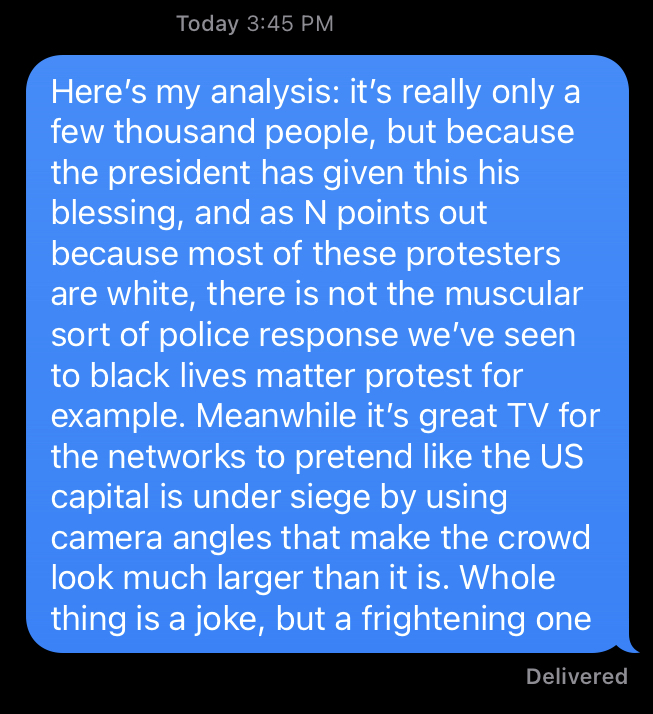
Heard an anchor on @abc (via Twitter) declare the police were “clearly outnumbered”; um, remember when all of DC was militarized over the summer to stop nonviolent protests orders of magnitude larger than this idiocy? And by “muscular” here, I mean racist, but also violent, excessive, and an undeniable display of the state’s monopoly on use of force.
More live coverage from DC – super great for ratings, but bad for democracy #DCRightNow

Obviously, a few thousand lightly-armed idiots can’t topple the most powerful government on Earth. At least not alone. Maybe we shouldn’t have filled our police and armed forces with avowed white supremacists though? Ahh, but that was half the point.

#DCRightNow – you get the point #DC #Washington #WashingtonDC

We’re living in a Debordian spectacle. I went for a walk before sunset and every shop and window I passed showed a television screen tuned to cable or network news. The seriousness of this event and the coverage of it are co-creative of each other.

QED: See this tweet from Nick Estes.

Ali Abunimah may have said it best, though: “Reminder that when right-wing, US-backed and funded mobs try to overthrow the governments of other sovereign countries, they are cheered by Democrats and Republicans alike as “pro-democracy” protesters. This would even be dubbed the “American Spring.”

This coup attempt must be stopped, but so must the Lincoln Project, if you follow my drift, and without historical memory about the so-called War on Terror, the PATRIOT Act, etc., etc., and all the people (now masquerading as patriots) who brought us those horrors, it will be hard to pull out of this tailspin (one of the many military metaphors that have so suffused our English), or perhaps better, awake from this nightmare (a Joyce-ism with which I’m perfectly comfortable), and so rise to the occasion of the singular historical moment in which we’re living.

Getting Left Holding the Bag

In a certain sense, my generation and those following it have already been left holding the bag of climate crisis, but considering the national situation in the US in more granular fashion, it becomes apparent that a great deal of climate bag-holding will soon be being lamented.

I’ve previously pointed to Christian Parenti’s excellent 2017 Jacobin piece “If We Fail” on the risk of a climate catastrophe-tax flight-infrastructure collapse spiral that we face in New York City; and to Jeff Goodell’s readable The Water Will Come that addresses, among other things, “real estate roulette” in Miami, as high-priced waterfront condominiums change hands in a city facing existential threats from sea-level rise and extreme weather (exacerbated by its porous geology) more dire and imminent than those menacing NYC. In 2019, Jason Jacobs – of growing My Climate Journey fame – featured David Burt (not, contrary to my initial impression, the trader played by Christian Bale in the film The Big Short, but evidently also someone who made money betting against the pre-Global Financial Crisis mortgage bubble) who has, in more recent years, founded DeltaTerra Capital, “an investment research and consulting firm serving institutional clients that seek to mitigate climate risk exposure and integrate climate-driven alpha strategies in portfolios.”

Burt’s thesis is largely summed up in the following quote: “[Given] how much those costs [of maintaining properties] are likely to go up as a result of increasing severe weather events, you find that a large swath of real estate investments are mispriced. So again, that’s the parallel to the sort of big short story that I experienced, 2005 through 2008.”

I started the year by offering some pushback to Fred Wilson’s take on climate adaptation and flight from coastal cities (because there are no places that will not be impacted by climate crisis); however, it is almost certainly true that just as non-human species are being forced to migrate poleward, so too will human populations, and this (along with the swamping/destruction of some coastal cities) will lead to tectonic transformations of global political economy. Given the scope of all this, and the severity of the potential negative consequences, I believe the emphasis should always be on mitigation whenever possible, and only secondarily on adaptation whenever necessary; that profit motives should be subordinate to human needs in climate response; and that climate/disaster profiteerism (like pandemic profiteerism) is reprehensible.

That being said, I think Burt’s position is somewhat different, for while he is, indeed, looking to profit off of climate harm, he’s looking to do so by incentivizing a repricing of currently mispriced assets, which would, in turn, be predicated on actually taking climate risks seriously. Unlike proponents of solar radiation management – whose profit-model is contingent on a failure to adequately address climate crisis globally – if Burt’s bets against US mortgages (that are currently systematically over-valued owing to a failure to take climate risks into account) pay off, it will be because intensifying climate harms (the fires, the tropical storms, the derechos, etc., etc.) drive a reckoning with our changed reality – either that, or there’s simply another massive housing market meltdown.

The point here is less to defend Burt’s particular position though, but to point out to those who remain unmoved by our worsening climate reality that if their hearts have yet to be touched, their pocketbooks may soon be. If conscience doesn’t move you, then perhaps self-interest will.

Postscript: I didn’t actually read this piece from the New York Times, but didn’t have to to confirm that it lends further credibility to my argument about innumeracy and undercounting of COVID-19 deaths across much of the globe.

A Pandemic of Innumeracy (and Bad Metaphors)

On Friday, I concluded that we’ve entered The First Climate Decade. Meanwhile, the COVID-19 pandemic rages on.

I’ll be the first to agree that the handling of the pandemic has been disastrous in the United States – where things continue to go badly, after millions of residents ignored public health guidance and common sense to travel and congregate over the holidays – but does the US really have “the worst epidemic in the world” as is so often repeated by commentators and everyday people alike?

As of this writing (January 1st, 2020 at 5 PM EST), the US has roughly 20 million confirmed COVID-19 cases and 350,000 deaths. (I wrote a few weeks ago, in predicting that the pandemic will end in the US early in the spring, about how ridiculous these numbers are, given that the IFR for COVID-19 seems to be somewhere between 0.5 and 1%.) Russia is only reporting ~60,000 COVID-19 deaths, but that number tripled in a single day recently. Our political culture – flawed as it is – would not permit such a massive deceit to be perpetrated, at least not domestically. (It has certainly permitted us to largely forget the crime of the invasions of Iraq and Afghanistan and our ongoing so-called Global War on Terror, but that is another issue.)

This map shows confirmed COVID-19 deaths per million by country. Belgium, for which a number is not shown above, has the highest confirmed COVID-19 deaths per million of any country at ~1,600. Source: https://commons.wikimedia.org/wiki/File:COVID-19_Outbreak_World_Map_Total_Deaths_per_Capita.svg#/media/File:COVID-19_Outbreak_World_Map_Total_Deaths_per_Capita.svg

India is only reporting ~10 million confirmed cases and ~150,000 deaths (and, of course, has four times the population of the US), but then, no informed person in India believes the official numbers, and serious policy and public health experts have speculated that the death toll may be as much as a 5x undercount. For comparison, I speculate that the US death toll has been undercounted by ~10% (with recent data showing 2020 excess mortality of 400,000+ deaths – ~20% above the official COVID-19 death toll, but with the excess likely explained in roughly equal parts by uncounted COVID-19 deaths and an increase in suicides, drug overdoses, deaths from avoidable but untreated causes, etc. during the pandemic). If that 5x figure happens to be roughly correct, that would put the actual Indian death toll closer to 750,000 – still lower than the US death toll per capita, but roughly double even the actual US figure.

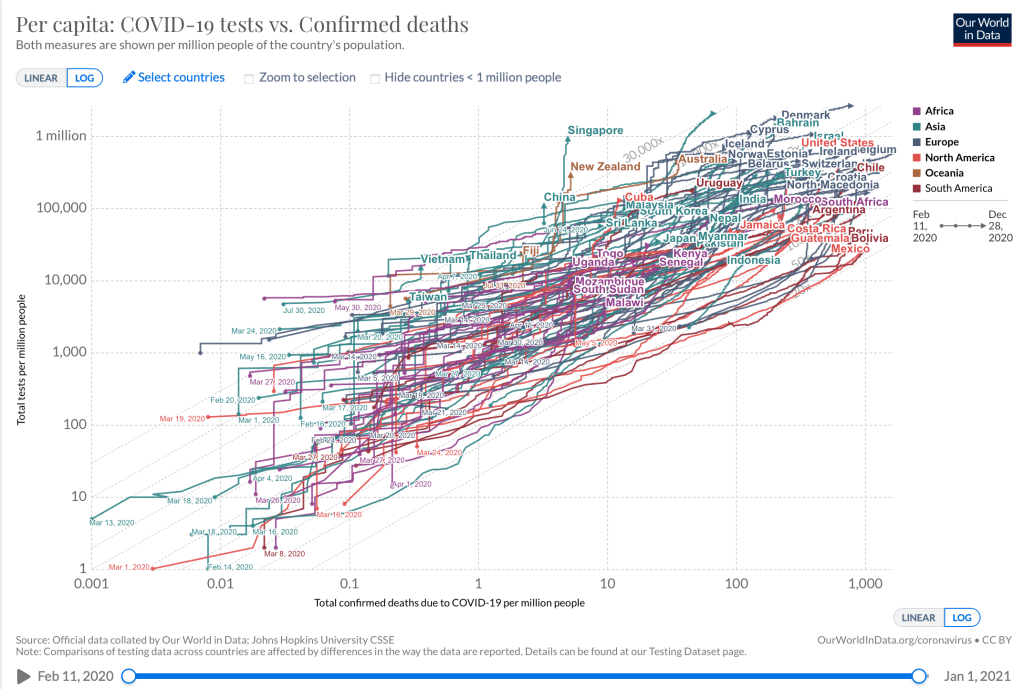
This graph shows the US more or less in the middle of the pack (though trailing most rich countries) in tests per million versus confirmed deaths for million, though of course, when Russia is capable of “missing” 2/3 of its deaths for almost a year and India is systematically undercounting COVID-19 mortality, it is worth discounting slightly how bad the US numbers look on a relative basis, not to forgive criminal negligence and cruelty in this country, but just so as not to be confused about facts. Food for thought: Why is this chart significant? Source: https://ourworldindata.org/grapher/covid-19-tests-deaths-scatter-with-comparisons

Of course, that 5x figure is speculative and out-of-date, but the case remains that the US is a rich country with well-resourced healthcare institutions and near universal access to emergency care. (What you pay for that care is, again, another issue.) In at least some poor countries, the governments of which lack both resources and incentives to accurately test at a population-level for prevalence of a disease which they cannot hope to control, and where large majorities of the population have limited or no access to healthcare, it may be easier to simply ignore a pandemic from which the rich, and relatively so, are relatively able to insulate themselves.

Layer on top of that failing of public health the fact that COVID-19 mortality skews very sharply to the right based on age, and it is easy to imagine that – whereas in the US and Europe, the aging populations of which have been hammered by the pandemic, hiding the death toll is impossible – in countries like India – where something like 1 out of every 6 deaths is not registered at all, and another 4 out of 6 deaths is not registered with an official cause of death – a young population, radical economic inequality (and concomitant disparities in healthcare access), and lack of robust public oversight might make it more viable to simply make the true toll of the pandemic disappear from public view.

This certainly isn’t a defense of the dismal US response, as rich countries with aging populations (like Japan, South Korea, and New Zealand) have shown that humane, rational, and effective responses to this pandemic are very much possible – setting aside the fact that not-so-rich (but incidentally nominally socialist) countries like Cuba, Vietnam, and China have all fared much much better than we have here in the US – but it can, at least, be helpful to temper our hot takes with data and numerical scrutiny lest we perpetuate false narratives, exceptionalism, and US/Euro-centrism.

Postscript: One might wish that ex post antigen testing might, in the future, shed light on the true extent of COVID-19 spread around the globe; given that SARS-CoV-2 antibodies seem to fade quite rapidly, that prospect will depend on as-yet-undiscovered means of accurately ascertaining past infection.