This Storm Is What We Call Progress

Genealogies of knowledge are fascinating. Case in point, a friend wrote – in response to my first post on New York City’s long history of confronting epidemic disease: “An interesting question though these days is to figure out who is actually an authority.”

In the email exchange that followed, I wrote: “I’d argue that having networks of trusted individuals and institutions is core to the process of identifying authorities (eg, it was through Democracy Now! which I’ve listened to for 15 years and trust deeply, that I first heard Laurie Garrett in early Feb which shaped my understanding of the risk to the US and our utter unpreparedness, and I follow Bill Bishop’s Sinocism, which was taking the impact of the disease in Wuhan seriously from early January) but it’s hard when these sources are largely “niche.””

And then followed up the above with the following example genealogy of how I came to read Gotham in the first place: “I’d been looking to read a big NYC history, but there are a lot of them floating around, and I didn’t have a good sense of how to differentiate. I read a review by Kim Phillips-Fein of Wallace’s Greater Gotham in The Nation (though I probably came to it through social media, perhaps Twitter, as I’m not a regular Nation reader). I’d heard Phillips-Fein interviewed on Doug Henwood’s excellent radio program Behind the News and subsequently read her book, Fear City, on the NYC financial crisis of the mid-70s. She wrote very highly of Wallace’s book, and so I decided to read first the volume that preceded it which Wallace and Burrows had written together (I’ve now read both). Digging further back, it was a close high school friend of mine who’d recommended Henwood’s radio program in the first place, and not just any friend, but one whose thinking I respect and who’s very knowledgeable about Left politics. Further, I’d actually previously been a regular reader of Henwood’s discontinued Left Business Observer, which I’d in turn come to through the nexus of independent media outlets (Democracy Now!, FAIR, Free Speech Radio News) that had played a big role in my own political development during the height of the Iraq War. Those, in turn, I suppose I came to on my own, but through an intentional process of self-education that had started with obvious books by Chomsky, Zinn, Arundhati Roy, and others, and gradually led me to circuits of discourse outside the corporate media sphere.”

Of course, such unwinding can get tedious, but I think it at once sheds light on how we know what we think we know, and on the ancient oral histories of human knowledge.

Anyway, in the spirit of reference, acknowledgment, (and even intersubjectivity!), today I’m going to quote/excerpt pieces that have been informing my own thinking in recent days and weeks, but which (mostly) haven’t yet made their way into my writing. My hope is that – in the spirit of a great unfinished work by Walter Benjamin (a quote from whom gives this piece its title) – these fragmentary voices will tell a story from which emerges some coherence.

With no further ado, writing on “Zoonotic origins of human coronaviruses,” researchers from the University of Hong Kong summarize:

To conclude, the most effective way to prevent viral zoonosis is for humans to stay away from the ecological niches of the natural reservoirs of the zoonotic viruses.

Obvious, yes, but an important conclusion nonetheless. Building upon one important obviousness with another, here’s an anonymous “former high-ranking C.D.C. official” as quoted in this New Yorker piece:

We have the best public-health agency in the world, and we know how to persuade people to do what they need to do. Instead, we’re ignoring everything we’ve learned over the last century.

Looking to China, we should’ve known what was coming, and indeed – as extensive reporting has shown – we did, but today, the water’s have been muddied, as Bill Bishop eloquently points out [paywalled]:

To follow up on yesterday’s comment, one of the things I am struggling with is how to wade through the escalating information war, while watching what sure looks like the impending collision between the US and China. Seek truth from facts, wherever they may lead…

But if the news is bamboozling, still, history warned us – history, like this piece from 2004 on the “origin of the 1918 influenza pandemic” (which speaks to why I reiterated yesterday: “This pandemic is not unprecedented. It was not a black swan event.”):

In recent years the World Health Organization and local public health authorities have intervened several times when new influenza viruses have infected man [sic]. These interventions have prevented the viruses from adapting to man [sic] and igniting a new pandemic. But only 83 countries in the world – less than half – participate in WHO’s surveillance system […]. While some monitoring occurs even in those countries not formally affiliated with WHO’s surveillance system, it is hardly adequate. If the virus did cross into man [sic] in a sparsely populated region of Kansas, and not in a densely populated region of Asia, then such an animal-to-man [sic] cross-over can happen anywhere. And unless WHO gets more resources and political leaders move aggressively on the diplomatic front, then a new pandemic really is all too inevitable.

I repeat – from 2004 – “a new pandemic really is all too inevitable”; we must only hope that the following quote, from the same piece, does not prove grimly prophetic of what is to come:

Thirty of the fifty largest cities in the country also had an April spike in excess mortality from influenza and pneumonia. Although this spring wave was generally mild – the killing second wave struck in the fall – there were still some disturbing findings.

In the US, we’ve seen fascists, kleptocrats, and crony capitalist moving at lightening speed to capitalize on the opportunity of the crisis, while Democrats and progressives mostly look on in various attitudes of complicity, complacency, outrage, and horror. David Dayen has been offering keen insights on recent Machiavellian happenings in DC:

Because we have effectively a planned economy, planned by mostly one man named Steve Mnuchin, his whims form the basis for how our economy works.
Power has been handed over to an [sic] transactional mediocrity making monumental decisions seemingly based on personal relationships. Welcome to Mnuchin-mnomics.

While also providing compassionate commentary on the nightmare of this unfolding train-wreck for everyday residents of the United States:

In this crisis, the government has offered some relief to debtholders, whether for mortgages or student loans. But all of the relief programs put the burden on the individual, requiring them to reach out to their servicer and seek the relief. Servicers have a fun way to respond to this: they don’t take the phone calls. Borrowers constantly report that they can’t get through to their servicers, and this keeps them from the options they were promised. It also helpfully keeps costs down for the servicers; they’re literally incentivized to have no contact with their customers.

Writing for The Intercept, Jon Schwartz opines that “The Corporate Right Is Giving Us Two Choices: Go Back to Work, or Starve” – elaborating that, from the perspective of the above mentioned fascists, etc.:

The short-term danger is that Americans will resist the push from business to get us back on the job and making money for them. Their plan is simple: Starve us out. They know we can’t survive indefinitely without a continuing government bailout focused on regular people’s needs. So they’re going to stop that bailout from happening.

The longer-term danger they face is that we’ll make the government work for us in the short term — and then we will realize we could make it work for us all the time by removing the threat of starvation from their arsenal. This would totally change the balance of power in society. This is their deepest fear, one that’s consumed them since World War II, the first time in history that everyday people gained consciousness that it was possible for them to use the government to create a world that puts them first, not their bosses.

While on a similar note, outspoken (and largely single-issue) anti-monopolist Matt Stoller (who is not without his critics, and whose singular focus on the admittedly key issue of the power of corporate monopolies I fear may be blinding him to the danger of allying himself with charlatans of the Far Right) argues:

We have to restructure our social hierarchy, so that people who do the work have control over the work, instead of the middlemen and monopolists.

At any rate, it’s time to think big, and to start from the premise that big business, at least temporarily, is going to be structuring the response to the pandemic. A new generation of leaders and thinkers is not going to tolerate that kind of governance for long, but we will still have a lot to clean up after this mess is over. So what are the policy levers to shape the world after we decide that we actually prefer our public democratic institutions to govern?

That’s the question that we should be thinking about.

Sadly, in New York State, we see a monopoly of a different sort consolidating before our very eyes – that is, Governor Andrew Cuomo’s monopoly on power:

In recent weeks, Cuomo has been lavished with national praise for holding nightly briefings about the pandemic, seemingly filling a leadership vacuum left by the federal government. But not only did Cuomo fumble his state’s response, minimizing [sic] the risks of the virus in early March, but he has also used this political moment to cement his authority and that of his political allies. Over the past month, Cuomo has canceled six special elections and used the state’s annual budget process, over which he wielded great influence, to enact some of the most strict ballot access laws in the nation and expand his budgetary power. Progressives say the combination of moves amount to a power grab, given cover by the ongoing pandemic.

Is it always darkest before the dawn? I’ll give the final quotes to the always-astute Mike Davis – writing in this instance for Labor Notes. Here he is on preparedness:

For nearly a generation the World Health Organization and all major governments have been planning how to detect and respond to such a pandemic. There has always been a very clear international understanding of the need for early detection, large stockpiles of emergency medical supplies, and surge capacity in ICU beds. Most important has the been the agreement of WHO members to coordinate their response along guidelines they all had voted to accept. Early containment was crucial: comprehensive testing, contact tracing, and the isolation of suspected cases. Large-scale quarantines, sealing off cities, shutting large sectors of the economy—these should be only last-ditch measures, made unnecessary by extensive planning.

Or lack thereof:

In other words, the U.S. was not ready and the government knew it was not ready.

Fantasy:

The proposal to test people’s blood and then issue back-to-work certificates if they have the right antibodies is mere fantasy at the moment. Washington has allowed more than a hundred different firms to sell serological kits without human trials or FDA certification. The results they give are all over the map, just a mess.

Reality:

But most recent research […] suggests that conferred immunity is very limited and coronavirus could become as entrenched as influenza. Barring dramatic mutations, second and third infections will likely be less dangerous to survivors, but there is as of yet no evidence that they will be any less dangerous to uninfected people in high-risk groups. So COVID-19 will be the monster in our attic for a long time.

And its ramifications:

A volcanic rage is rapidly rising to the surface in this country […]

In the genealogical spirit, I came to this Davis piece through the DSA’s COVID-19 Bulletin whose style of organizing and “building power” hints at how “volcanic rage” might be used to “shape the world” anew. Sadly, we’ve already largely missed the initial opportunity the pandemic presented. Cuomo, McConnell, and others of a similar bent – if nominally, but meaningfully different politics – have long since seized the initiative out from under our powerless noses. It was always a generational struggle though, and a trans-generational one, so we can at least hope that Stoller is right and we don’t “tolerate that kind of governance for long,” as the messes we have to clean up are big ones.

What Kills Us Only Makes Us Stronger

Image 4-29-20 at 11.13 AM.jpegRemember when people still compared the number of COVID-19 deaths in NYC to the number of deaths the City suffered on 9/11? That was three weeks ago. Now the former is 8x the latter. If not for the horrible stakes, it would almost feel quaint.
New York is a city perpetually destroyed and remade by crisis. From the yellow fever and smallpox outbreaks of the early settler-colonial period; to the Revolution itself; the cholera epidemics and great fires of the first half of the 19th century; the so-called Draft Riots (which deserve that name, but were also anti-Black pogroms); the increasingly crushing financial panics of the 19th century’s second half; and on to the cataclysms and paroxysms of the 20th century with which most of us are more familiar, right up to September 11th, the Global Financial Crisis, and Hurricane Sandy, New York has a long history of rising from its own ashes and financial ruins, and I expect it will do the same this time around.

(The question of global climate crisis – as of the ever-present threat of nuclear war – is of a qualitatively different order which likely, if left unaddressed, would preclude recovery.)

As I’ve written elsewhere, I suspect that we’ll be surprised how fast we forget when all this is over. Right now, I’m reading, seeing, and hearing a lot about dystopian and anti-human near-future scenarios, and while the threats of rising digital surveillance and authoritarianism are very real, the idea that in-person restaurant dining or days at the beach will come to an end because of this pandemic strikes me as shockingly ahistorical and narcissistic. As much as some of us claim to be critical of neoliberalism and its now-and-always-risible Fukuyaman end-of-history ethos, it’s hard not to absorb what’s in the air we all breathe. Ideas, like pollution, are ambient, and so I’ll repeat, again: This pandemic is not unprecedented. It was not a black swan event. Certainly, it will change the world, but let’s try to have some modesty and to keep our senses of proportion and perspective. Pubs and inns date back at least to first century of the Common Era in what was then the Roman Empire, and one imagines that similar institutions existed even earlier in China, Central and West Asia, and the Indian Subcontinent.

We all learn about “the Black Death” – a name that could do with changing – and yet, here we are nearly 700 years laters, and don’t you know: We still have pubs, inns, and now even coffee shops and restaurants. This remarkable document from the NYC DoHMH, to which I’ve linked before, shows the extent to which New York City was ravaged across much of its history by epidemic and pandemic disease.

Do we still have restaurants? We do.

We need to stop with the histrionics and exceptionalism. It’s not enough – having bungled our initial pandemic response through negligence and complacency – to now wallow in despair and hysteria. The question is not – as a much-circulated New York Times piece asked over the weekend: “Does the World Need” restaurants, anymore?

The question is: What type of restaurants will the world get?

Here in New York City, we should be asking ourselves: Do we want Prune, or Appleby’s? If the answer is the former, then – as I advised in my title yesterday – we should stop with our pitiful handwringing and nostalgia for two months ago, and focus on organizing, struggling, building political power, and paying attention to the details.

The pandemic won’t kill Prune, but the corporate bailout could.

We’ll be surprised how fast we forget, and while some habits will change, social distancing will not be with us forever. It probably won’t even be with us for very long from what I already observe in the streets of the West Village, and so – while personal and social adjustments are necessary, and official regulations will continue to be promulgated – the bigger challenge relative to public health is building and rebuilding systems, institutions, knowledge, and norms; relative to our social fabric, the struggle is to beat back the corporate coup and reverse the national and global rise of fascism.

Pub(lic house)s survived the Plague, and they’ll survive this, too. As our friend and neighbor – who owns and cares for one of the great, still-extant Village dives – opines (I’m paraphrasing): Pubs are ancient institutions. They bring us together.

Simple. True. And I can’t wait to get back to his.

In the meantime, stay clear headed. Stay strong. Be kind to yourself, your partner, your roommates, your loved ones, your neighbors, and – please! – by all means, fight for the future where we get Prune, and not Appleby’s, and where the world moves inexorably –not into violence and collapse – but towards peace, justice, and sanity.

Don’t Mourn…

… organize! Or so the saying goes, though, today, of course, we have to mourn as well. Mourn and organize. And nurture. And care. And think.

And imagine, as well, though not so much that our enemies and opponents seize the future (as it seems they have) while we’re daydreaming.

I’m of course referring to the big, world-reshaping imagining that has been necessary for generations, but briefly, let’s do some narrower imagining around the rapidly evolving data on COVID-19.

Let’s imagine a best-case for NYC: Recent serological surveys are roughly correct and ~20% to 25% of the City’s population already has antibodies for SARS-CoV-2/COVID-19. Research out of China (from early April, so perhaps already dated) suggested that 4 out of 5 cases of the disease were asymptomatic, so if we further imagine that people with asymptomatic cases generate positive PCR tests (while infected), but negative serological tests (post-infection), then we could even come to the conclusion that ~1 out of 5 NYC residents have already had symptomatic infections, but nearly all NYC residents have already been infected, symptomatically or otherwise. If we layered on further the assumptions that antibodies confer at least temporary immunity (say for 1-3 years), and that people who experienced asymptomatic infection, while not immune, may simply not be susceptible to this disease (and thus to future symptomatic infection), we’d have a situation in which all surviving vulnerable individuals had at least near-term immunity, and very few people in NYC remained at risk of suffering serious illness or death – though, of course, asymptomatic individuals in this hypothetical could still be dangerous carriers again in a context where a significant number of susceptible individuals were present.

(I’ll note that 13 fighter jets just thundered overhead. I’m reassured about the strength of our life-destroying military, but remain deeply concerned about the state of our public health apparatus and all of our life-sustaining public goods and services.)

Okay, now let’s imagine the worst-case scenario: The serological tests have overstated the seroprevalence in NYC, and either way – as the WHO has warned may be the case – antibodies/previous infection do not confer immunity, so more or less the entire population of the City remains at risk for re/infection.

Unfortunately, at present, we still have no idea to what extent either of these scenarios accurately reflects reality, or about what that reality really is. Some things, at least, we know with greater certainty, though sadly, those hard facts come in the form of deaths. Yesterday, I estimated that COVID-19 has taken the lives of ~21,000 New York City residents to date, and yesterday, also, (though it popped up in one of my feeds this morning), the New York Times put out this analysis suggesting that there have been 20,900 excess deaths in NYC since the pandemic hit us. Nice – if utterly tragic, in this instance – when the Times and I can agree about something…

Researchers from Yale’s School of Public Health found the rate of excess death in the US from March through April 4th was nearly double the official COVID-19 death toll as of the latter date, again suggesting that the actual US death toll is likely roughly twice the official figure (which currently stands above 56,000) so already well above the 100,000 US COVID-19 deaths I estimated two days ago.

As I wrote in this Tweet, about this Axios alert, “Unless someone asks the people being imprisoned themselves about their symptoms (or lack thereof), I think these results should be taken with a pound of salt”; I’ll be surprised if the rate of asymptomatic infection turns out to be, not 4 in 5 – as the Chinese study referenced above suggested – but 24 out of 25, as these results from an Ohio prison indicate. So far, at that prison – Marion – out of the ~2,000 incarcerated people infected, only four have died, thank goodness (for a 1 out of 500 or 0.2% IFR); however, I’m inclined to worry that, on the one hand – in the absence of the voices of the incarcerated individuals themselves – symptomatic cases are probably being drastically undercounted as people with milder cases simply hide/don’t talk about their fevers, chills, coughs, etc., and on the other hand, given the delays we’ve seen everywhere else between spikes in confirmed case counts and recorded deaths, we can likely expect a significant increase in mortality at Marion (and many other of the prisons across the US’s inhuman archipelago of incarceration) in the coming weeks and months.

Sadly, many prison employees have also been infected (one imagines they were the likely source of the infections in most institutions, not to engage in the often odious practice of vector shaming), which points, yet again, to how carceral institutions like prisons and immigrant detention centers serve to amplify and perpetuate infections beyond the razor-wire fences and concrete walls.

Finally, in continuing to make the connection between the logics of the crises of pandemic and climate, I’ll point to two recent pieces of scholarly work. This one – “Nonessential Research in the New Normal: The Impact of Novel Coronavirus Disease” – which notes that:

The impacts of research shutdowns will be felt long after the pandemic. Many scientists study diseases that do not share the same obvious urgency as COVID-19 and yet take a shocking toll on human life. For example, malaria infects more than 200 million people and takes the lives of nearly half a million people, mostly young children, each year. During laboratory closures and without clinical studies, there will be no progress toward treating and preventing malaria: no progress toward new drugs, vaccines, or diagnostics.

[…]

We must acknowledge the harm that will be caused by neglecting areas of research that are not tied to COVID-19 and ensure we balance our priorities to save lives. If we assume that health and medical research are essential to reduce morbidity and mortality, then every month that research is delayed will ultimately lead to in- creased suffering.

And this one – “Research is not immune to climate change” – which concludes:

It is time to call attention to the vulnerability of [climate change] research to climate change [itself] and begin to address it. Regardless of discipline, location or topic, research of all sorts is threatened by climate change in multiple ways. To reduce this vulnerability, the research sector urgently needs to begin adapting, from individual researchers and research groups, to large-scale programmes and institutions. If it does not, its value to the rest of society will be eroded, including its role as an enabler of others’ adaptation.

Both of these papers point, in neat and frightening fashion, to a corrosive truth: That failure to take commensurate action now, and in the past, only serves to undercut our future capacity to act, even as the problems we face grow rapidly worse. In short, we face something worse than a Red Queen game, a global scenario in which our ability to confront challenges steadily deteriorates even as the challenges themselves steadily mount.

I’ll close with a nod to two striking passages from Discerning Experts – a dense, tightly-written, and fascinating book on “The Practice of Scientific Assessment for Environmental Policy” – co-written by a neighbor of ours. Towards the book’s end, its authors opine, first:

The evidence presented here suggests that when scientists feel vulnerable [to political attack], they retreat from policy recommendations. Scientists in the late 20th century found themselves in a weaker position than their counterparts in midcentury, as the cultural preeminence of science declined, the postwar consensus frayed, and political polarization increased. As a result of these (and other) factors, opposition to scientific findings that challenged the status quo became increasingly well organized and well-funded. Since the 1980s, scientists have faced pushback not just in the arena of climate change but also in domains related to endocrine-disrupting chemicals, lead poisoning, tobacco, the safety of vaccinations, and other matters. (187)

And, second:

This […] makes it clear that society owes a great debt to [scientists] who acted as sentinels on the ozone issue. Society needs scientists to be sentinels on issues like ozone or acid rain or climate change (or emerging epidemics) because laypeople are not in a position to appreciate these sorts of threats or in some cases even to know that they exist. (190)

Discerning Experts was published in 2019. Of the threat of “emerging epidemics,” how many of us could then have said, I “know that they exist”? As we’ve learned relative to COVID-19 – with heartbreakingly catastrophic consequences – every day we waited to act  in the past means more deaths, more suffering, and more harm in the present, and more deeply curtailed possibilities for the future. Much the same can be said of climate crisis, though on a scale that makes our current global predicament look modest in comparison.

As I wrote on March 7th, in temporarily shifting the focus of this site from climate crisis to the burgeoning crisis of the pandemic: “Do I fear its potential consequences? I’m terrified. And you should be too.” What stood then for COVID-19 stands – now and indefinitely – for climate crisis many times over.

We have to care for the suffering. We have to stop the metaphorical (and actual) bleeding. We have to dislodge the thieves and fascists from power. We have to move forward in the name of justice and sanity on the basis of what we know to be true, and in search of further truths to guide us.

Death to fascism. Here’s to a better world.

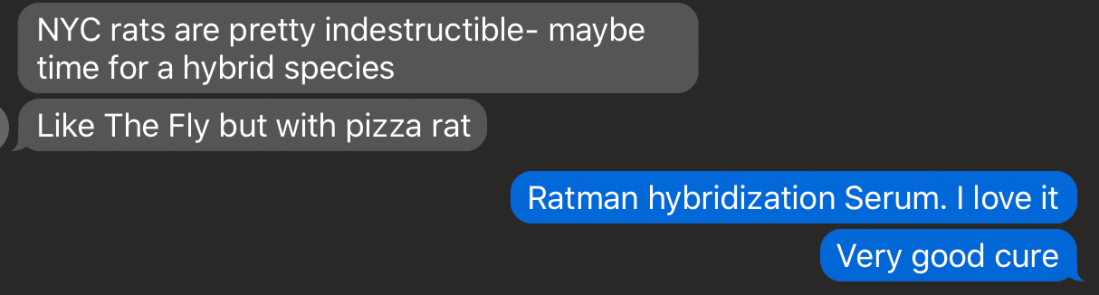
Ratman Hybridization Serum

Screen Shot 2020-04-27 at 5.58.06 PM.png
Friends and I came up with some promising COVID-19 treatments…

I’m feeling pulled in many different directions today. Always thoughtful, Brad Feld has a nice piece up –”The Disorientation of Exiting Phase 1” – about the transition to phased lifting of some social distancing restrictions. There were stories out of Wuhan that some people refused to come back out even once the city officially reopened, and I imagine we’ll all struggle with the step-by-step adjustments to come.

The New Yorker has a damning long article out about the failure of New York’s initial response to COVID-19 (spoiler: Mayor de Blasio comes out looking especially bad). On the flip side, ever schizoid in its programming, Radio Open Source joined the chorus of Cuomo hagiography this week.

Screen Shot 2020-04-27 at 6.02.51 PM.png
“[I]t would kill Covid technically…”
Talking Points Memo predicts a “A ‘Tsunami’ Of Business Bankruptcies” (as I did more than a month ago and about the risk of which in a pandemic, Larry Brilliant warned more than a decade ago); true to form, David Wallace-Wells has a piece with a sensational title in New York Mag (“We Still Don’t Know How the Coronavirus Is Killing Us”); and over the weekend, a “Heat Wave [Drew a] ‘Summer Day Crowd’ to [a] Southern California Beach.”

As the FDA continues to warn against the use of anti-malarials to treat COVID-19, the Indian state of Telangana (where I have family ties) has expedited permitting for the “bulk-drug manufacturers involved in the manufacture of hydroxychloroquine,” while the Indian Government continues, implausibly, to deny the existence of community spread in the country even as the number of confirmed cases in India approaches 30,000 against a backdrop of extremely limited testing.

Screen Shot 2020-04-27 at 6.18.41 PM.png
“Sorry to Bother You” spoiler alert! If equihumanism turns out to be the latest surprise symptom of COVID-19, that will truly be a bridge too far

I took note of the appointment of Richard Ravitch “who helped steer the city through the financial crisis of the 70s” to the Fair Recovery Task Force that the Mayor announced over the weekend. I’ve been planning to do another historical post – this one looking back at the cuts to public services in NYC that followed from that same “financial crisis” (itself largely precipitated by racist Federal housing and transportation policies, and by deindustrialization spurred by capital’s war on labor / search for wider profit margins) through the lens of Kim Phillips-Fein’s excellent, Fear City, the subtitle of which should make us all shiver these days: “New York’s Fiscal Crisis and the Rise of Austerity Politics.” I’m not encouraged to see no small business representation on the Task Force, and have reached out to the one member I know to express my concern.

In fact, sadly, it’s been a week for (further) loss of faith in our governments’ capacities to govern, with the idiotic circus and wholesale plunder continuing to churn in DC, and locally, my partner embroiled in largely time-wasting interactions with a Department of Small Business Services that is only too ready to partner with AmEx, and nothing but patience with the City’s ever-proliferating BIDs, but – when it comes to interfacing with actual small businesses – seems to regard them largely with contempt.

Screen Shot 2020-04-27 at 1.10.22 PM.png
The Governor rightly understood that what the City needs right now is a mock aerial bombardment

Anyway, enough of all that. I’d like to briefly revisit the numbers in view of some new developments. After an analysis of “deaths in excess of normal levels across 14 countries,” the Financial Times concluded that the “Global coronavirus death toll could be 60% higher than reported,” which reflects my own previous guess that the national and global death tolls are at least 50-100% higher than the official numbers currently reflect. That gap will likely only widen as the toll taken by the virus intensifies across the Global South. As it is, the estimate from the FT would put the current global death toll close to 350,000 and the US death toll close to the 100,000 I estimated yesterday.

Ironically, here in NYC, I think our death toll reflects a significantly lower undercount than do official death tolls in many other places; for a complex set of reasons including media concentration, our long history of public health excellence, and having been hit hardest first in the US (plus being the spiritual capital of the country), New York figures strike me as increasingly reliable. As we begin to have more provisional data on seroprevalence, we are then able to start to make some more reliable calculations.

IMG_5442.jpeg
The City sent me this alert, but I continue to believe the best way to “honor essential personnel” is to adequately pay, protect, and support them

This afternoon, the Governor announced results of an additional serology survey in New York State in which ~15% of people state-wide and nearly 25% of people in NYC tested positive for antibodies against SARS-CoV-2/COVID-19. (Unsurprisingly, only ~3% of people upstate tested positive.) I’m continuing to use 8 million as the current actual population of NYC at the moment, given how many New Yorkers of (some) means have fled the City, so that would suggest that approximately:

8 million * 1/4 = 2 million

people have already been infected, at some point, with SARS-CoV-2 in NYC.

According to the State’s data portal, there had been 12,287 confirmed COVID-19 deaths in NYC as of yesterday. According to the City’s data portal, there have been an additional 5,228 “Probable deaths.” According to my own basic math, and this helpful report from NYC Health, there have been ~3,500 additional “Still-ignored deaths” from COVID-19 (a figure at which I arrived by simply taking the number of “Deaths not known to be confirmed or probable COVID-19” from March 11th through April 26th – 11,138 – and then subtracting the estimated mortality for one and a half months – 7,500 – which latter figure itself likely reflects on overestimation; the method I’ve employed here, and previously, is basically the same approach the Financial Times used above).

Adding up, we get:

12,287 + 5,228 + 3,500 ~ 21,000

So to calculate a rough IFR, we now simply divide the number of estimated deaths by the number of estimated infections, which yields:

21,000 / 2,000,000 ~ 1%.

I would love for the world-class researchers who persist in insisting that the virus is far less deadly than it appears to be to make sense of this figure. Perhaps every New Yorker, more or less, has actually already been infected, and the serology tests miss those who were asymptomatic. (Even that scenario would put the IFR at ~0.25%.) Maybe New Yorkers are just so unhealthy that we’re dying in larger numbers. Or maybe those researchers should have been more circumspect before producing speculative work on a pandemic of a novel virus that was tailor-made to feed the engine of denialism. Only time will tell.

Remembering Not To Forget

A brief roundup of corruption and stupidity in the upper echelons of our country’s government, corporate, and media apparatus: The Intercept reports that small business relief money is going to business that are not small at all, but are connected with the President; on the subject of the President, the FDA reiterated its warning about the risks of using anti-malarials (read: the drugs chloroquine and hydroxychloroquine which the President has been regularly promoting, without evidence, since well before he started encouraging the people of this proud country to “inject” bleach) to treat COVID-19; not only is Amazon abusing its workers, but evidently, its also circumventing restrictions on non-essential construction in Greater DC while Bezos’ Washington Post looks the other way; all its pious protestations aside, Facebook continues to promote “pseudoscience” in the name of driving ad revenue; in New York, The Indypendent reports that “As [the] Virus Spreads in Nursing Homes, Gov. Cuomo’s Big Donors Are Immune from Liability”; circling back to bleach, the wife of the brother of that same Governor has been encouraging followers of her “health and wellness platform” to bathe in that caustic household cleaner (as is so often the case, The Onion is both ahead of the curve and painfully hard to differentiate from our absurd reality – thanks to the Tech:NYC newsletter for sharing); and, in a gesture of supreme idiocy, the New York Times opines –in concluding that “The Nude Selfie Is Now High Art” – that “It has become [the nude selfie that is] a way to seduce without touch”; my god! What the fuck did they think it was before?

Okay, dispensing with all that, a brief look at some basic facts as we prepare for a new week. The Hopkins tracker has the US COVID-19 death toll approaching 60,000 as our national confirmed case count approaches 1 million – which, to borrow a framing often used in characterizing the obscenity of our military spending, exceeds the case counts of the five next “leading” countries combined. Some readers will recall that barely two weeks ago, the proclamation of Dr. Anthony Fauci that total US mortality might “only” hit 60,000 was lauded with much optimism, and yet, here we are, two weeks later – with Georgia already “reopening” and other states run by sociopaths considering doing much the same – still in the early days of pandemic, and already on the verge of officially passing that count. Dean Baker rightly asks: “Can We Stop Using the 60,000 Death Projection Number?”

As started to be reported early in the week, and The Washington Post now confirms, “Young and middle-aged people, barely sick with covid-19 [sic], are dying of strokes”; I’ve written at length elsewhere about the tragic number of people across the City and the country who have been dying at home from this disease, and revelations about its pathology give further insight into this sad phenomenon. Owing to immigration status, poverty, lack of (sufficient) health insurance, fear of hospitals – which increasingly look like death traps – and a host of other factors, people have been reluctant to seek care, but the risk of sudden death from COVID-19-related heart attack and stroke obviously heightens the likelihood that people will die without ever seeking medical attention.

I’ve also written elsewhere about the certainty that official figures reflect a vast undercount, both of the number of infections and the number of deaths from this disease. We know public health systems have been gutted both globally and across the US. We understand, further, that politicians have zero incentive to count any more of the dead than they absolutely must. Based on the experience in New York City, I think it’s fair to approximate a 50-100% undercount for the US at the moment, and to make the math easy, I’m going to guess that 100,000 people have already died of COVID-19 in the United States, official figures be what they may.

Ahh, but we also know that case and infection fatality rates (CFR and IFR; this Wikipedia entry differentiates between the two) have also been drastically overstated owing to consistent under-testing and the large number of asymptomatic cases. As I’ve written elsewhere, I think current best estimates put the IFR somewhere between 0.6% and 1% (with an asterisk regarding the possibility that some/many asymptomatic individuals never seroconvert). Using 100,000 as the current US death toll, that would put the total number of US infections to date (say a week or two ago, given the lag between infection and mortality) at between:

100,000 / 0.01 = 10 million and 100,000 / 0.006 ~ 17 million.

Current US population is ~330 million, which – if everyone infected does seroconvert – would put the current seroprevalence in the US at between:

10 million / 330 million ~ 3% and 17 million / 330 million ~ 5%.

I’ve been railing for some time against people – including some with far more expertise than myself – who without being outright COVID-denialists, have mobilized preliminary data in ways that I’d call dishonest to downplay the significance of the threat posed by the disease. Now, taking the high-end of the above range (because it will lead to a lower overall mortality estimate when extrapolated out) we’d expect total nationwide mortality of:

100,000 * 20 = 2 million

were every person in the US to become infected. If, say, “only” 40-60% of people in the US became infected, this line of reasoning would predict total nationwide deaths between:

100,000 * 8 = 800,000 and 100,000 * 12 = 1.2 million.

There are so many unknowns and assumptions built in here I almost don’t feel comfortable putting these numbers out there, but given that preliminary (and widely/rightly-critiqued) serology/antibody surveys are giving results roughly consistent with these prevalence figures (with even hardest-hit NYC showing ~20% prevalence, and communities in California showing ~3-4%), I think it’s fair to estimate that a single-digit percentage of residents of the US have been infected with SARS-CoV-2 to date and that at least a high five-digit number of those people have died from their infections. Even assuming the nationwide rate of infection is already 10%, and using the current figure from the Hopkins tracker of ~55,000 deaths, we would expect hundreds of thousands, and perhaps as many as half a million total COVID-19 deaths in the US by the time we are finally on the other side of this. (Here’s annual US mortality data by cause from the CDC for comparison; in 2017, two leading causes of death, heart disease and cancer, both killed ~600,000 people.) These numbers, in turn, start to look very much like the early “worst-case scenario” predictions which beg the question: What is our scenario now?

The WHO is warning against the introduction of “immunity passports,” stating bluntly: “There is currently no evidence that people who have recovered from COVID-19 and have antibodies are protected from a second infection,” which basically puts us back where we started – at actually committing to public health and the hard work of non-pharmaceutical interventions while we wait and see if an effective vaccine emerges. Other countries, localities, and past versions of our own City have proven that such measures pursued with diligence, sufficient funding, and public buy-in can be highly effective. Let’s commit to that world starting some time ago.

And speaking of public health, this webinar from the American Public Health Association is great. As a New Yorker, I especially enjoyed being so impressed with Jill Taylor who runs New York’s Wadsworth Center, but the whole slate of speakers, and indeed, the whole webinar series has been tremendous. From David Dayen’s daily COVID-19 newsletter, Unsanitized, I learned that the man in the already legendary viral video “A Message to the Government” (to which I linked yesterday) is none other than Vic DiBitetto (aka, Ticked Off Vic). Vic and I don’t see eye to eye on everything, but I thank him for his remarkable contribution to sane discourse in this country.

Fridays for Future (the global movement which has grown out of the work of Greta Thunberg) just put out this (perhaps Billie Eilish-inspired) ad – “Our house is on fire” – that I encourage everyone to watch. To state the obvious, it centers climate crisis and our collective state of (passive) denial, and I suspect it will make your hair stand on end.

Finally, please don’t go crowing, “We are the virus!” or invest any undue optimism (regarding the long-term trajectory of the Earth’s climate system) in the short-term improvement in air quality (as global atmospheric concentrations of carbon dioxide have continued to rise since the pandemic hit), but I was pleased to see New York City add an “Air quality during COVID-19” page to its official data portal. Unsurprisingly, the quality is better, and that, at least, is something that we can all enjoy.