Opiates Are the Opiates of the Masses

In a piece in Nature Climate Change – entitled “Transformative change requires resisting a new normal” – on the devastating bushfire season just ended in Australia, Lesley Head writes: “Rhetoric resisting the economic cost of transformation sounds hollow against estimates of the actual cost,” and while Head goes on to finish that sentence “of the fires,” we could just as easily replace that phrase with “of the pandemic.”

Rhetoric sounds hollow: That could easily be the tagline for this entire disastrous presidency of which we all now find ourselves victims. In New York State, Governor Cuomo has announced that we’re “past the high point,” while writing for FAIR, Jim Naureckas questions, “Is the Coronavirus ‘Peak’ a Mirage?” In critiquing the IHME models which have become ubiquitous in recent weeks, Naureckas points to the example of Italy, in particular, which, rather than a peak, hit, instead, a long grisly plateau, the likes of which it seems we are currently on here in New York City.

Maybe Cuomo’s avoidance of the word “peak” was intentional?

The Atlantic writes – in a piece shared with me by my friend Adam in North Carolina – that “Nobody knows the true number of Americans who have been exposed to or infected with the coronavirus.” ProPublica coverage reveals the staggering number of people currently dying at home, not just in New York City, but across the United States, their deaths largely excluded from official COVID-19 death tolls. World-famous doctors are polling Twitter as to what “the seroprevalence rate is in NYC”.

Obviously, we have no real idea what our current predicament even is, and while it feels a little rich for Dan Doctoroff to opine on how “to build a more inclusive and sustainable city” in the wake of the pandemic – the same Dan Doctoroff who, as a deputy mayor under Michael Bloomberg, did more to drive inequality in New York City in the 21st century than perhaps any single person other than Bloomberg himself, and who is now the Chairman and CEO of Sidewalk Labs, a kind of Google-owned think tank for the techno-utopian peak-neoliberal metropolis – Sidewalk’s Eric Jaffe does have this interesting piece out on what went wrong in Pittsburg during the influenza pandemic of 1918-1920 (and not 1917, as the President persists in claiming). Long story short: Pittsburgh waited too long to take action; ignored scientific evidence; took too little action when it did finally respond; and suspended its measures far too quickly, all of which resulted in Pittsburgh having the highest death rate, during that prior pandemic, of any US city.

Jaffe calls this Pittsburgh case study a “cautionary tale,” and given our precarious current moment, indeed it is. Astoturfed into outrage (and credit again to Adam in NC for this interesting thread suggesting that, like the Tea Party before it, this anti-lockdown movement is less a spontaneous popular uprising and more a carefully-orchestrated manifestation of corporate power and mass gullibility), sometimes-automatic-weapon-toting protesters are calling for the lifting of anti-pandemic measures in (Democratically-led) states across the country, while a number of Republican governors – most notably in Florida and Texas – are already moving to lift restrictions meant to limit the spread of COVID-19.

It’s a whole lot of idiocy for which we’ll all pay a price, but some of us much more than others, for even as the “past the high point” narrative gains momentum in New York, so too does the spread of the virus in New York’s prisons. New York Mag reports that “The White House Has Erected a Blockade Stopping States and Hospitals From Getting Coronavirus PPE”, while The Intercept points to attempts by the processed food mega-corporation Smithfield to cover up evidence of the spread of COVID-19 at a processing plant in Wisconsin and to pressure workers to continue working under unsafe conditions. Our industrial food system is failing – with food rotting in the fields, but food shortages at the stores, and huge numbers of US residents queuing up for food aid, while “essential” workers across our long food supply chains fall sick – just as our for-profit healthcare system is a scandal – with hospital consolidations delivering lower quality care at a higher price while hospital executives make record salaries.

It’s become commonplace in recent weeks to talk of the US as a failed state, a fact I find both understandable and deeply worrying, and while I could go on at length here, I have dinner to make, so I’ll end where I started, in reflecting on the immense costs of the pandemic relative to “the economic cost of transformation,” and in looking – as this JAMA piece, from which the following quote is drawn – for “Opportunities for a Better Normal”:

Estimates suggest that the growth rate of the US gross domestic product (GDP) will decline 5% for each month of partial economic shutdown; with only 2 months of shutdown, the pandemic is estimated to cost the US more than $2 trillion. Facing an extraordinary opportunity cost of remaining closed, the US must finance the critical investment in public health required to safeguard well-being and avert the personal and financial tolls of future pandemics.

I’ll again paraphrase, but now in the reverse direction, for that last sentence could just as easily read: “Facing an extraordinary opportunity cost of remaining [in denial], the US must finance the critical investment in [climate adaptation and mitigation] required to safeguard well-being and avert the personal and financial tolls of future [civilizational collapse].” Pandemic and climate are crises moving on radically different timelines, and yet, in the former, we can see foretold a terrifying story of what the latter – in the absence of drastic, once-in-a-civilization action – portends. In the case of pandemic preparedness, I’ve read elsewhere that $2 trillion would’ve been enough to cover all public health needs globally for a decade (the source escapes me now, but is linked in a previous post). In the case of climate action, $2 trillion would be a nice if (very) modest start.

Relative to the urgency of climate action, Sharon Lerner has another great piece on plastics – this one subtitled, “As Africa Drowns in Garbage, the Plastics Business Keeps Booming” – up at The Intercept, while, on a brighter note, this sweet, short piece from Laura Gao – to which I came through our friends at Culturework – reminded me of why I fell in love with Wuhan during the week I spent there in 2004.
 

When the City Breathes Again, I’ll Breathe Again, Too

As I’ve mentioned previously, I’ve been reading roughly 10 pages a day of Giovanni Boccaccio’s Decameron as one way of keeping time during the shutdown here in New York City. (Given that my copy is only 562 pages long, but that it took Wuhan 76 days to re-open, I’ve now grown lax with myself about missing a day of reading here or there.) The Decameron is truly a book for our time though. Set against the backdrop of the devastation wrought by the Plague in Florence, it is largely made up of one hundred short stories (ten stories told per day over the course of ten days by ten rich young people who have decamped together from Florence for one after another of their lavish country estates), and although I picked up my used copy years ago – I think from the crunchy old Left Bank Books on Hudson – out of interest in Boccaccio’s famous opening pages, which proceed roughly in the following fashion:

In the year 1348 after the fruitful incarnation of the Son of God, that most beautiful of Italian cities, noble Florence, was attacked by deadly plague. It started in the East either through the influence of heavenly bodies or because God’s just anger with our wicked deeds sent it as a punishment to mortal men [sic]; and in a few years killed an innumerable quantity of people.

The book itself deals vanishingly little with the Plague – preferring, as do its young protagonist, to tell tales of adultery, intrigue, adventure, outrage, hijinks, mistaken identity, and all the rest – which make passing references on page 316 (“The Bishop saw a young woman, who has since died in the present plague…”) and page 335 (“You know that owing to the misery of the times, the judges have deserted the tribunals, the laws both human and divine are silent, and full license is granted everyone to save his [sic] own life.”) the more startling. Fittingly, it is a book which trembles in the nascent fiction of a certain canon between the Medievalism of Chaucer and Dante, and the rambunctious, semi-secular modernity of Rabelais, Cervantes, and Shakespeare.

Now – in our ailing condition of late-capitalist hypermodernity – thank goodness, at least that our current pandemic hasn’t led to quite the degree of suffering and collapse brought on by the Plague that ended Europe’s Middle Ages. Still, we can hope for endings and new beginnings from the global ravages wrought by this novel coronavirus as well.

In recent weeks, I’ve revisited the impacts of and responses to the first cholera epidemic in New York City (1832) and the last great flu pandemic, which hit New York in 1918. Yesterday’s post centered a remarkable chart from NYC’s Department of Health and Mental Hygiene, showing the annual mortality rate for the City from 1800 through 2017 – a few striking key takeaways included: Beyond yellow fever, smallpox, and all other infectious diseases, cholera was far and away the great epidemic killer in New York in the 19th century; after the creation of the Board of Health in 1866, and especially following the introduction of  targeted public health interventions (based on breakthroughs in scientific medicine) starting around 1890, the annual death rate in New York City declined drastically from a baseline of around 25 deaths per 1,000 residents to a rate of ~10 deaths per 1,000 which held steady through much of the 20th century; and – although each horrific in its own way – the flu pandemic of 1918-1920, the Great Depression, NYC’s 1970s fiscal crisis, the AIDS Crisis, and September 11th all did comparably little to increase the annual death rate (until the onset of COVID-19, below 6 per 1,000 residents) relative to the staggering progress attributable to the public health advances of the late 19th and early 20th centuries.

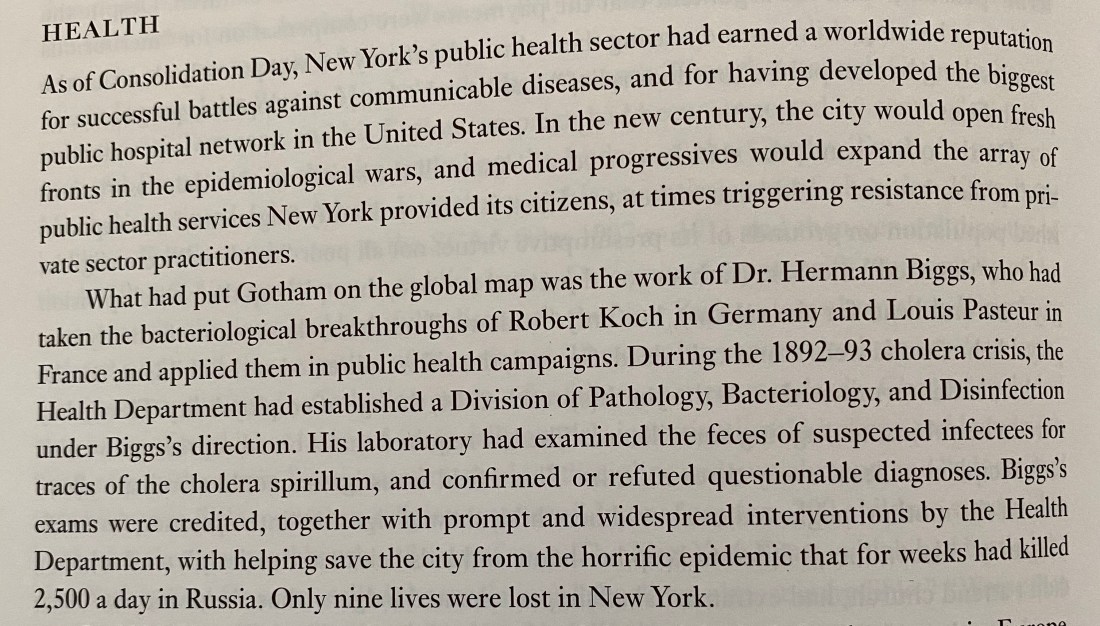
So what were those advances? Glad you ask. I’ve leaned heavily on the work of eminent New York City historian Mike Wallace (and his late collaborator, Edwin G. Burrows) and, one last time, will do so again today. Rather than focusing on a particular disease/outbreak this go-around, however, I’m going to revisit, with some brief comments, some of those advances as outlined by Wallace (from page 544 to 560) of his incomparable Greater Gotham. With no further ado:

IMG_5399.jpeg
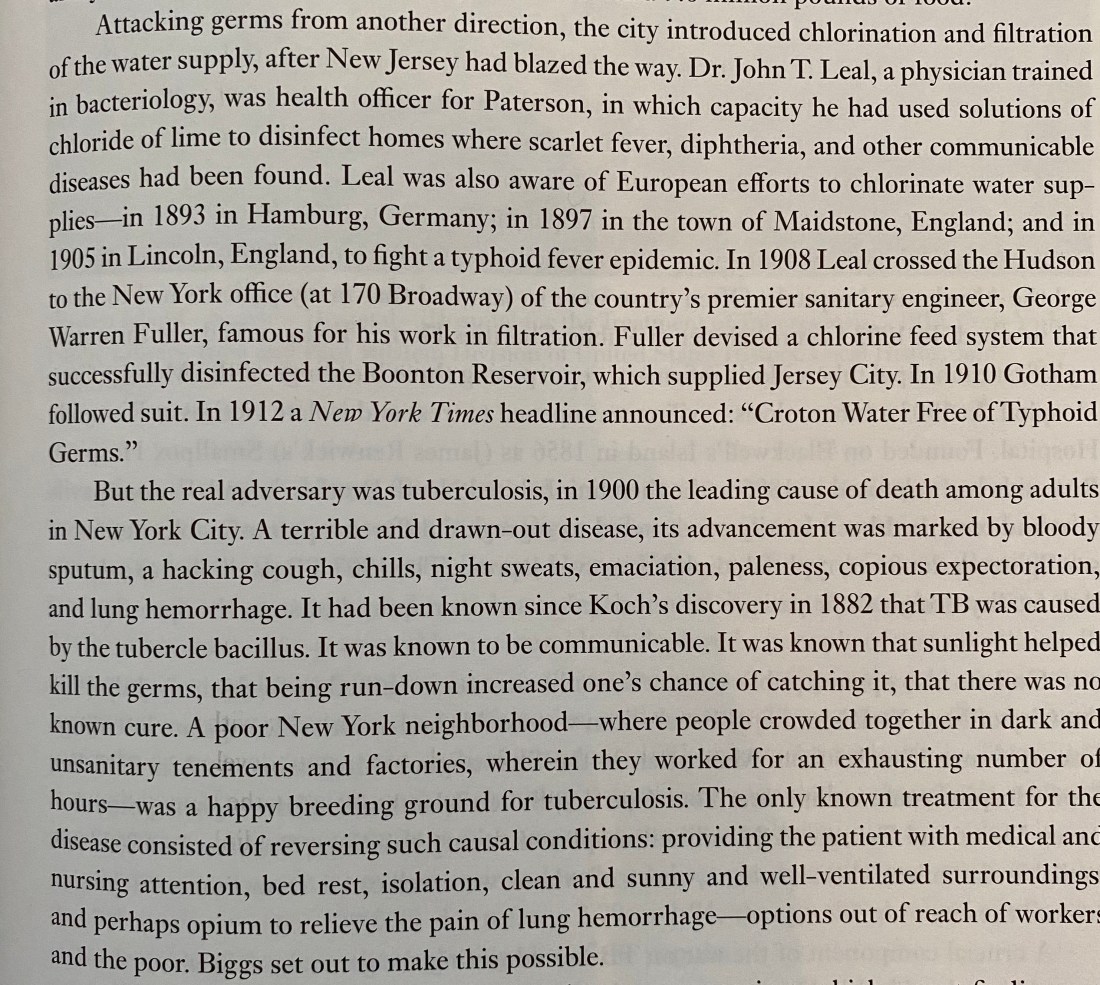
Following a European Lead, New York Emerges as a Global Leader in Public Health

Louis Pasteur and Robert Koch were towering figures in the early history of scientific medicine, and it’s a shame that figures like Dr. Herman Biggs are not more widely remembered and celebrated for their transformative work in New York City. As yesterday’s post highlights, cholera was the great epidemic killer of New Yorkers in the 19th century (for context, no other disease caused the annual mortality rate to spike much above 30 deaths per 1,000 residents; on three separate occasions, cholera epidemics led to spikes in the death rate to ~50 deaths per 1,000, which is to say, 5% of the City’s entire population dying in a single year), and yet, we see above that the work of Dr. Biggs stopped cholera in its deadly tracks; in fact, after 1893, cholera would never again appear in epidemic form in New York City.

IMG_5400.jpeg
Clean Water and Clean Food Save Lives

So thoroughly do we take these facts for granted, that we tend to be rather shocked and outraged when water and food are not “clean” in New York City today, though, of course, there is both a class component to this expectation (as recent revelations about widespread water system-related lead poisoning across the United States make clear) and a growing threat from our industrial food system and the petro-agro-chemical complex to the safety of our food and water supplies (as evidenced by regular national outbreaks of salmonella, E. coli, etc. and by the increasing prevalence of herbicides, pesticides, and “forever chemicals” in water supplies across the country).

IMG_5401.jpeg
Public Health through Infrastructural Improvements and Community Engagement

I’ve written elsewhere that anti-vaccine sentiment is only possible in a post-vaccine world (logically, perhaps, but also owing to the privilege of a population that no longer lives in fear of many deadly diseases) and that “conquest” of diseases like tuberculosis in the rich countries allows most people in the United States to ignore the fact that tuberculosis is still the leading infectious cause of death globally. Similarly, while there are valid criticisms of chlorination of water supplies, I’d argue they should always start by affirming the inviolability of access to clean water for all.

IMG_5403.jpeg
Disease Surveillance and Contact Tracing Work

This one speaks for itself. As a friend in Bombay wrote yesterday, with some exasperation, regarding the effective response to COVID-19 in the (communist-led) South Indian state of Kerala, “I don’t know why we behave like it’s so tough to do that in India.”

She’s exactly right. Approaches to problems like those we face today in the US, in India, and across much of the world were worked out more than a century ago, and continue to prove effective at present – as has been amply documented and pointed out – in places like South Korea, Taiwan, Singapore, and Hong Kong.

IMG_5404.jpeg
Community Health Works

Again, mostly self-evident, though I’ll note that, in New York in the early 19th century, as in New York today, women were often at the forefront of care work and the implementation of sane, holistic models for health.

IMG_5405.jpeg
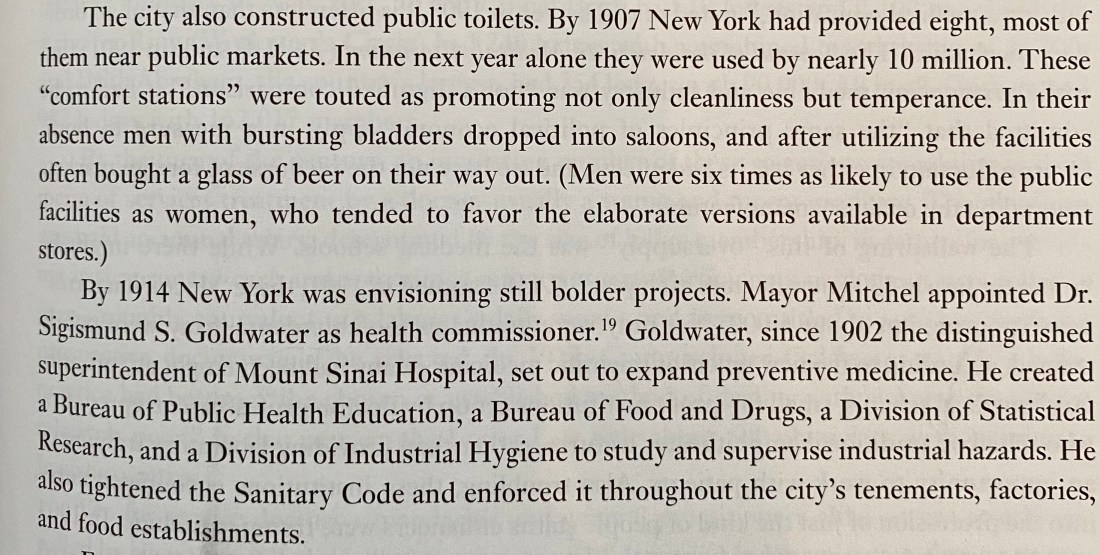
Public Toilets Are (Still) a Good Idea

The more things change, the more they stay the same. The (public) money we spend (collectively) on good, clean, well-maintained public toilets yields returns multiple fold over in the form of urban cleanliness, public hygiene, and the peace of mind from which we all benefit in living in a humane society.

IMG_5406.jpeg
Private Medicine Undercuts Public Health

For readers interested in a dry, very-deep, but illuminating dive into the struggle between private medicine and public health in the United States, I recommend Paul Starr’s The Social Transformation of American Medicine which I read in college under the guidance of the cantankerous, good-hearted, now-late Joel Schwartz, a model of humane thinking if ever there was one.

IMG_5407.jpeg
Consolidation of the Wealth, Power, and Institutions of Private Medicine

“The sea change,” in question was the Flexner Report of 1910 that led to a complete overhaul of medical education and licensing in the US, and the publication of which marked a watershed moment in the establishment of the prestige and power of the medical profession in this country.

IMG_5408.jpeg
Scientific Medicine and the Corporate Hospital

This selection is notable for the light it sheds on early corporate consolidation, shifting class dynamics, and gendered labor relative to New York City’s major hospital networks which – consolidations notwithstanding – remain largely unchanged from more than a century ago.

IMG_5410.jpeg
Public Health / Private Reaction

The reactionary power of the private medical establishment has done a great deal to undermine public health in the United States. No clearer example of this fact can be found than in the short paragraphs above starting, “Doctors fought,” “Doctors opposed,” and “Doctors denounced”; incidentally, NYC doctors also fought to prevent the implementation of widespread diphtheria inoculation, then, when it proved effective, fought to prevent this inoculation from being provided free/at low cost as a public good, claiming this would undercut the profits of private medical practitioners.

IMG_5409.jpeg
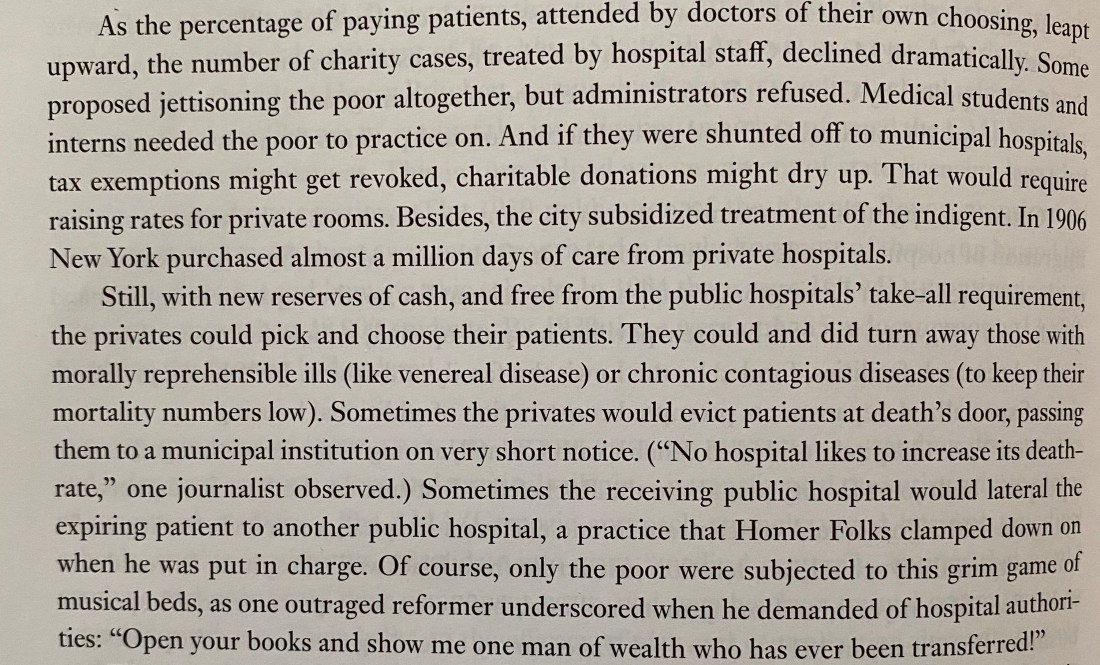
Public Subsidies, Private Profits

Wallace’s observation that “Medical students and interns needed the poor to practice on,” reflects a long, shameful, often racialized tradition in US medicine that has been amply documented by Harriet Washington, and evidence of which can be found in the sadistic work of J. Marion Sims – “the father of modern gynecology” – of whom the statue was, at last, removed from Central Park not so long ago. The testing of the birth control pill on poor women in Puerto Rico, and the recent proposal by a French scientist to test potential COVID-19 vaccines on the poor in Africa both reflect this same callous spirit evinced by privileged researchers for the lives of others.

IMG_5411.jpeg
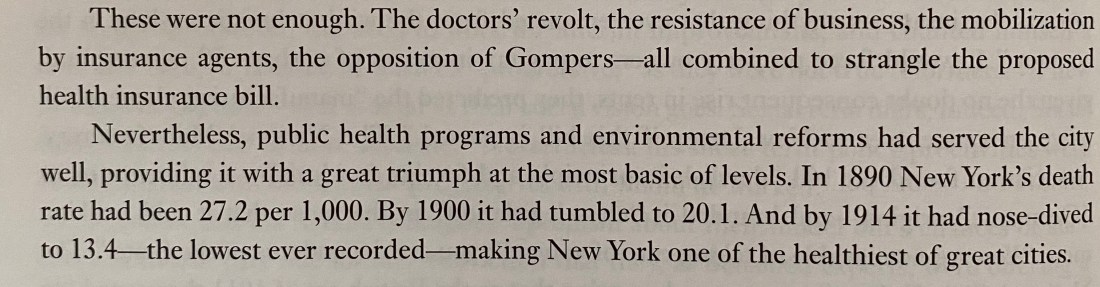
The Triumphs of Public Health Live On!

As I wrote yesterday, “we, in settler-colonial New York City, are at once descendants – or at least inheritors – of a grisly legacy of violence, and beneficiaries of an almost unimaginable history of progress.”

As we chart our way out of this mess, we should be looking to the lessons of the past to shape a better future. We’ve come a long way, have a long way to go, and have both the benefit of lessons – good and bad – from which to learn and the resources and understanding to do so much more than is currently being done in the name of justice, sanity, and public luxury.


Counting Whom, Though?

The Conquest of Pestilence in New York City.png
Drawn from the “SUMMARY OF VITAL STATISTICS 2017 THE CITY OF NEW YORK” of the BoVS of the NYC DoHMH

It’s a drizzly Saturday in New York City, and I plan to spend the day with my partner. We have a Zoom brunch scheduled with friends, one of whom is an ER doc. Maybe the sun will burn through once in the afternoon. We can hope.

Given my plans, today’s piece will be relatively short, but in this short piece, I will center the remarkable image above. Meditate on it please and take a minute or two to tease out its obvious features and key trends. As you can see, between 1800 and 1890, baseline mortality seemed to vary between 20 and 25 deaths per year per 1,000 residents with the rate often spiking closer to 30 in epidemic years, and spiking three times close to 50, in each instance, during a cholera outbreak. We see further that from the time of the creation of the Board of Health and Health Department in 1866, there is a clear, steady decline in the mortality trend until around 1930, whereafter – even with the Great Depression and World War II – mortality leveled off at around 10 deaths per year per 1,000 residents until roughly 1990.

This simple graph represents a human triumph of staggering proportions. During the life span of a single person, the death rate in New York City was cut at least in half, all – essentially – through public health interventions (note a few mentioned above) though aided, of course, by the emergence of modern pharmaceutical medicines such as antibiotics.

As is pointed out in the image, the AIDS crisis – still, today, in its pandemic form, a global tragedy of awful proportions – and the attacks on September 11th, 2001 are both barely visible, and in fact, if anything, appear as minor upward blips in the otherwise gently downward trend that persisted from 1990 until around 2010, probably owing to shifts in habits around diet, smoking, and exercise, though perhaps also attributable to the City’s renewed financial “health” (although, surprisingly, no mortality spike appears in the aftermath of the City’s mid-1970s fiscal crisis/de facto bankruptcy). It seems like there has been a renewed leveling since the Global Financial Crisis – and perhaps the impact of the opioid “epidemic” will only show in years after 2017 – but, even so, the Bureau of Vital Statistics of the New York City Department of Health and Mental Hygiene reports that the city-wide mortality rate for 2017 was 545.7 or less than 6 people per thousand, so roughly one quarter of the prevailing rate through the 19th century.

A few additional observations: We see that yellow fever, small pox, the measles, scarlet fever, typhus, diphtheria, and meningitis were all capable of exacting brutal human tolls on the pre-germ theory city, but that cholera stands out as the great scourge of 19th-century New York City. Although a much bigger killer in terms of raw number of deaths (owing to the much larger population of the City in 1917 than in the mid-1800s), the flu pandemic of 1918-1920 inflicted a slight fraction of the death toll of the worst cholera outbreaks on a percentage basis. Hard to imagine, but in the three worst years of cholera in the 1830s, ’40s, and ’50s, roughly 5% of the City’s population died. Of course, only 2-3% out of that 5% were actually attributable to cholera, but imagine if between 175,000 and 250,000 New Yorkers were to die of COVID-19 – that’s what that would mean on an equivalent basis today.

(Incidentally, it should fill our hearts with sadness and shame that – owing to a war waged in our names – this dread disease, cholera, which has been banished from our shores for more than a century is currently ravaging Yemen (and that it previously ripped through a Haiti wrought vulnerable, yes, by natural disaster, but even more so by two centuries of vengeful French and US policies of neocolonialism). Since the start of the US-backed Saudi-Emirati War on Yemen, at least 1.3 million people have contracted cholera of whom at least 2,500 have died – the latter figure, both heartbreaking and yet a clear sign that, even in the midst of conflict-driven social/infrastructural collapse, the people of Yemen are likely receiving much better healthcare than did 19th-century New Yorkers.)

We don’t have to look all the way to Yemen, though, to see the ravages of health disparities wrought by injustice; here in New York City, while wealth and access to COVID-19 testing clearly correlate, so too, likely, do dying at home from this disease and lacking proper immigration status. This interview on Democracy Now! with ER nurse and labor activist Sean Petty marked the first time I’d heard it suggested publicly that undocumented people likely make up the majority of those dying at home in New York City from COVID-19, and while we currently lack data to confirm this grim conclusion, this points to another clear reason why a proper accounting of the death toll is so crucial as we start to move forward. Undocumented New Yorkers are estimated to make up between 6 and 7% of NYC’s population. If even half of the people who have thus far died at home have been undocumented, then undocumented people are dying at a rate disproportionate to their numbers, and the true toll is probably significantly worse (as we look to how hard hit has been immigrant and service sector-heavy central Queens).

From rural meatpacking plants to the New York City public schools; from elite US universities to authoritarian governments (both seizing the opportunity of the pandemic to further persecute/criminalize dissent); from politicized pandemic response from our ignoramus-in-chief to increasingly captive regulatory bodies and cowed Federal agencies afraid (as the Good Germans must have been) to acknowledge obvious scientific truths; from Bezos’ Amazon firing workers of conscience for speaking out to the New York Times continuing to give the blowhard David Brooks a platform; from the financial press reporting credulously on our elected executives to the scientific press failing to properly scrutinize Big Pharma (note, what’s reported on in the linked piece are results of Gilead’s own clinical trials); from the insistence of much of our media and political classes on using bellicose rhetoric to characterize public health efforts that are about life-saving, not life-taking to the already present convergence of climate crisis and pandemic that menaces much of the Global South, one need not look any farther than any given day’s news to see the profound state of corruption, despair, hypocrisy, contradiction, and injustice which have been surfaced by COVID-19’s global spread, but – in perhaps slightly less egregious forms – have been with us all along.

At the same time, everywhere, we find reasons for hope: In Colorado Governor Jared Polis confronting anti-Semitism and reaffirming our interdependence; in Michael Che honoring his late grandmother (who died of COVID-19) by offering to pay rent for 160 NYC families; in the hundreds of thousands of New Yorkers who plan not to pay rent altogether as part of a massive, coordinated rent strike launching May 1st; in the work of scientists, technologists, and policy people to chart a path out of our current state of paralysis by massively ramping up speed and availability of testing; to the healthcare workers and hospital support staff putting their lives on the line everyday to care for the sick; to the heroism of MTA train operator, Garrett Goble, who died after helping to evacuate passengers from a train car that was consumed by flames in what seems to have been a shocking act of arson.

I look at the image at the top of this page, and recognize that we, in settler-colonial New York City, are at once descendants – or at least inheritors – of a grisly legacy of violence, and beneficiaries of an almost unimaginable history of progress. As the deaths of all those New Yorkers who have died at home in recent weeks – alone, afraid even to seek medical attention – lay bare, we have only progressed so far, but even should COVID-19 kill not the ~16,000 New Yorkers it has to date, but ~50,000 New Yorkers (effectively doubling the annual rate of death) that would still only make the city-wide mortality rate for 2020 roughly equal to the average rate that held throughout much of the 20th century.

We have come a long way, and yet, we have a long way to go, and rather than hand-wring on the one hand, or disingenuously celebrate all our successes (a la Steven Pinker) on the other, we should be asking ourselves – given our great fortune to be heirs to proud traditions of public health and public-minded science – what type of world can we make if we set our minds, our immense resources, and – with tongue only half in cheek – our lives, (public) fortunes, and sacred honors to building the sane, just world that, today, trembles just the other side of the possible?

Words Mean Nothing

The above was my partner’s belated response to a story told us by a friend during a FaceTime happy hour yesterday evening. Someone our friend knows lost her husband. He’d refused to go to the hospital even though his wife works at one. In the evening, she urged him to go to the emergency room; the next morning, she woke up and he was dead beside her in bed.

In confronting the grief that is now ubiquitous in New York City, I agree with my partner’s assessment – sometimes: “Words mean nothing.”

But for confronting the social and political dynamics underlying that grief, words are essential, which is why I keep on writing. Picking up where we left off yesterday, the Mayor acknowledged (actually, to his credit, before I wrote the piece, though I only came to reportage on his comments after the fact) that – in addition to the confirmed deaths that the City has been counting for weeks (~7,600 according to the City; nearly 9,000 according to the State); and the probable deaths that the City began to include in the COVID-19 death toll a few days ago (~4,000 at present) – the 3,000+ additional deaths above baseline since the pandemic’s onset in NYC that, so far, are being categorized as “not known to be confirmed or probable COVID-19” (and which I’m calling “Still-ignored deaths“) should also be considered COVID-19 deaths. As the Mayor put it, this seems like “obvious truth,” and, on that point, I agree with him.

Let’s say that – adding up the State’s updated figure of ~9,000 deaths, with the ~4,000 probable deaths the City is acknowledging, and the ~3,000 unaccounted for deaths that both City and State continue, for now, to ignore – that the total NYC COVID-19 death toll to date has been ~16,000. The current population of NYC is ~8.5 million, though – with all the rich people who have decamped for the Hamptons, the Berkshires, Florida, Maine, etc. to wait out the pandemic and, having inadvertently vectorized themselves, spread the disease – the number of people actually resident in NYC at the moment is likely appreciably lower. I’m going to use 8 million for mathematical convenience given that plenty of uncertainty and rounding are already baked into these numbers.

To put things really simply, 1/1000th of 8 million is 8,000, and 1/1000th is equivalent to 0.1%, which is also approximately the case fatality rate for the seasonal flu. That doesn’t mean that 8,000 people die in New York City each year from the flu though, because not everyone gets the flu. In fact, the City estimates that roughly 2,000 people die each year from the flu in NYC, which suggests that ~25% or 1 in 4 New Yorkers have symptomatic cases of the flu each flu season. (I bring up influenza because of all the lies we were told comparing COVID-19 to the seasonal flu.) To put things in perspective, the seasonal flu kills approximately 1 out of 1,000 people who suffer symptomatic infections each year in NYC, and seems to infect, on average, perhaps 1 out of every 4 New Yorkers, so ~1 out of every 4,000 New Yorkers dies each year from the seasonal flu. Just to show that math:

1/1000 x 1/4 x 8,000,000 = 2,000

which obviously involved a lot of rounding and simplification, but gives us the ~2,000 seasonal flu deaths per year figure that the City points to.

Okay, so if 16,000 people have already died in NYC thus far from COVID-19 – with the daily death rate still plateauing at a rate near 500 deaths per day – we can see that ~8x as many City residents have died already, in about one month, from this disease as die, on average from the seasonal flu per year; however, we also have no real idea, as yet, what fraction of the City’s population has been infected by SARS-CoV-2. I’ve recently pointed to data on infection rates in birthing people in NYC to suggest that perhaps the cumulative infection rate to date among NYC residents is ~15-20%, but that’s highly conjectural.

Still, using the 20% figure, we could work backwards and say that if 16,000 people have already died, and 1 out of 5 New Yorkers has been infected, that means that (still using 8 million for convenience), 1.6 million people have been infected out of whom 16,000 died, which gives a 1% infection fatality rate:

8,000,000 x 1/5 x 1/100 = 16,000.

(The difference between case fatality rate and infection fatality rate is that the former only counts symptomatic cases, which is how the CDC seems to approach their seasonal flu data, while the latter includes all people who have been infected, even those who were asymptomatic; in the case of our current COVID-19 predicament, infection fatality rate may be the more meaningful figure, as we work towards getting out of this shutdown, but there remain many unknowns, including if reinfection is possible in general, and if those who have been asymptomatically infected will have sufficient antibodies to protect them from reinfection in particular. I learned all this at COVID University!)

To the extent that some people experience asymptomatic infection, infection fatality rate should always be lower for a given disease than case fatality rate (because you’re dividing the same number of fatalities by a larger denominator of people), so if these back-of-the-envelope numbers give an infection fatality rate of ~1% for COVID-19 as compared to a case fatality rate of ~0.1% for the seasonal flu, we could guess that the former is at least 10x more deadly than the latter; however, lack of adequate testing capacity and, hence, our utter lack of knowledge about the total number of infections to date in NYC makes it next to impossible to have any faith in these numbers. What if it turns out I’m badly wrong, and fully 50% of New Yorkers have already been infected with SARS-CoV-2? Paradoxically, if it turns out that those of us who have been infected have some degree immunity, a 50% cumulative infection rate to date would be good news and bode well for the “reopening” of the City. It would also yield a significantly lower infection fatality rate.

Even with all that said, though, now that we can say relatively conclusively that at least 16,000 NYC residents have already died from COVID-19, even if the entire population of the City had already been infected with SARS-CoV-2, that would still yield a 0.2% infection fatality rate, and a case fatality rate significantly higher, given that studies are increasingly suggesting that perhaps as many as 4 out of 5 SARS-CoV-2 infections are asymptomatic.

(Eg, even if the entire population had been infected already, and 16,000 people have died, with only 1 out of every 5 cases symptomatic, that would actually still yield a case fatality rate of 1% – that is 1 out of 100 people with symptomatic cases dying – even though the infection fatality rate would be 0.2% because:

8,000,000 x 1/5 x 1/100 = 16,000.)

All to say, analyses like this one from John P. Ioannidis of Stanford have not aged particularly well. I agree with Ioannidis’ assessment from mid-March that: “If we decide to jump off the cliff, we need some data to inform us about the rationale of such an action and the chances of landing somewhere safe.” But the dismissive angle he took (his title begins: “A fiasco in the making?”) now seems rather foolish. Such is the risk of being contrarian and being wrong. Or, at least, not very right.

To Ioannidis’ credit though, had we had proper data in March, we could have acted more properly, and had our elected executives acted on the sound data that we did have in January and February, we wouldn’t be here today. As we’ve know learned the hard and deadly way, this disease is not very much like the seasonal flu. Words aren’t good for expressing the grief and suffering that have accompanied the verification – in bodies – of that hum-drum fact, but they can serve us in speaking truth to power in the names of the dead.

The Dead: Confirmed, Probable, and Still-Ignored

Naomi Klein speaks of a “disaster capitalist Cabinet“; the President announces plans for an “economic task force” to “reopen the economy,” of which his daughter and son-in-law may or may not be members and which – like Federal plans to build “a new fleet of ventilators” – may or may not actually come to pass; the President does have financial ties to a French firm that produces hydroxychloroquine (the unproven “treatment” for COVID-19 that the President has been regularly touting during his nightly propaganda lectures which the corporate media has been dutifully broadcasting live) as do some of his advisors and major donors; meanwhile, the confirmed US COVID-19 death toll has crossed 30,000 and more than 2,000 people have been dying (confirmed deaths) from this disease each day in this country; Mehdi Hasan calls this Administration “kakistocratic,” and it’s hard not to feel that he’s right.

Were this President to win re-election, I believe we’d be looking at a doomsday-like scenario. He must be stopped. I’m happy to see Bernie Sanders and Elizabeth Warren endorse Joe Biden for the simple reason that I don’t see any other option at the moment. It’s not just – as Tara Reade’s accusations against Biden seem credible – and Joe Biden’s manifold weaknesses as a candidate may yet come to haunt us all, but this is the scenario we face, and this puckering anus-lipped incumbent must be stopped.

In New York, the failures of our own elected executives become ever more apparent as they are, increasingly, written in dead bodies. Under pressure from media outlets to actually count the people dying at home in NYC from COVID-19, the City adjusted its official death toll, earlier this week, by a staggering 3,778 deaths (adding more than 50% to the previous official figure). This was an important and necessary step, and it shouldn’t have taken investigative journalism to force the City’s hand. (When I wrote a piece three weeks ago entitled “We’ve Stopped Counting the Dead,” I was quoting an Italian nurse from hard-hit Lombardy, but relative to our own hard-hit New York, the title perhaps should have read, “We Never Really Started…”.)

Unfortunately, there are still more layers to this mortal drama, for – although the City is now counting “Probable deaths” (that is: “People who did not have a positive COVID-19 laboratory test, but their death certificate lists as the cause of death “COVID-19″ or an equivalent.”) a mystery remains unresolved. Vital statistics for the City show that, between 2007 and 2016, the annual number of total reported deaths varied between 52,000 and 55,000. (Incidentally, they also reflect that the City has grown significantly healthier/safer/younger in recent decades.) For simplicity, here, I’ll round up to 60,000 annual deaths.

Now, glancing at this report from NYC Health, we see the following: “Deaths not known to be confirmed or probable COVID-19: 8184” for the period March 11th through April 13th, 2020. I’m going to round this to 8,000 deaths for the ~month-long period in question.

Continuing with some simple arithmetic, we take the 60,000 annual deaths above and divide by the 12 months in the year, which yields 5,000 deaths per month. Obviously, there can be both random and seasonal variations in the number of deaths occurring per month in NYC, and it would be illuminating to better understand, in particular, what the seasonal variations might look like; however, it seems clear to me that the City’s data here are hiding something: If 5,000 people die per month on average in NYC, and ~8,000 people died in the month-long period ended April 13th (a stretch happening to coincide with the swift onset of pandemic in the City), it would seem reasonable to conclude that the majority of that 3,000-mortality difference could be accounted for either by deaths from COVID-19 itself, or deaths caused indirectly by the pandemic (eg, of people who were unable to access necessary care owing to the current state of our hospitals).

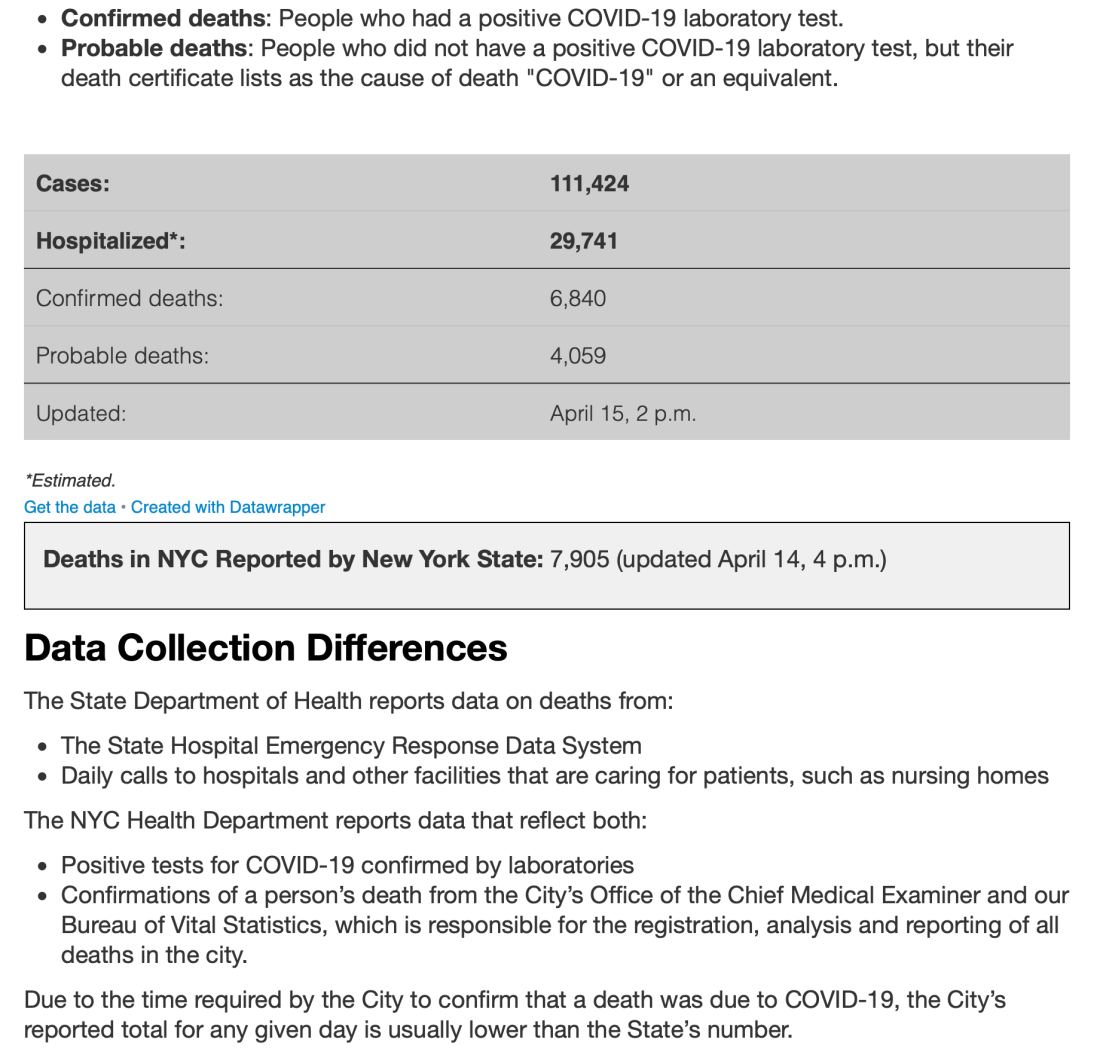
Circling back around, through April 15th, the City reports 6,840 “[c]onfirmed deaths” and 4,059 “[p]robable deaths” for a total death toll – strangely not indicated on the City’s own data portal – of 10,899.

Screen Shot 2020-04-16 at 12.38.33 PM.png
This is drawn from NYC’s COVID-19 data portal. I include the details about “Data Collection Differences” both because they give insight into the complexities involved in tracking the toll of the pandemic, and because they shed light on how the acrimony between Governor and mayor, State and City, hamstring our pandemic response and harm us all.

In spite of the the figure shown above for “Deaths in NYC Reported by New York State,” consulting New York State’s own COVID-19 data portal, we conclude by simply adding up the death tolls for each of NYC’s five counties that the current total NYC COVID-19 death toll according to NYS is 8,455.

Screen Shot 2020-04-16 at 12.46.50 PM.png
For simplicity, I’ve underlined in red the COVID-19 fatality numbers for Bronx, Kings, Manhattan [New York], Queens, and Richmond Counties. This image is drawn for the NYS COVID-19 data portal. Total city-wide COVID-19 mortality according to the State is 8,455. (Interestingly, “Manhattan” is probably shown above owing to the fact – which I just learned – that Marble Hill in the Bronx adheres to New York County which is otherwise coextensive with Manhattan Island.)
This starts to get a bit confusing, as the City is reporting 10,899 COVID-19 deaths (including probable deaths) while the State is reporting 8,455 COVID-19 deaths (with no mention of probable deaths). The State’s numbers have consistently been more up-to-date for reasons partially explained above and partially due to the stupid and bitter feud between Governor Cuomo and Mayor de Blasio. By taking the State’s figure of 8,455 and adding the City’s figure for probable deaths of 4,059, we get 12,514. I have no reason to believe that any of the so-called probably deaths have yet been counted by the State, so this seems like as reasonable an approach as any given the limits on our knowledge/publicly-available data.

Okay, so 12,514 deaths is a very large figure – as a raw number; given that the average monthly number of deaths in NYC is approximately (and actually less than) 5,000; and, most of all, because that figure contains within it immense suffering, loss, and human tragedy – but, as explained above, I believe it still reflects a significant undercount.

What explains those ~3,000 additional deaths above baseline over the month-long period ended April 13th? They must be – most of them – COVID-19-related deaths. This figure, divided out, would give an average of an additional ~100 deaths per day on top of the existing totals, though, of course, the rate of death had been spiking until last weekend, and has now leveled off for the time being at a very high rate (of above 500 official recorded deaths per day), so it seems fair to estimate that these 3,000 additional deaths were heavily weighted toward the first two weeks of April. That would suggest to me that on top of the “Confirmed deaths” and the “Probable deaths” to which the City now rightly points, we need a third category, “Still-ignored deaths” to account for this anomaly.

Given the disproportionate concentration of these “Still-ignored deaths” in the first two weeks in April, I think it’s reasonable to guess that an additional 200 people per day are dying of/because of COVID-19 in NYC on top of “Confirmed” and “Probable” deaths; given that the confirmed death rate has been steady around 500 deaths per day, and the probable death rate seems to be be between 200 and 300 deaths per day at the moment (considering, among other things, that, in one day, the probable death toll jumped from 3,778 to 4,059), counting this still-ignored death rate of ~200 additional deaths per day would put the city-wide COVID-19 death rate closer to 1,000 deaths per day.

If we are badly undercounting in NYC with all our resources, our world-leading history of public health, our concentration of media (including excellent investigative journalism), and our pseudo-progressivism, what do you think is going on in other parts of the country, where politicians disincentivized to count the dead and often hostile to the marginalized groups (read: Black, Latinx, and Indigenous peoples; incarcerated and detained people; elders; working people of all types) most at risk from this pandemic are confronted with the rage and despair of their constituents at the same time that medical and public health systems – threadbare from decades of neoliberal austerity – are stretched thin or past the breaking point by the onslaught of disease?

What, exactly? Someone must do this grisly accounting so we can hold the people responsible to account.

Postscript: I have to give credit where credit is due. I’d been meaning to write this piece since the 14th, but in doing some catch-up reading this afternoon, I came across this Politico piece (from the 15th) which quotes the Mayor acknowledging that it’s the “obvious truth” that those ~3,000 additional deaths were “overwhelmingly of folks” who suffered COVID-19-related mortality. Why they’re not being counted as such for the time being is probably at once technical and political, but sooner rather than later, their loss should be added to the collective toll.