What Type of World?

I’m sitting here with our kitchen window cracked open, a slightly too-cool breeze blowing in (I’ve closed the window, but it was nice to feel the air), and still, I can hear a bird I don’t recognize singing, see a person I don’t know going for a jog on her building’s roof – back and forth, back and forth – see the magnolia tree in the courtyard in bloom earlier than I can ever before recall seeing its purple-white flowers.

Yesterday, I delved into the doubts and uncertainties in our knowledge about COVID-19 and SARS-CoV-2 (the virus that causes it). Unsurprisingly, given that it’s a new pathogen and most of the world was – unjustifiably – caught off guard by its emergence, there’s a lot we don’t know. At the same time, as I’ve addressed on many occasions in the past, the root question we should be asking ourselves is: What type of society is it in which we’d like to live? And a follow-up on that: How in the world did we let things get to this point?

My concern – in looking to people of good faith and sound reason who raise valid questions about both our knowledge of and responses to the pandemic – is that the doubts they raise can all too easily serve as fodder for those with more cynical interests – people like our President, or Brazil’s, and the craven politicians of various parties who follow these men. As Adam Serwer of The Atlantic put it on the latest episode of Mehdi Hasan’s brilliant podcast, Deconstructed (an episode the title of which questions if the President’s “Cult” is a “Death Cult,” a question to which I’d have to answer: Yes), in addressing recent brave proclamations by (no-doubt-secretly-self-isolating) prominent Far Right figures: “When they say they’re willing to die for the economy, what they mean is that they’re willing to let you die for the economy. That’s what they really mean.”

In New York City, Democracy Now! reports that “[r]efrigerated trucks and tents have been stationed outside some hospitals to hold the bodies of the dead as morgues fill up.” It only gets worse from here, at least for the next few weeks. I encourage anyone who hasn’t yet to watch this interview (from the same DN! episode) with NYC emergency room physician, Doctors Without Borders volunteer, and Ebola-survivor Dr. Craig Spencer. Already, healthcare workers in New York are starting to report Lombardy-like conditions in our hospitals, and, as my own admittedly back-of-the envelope modeling work suggests (see below), we’re only at the beginning of a very large surge in hospitalizations, ICU admissions, and deaths. As Spencer put it: “In a week, we will be Italy.”
Screen Shot 2020-03-26 at 4.43.04 PM.png
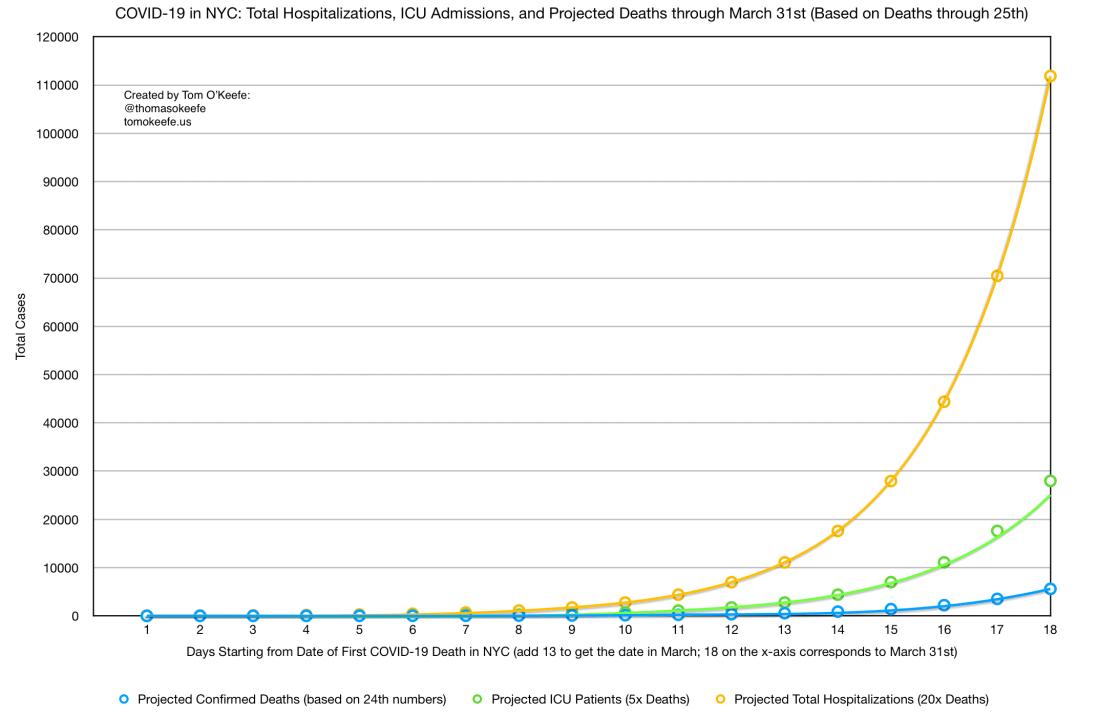
This graph was created by extrapolating from the (exponential) trend in confirmed COVID-19 deaths in NYC to date. I assumed that those who, tragically, die from the disease, die on the 14th day after the onset of symptoms; that 1% of patients die, 5% require ICU admission, and 20% require hospitalization; given the extremely wide range of estimates for these three parameters, it is possible that these estimates are highly inaccurate; however, they’ve been made using the best available data I can find and based on what I see as reasonably cautious assumptions. For more background on method, you can visit (of all places), my Instagram, which, for the time being is public, and where you’ll find both a number of posts on these modeling efforts and a Stories “highlight” (circular icon labeled: “COVID-19 in NYC” for Insta non-initiates) that details what I’ve been up to for the past two weeks.

Of course, all of this could have been averted. We know that, because some countries have averted the equivalent. Given our negligence here, and the negligence of others elsewhere, it remains to be seen if South Korea, China, Singapore, Hong Kong, Taiwan, and others will be able to continue to suppress the pandemic, but for now, they’ve proven it is possible to, and should we have done our part in the global struggle, their position would be that much more secure.

It is also, indeed, possible, that the assumptions I outline in the caption above overstate the deadliness of this disease, but from Italy, Iran, China, and now here in New York City, we have solid, incontrovertible evidence that it is deadly enough. By extrapolating from numbers in Wuhan, or Lombardy – as I attempted to yesterday – we can conclude that this virus is already on pace to kill millions around the world; given the laxity of responses in many places, and the likelihood that we will see second waves of infection in hard hit locales – as lockdown measures are loosened, and owing to the insufficiency of governmental responses and preparation all around the globe – I see it as reasonably likely that it will kill tens of millions.

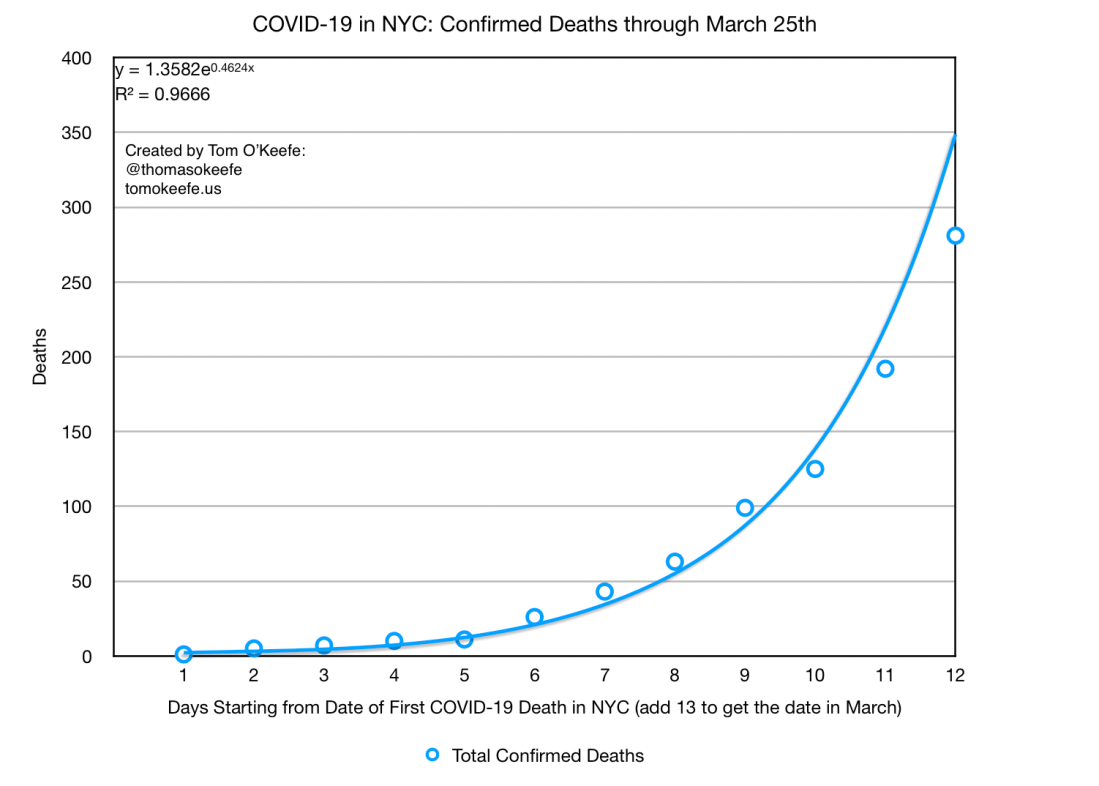
Speaking of incontrovertible, here’s a graph showing the trend in already confirmed COVID-19 deaths here in NYC.
Screen Shot 2020-03-26 at 4.55.26 PM.png
Now that the City is regularly sharing reliable data, I’ve been using it. As you can see the R^2 value in the image suggests a strong fit for the regression curve to the data, and for each of the past two days, the addition of the latest data point has seen a modest increase in the R^2 value (from 0.9551 through the 23rd, to 0.9615 through the 24th, and now to what you see above).

Up until recently, I was still trying to project the total NYC case load based on the confirmed numbers and a model I’d cobbled together based on the data for Wuhan which appeared in JAMA. This week, as the number of deaths has (sadly, predictably) steadily risen, I’ve shifted to the method described in the first caption above.

As you can see below, the projections of number of deaths are starting to converge with ominous implications.

Image 3-26-20 at 1.07 PM.jpeg
Comparing the spread between the blue curve (projected based on number of COVID-19 deaths in NYC through the 23rd) and the green (through the 24th), to the spread between the green and the yellow (through the 25th), it seems likely that the trend is beginning to converge as the data (in the grisliest form possible) begins to accrue.

Perhaps most shocking, in a way, though, is what the assumptions outlined in the first caption above suggest regarding the total case load in New York City.

Image 3-25-20 at 3.43 PM.jpeg
Please read the fine print above. As you can see, this extrapolation would suggest that, a week ago, there were already approximately one million people infected with SARS-CoV-2 in NYC. These numbers run well-ahead of those predicted by my previous model. Revising this graph based on the regression updated for data on deaths through the 25th brings the estimated total case count down closer to 900,000 for March 19th.

There is truly almost nothing we can do about any of this now – other than respond to it, of course, with humility, compassion, and, at last, due urgency – and the frantic efforts of City, State, Army Corps, and others, to expand our hospital and ICU bed capacity reflects an admirable, if profoundly belated, effort that is likely doomed largely to failure. If the projections are anywhere near correct (you can see that my first graph above calls for more than 100,000 hospitalizations by the end of the month – that is, five or six days from now – and more than 20,000 people requiring ICU care; we have ~20,000 hospital beds and 2,000 ICU beds in the City), our hospitals will be totally overwhelmed, and all we – or really, our healthcare workers and support staffs – can hope to accomplish is harm reduction at the margins of this tragedy.

One form of that to which I’ll point in the spirit of the path forward is the effort which my partner has been pushing forward calling for the urgent creation of alternative birthing sites in NYC. As she argues in her short, powerful piece, Birth Centers NOW:

We have decided that the safest thing for pregnant women to do in this moment is to go into the hospital, the epicenter of our struggle against this disease, while everyone else is asked to shelter in place. Worse — they are induced early (with a significant respiratory risk to neonates), potentially devoid of their partner, family members, their doula, and at significant risks sent home early with nonexistent postpartum care.

She and I have both been working hard on this effort (and making some headway in recent days), and would welcome your support if it speaks to you.

Every day confronts us with reasons for laughter (my mom just sent me this New Yorker piece – first sentence: “Calling it a “promising development,” Dr. Anthony Fauci said on Sunday that alcohol may help people survive the most severe effects of coronavirus briefings.” – and my partner showed me this tremendous Insta post last night); heartbreak (like for the man in Karnataka, in South India, who killed himself for fear he’d contracted the disease); and some combination of the two (as at the inadvertent spread of COVID-19 misinformation by Bollywood legend Amitabh Bachchan); for hope (that “UK researchers develop[ed a] new low-cost, rapid COVID-19 test that could even be used at home”; that people in India, and elsewhere, are finding creative ways to socially distance while still attending to life’s essentials; and that, in spite of lacking our resources, Nigeria may be more prepared (could a country have been less prepared?) than the US to confront the pandemic); and despair (at the behavior of white supremacists on the streets, as in Congress). The DSA has another excellent Bulletin out – which led me to this good piece by Mike Davis on the history and contemporary political economy of pandemics – and Science for the People has issued a well-considered Statement on [the] COVID-19 Pandemic.

The President’s Cabinet has a “Bible Teacher [who] Blames [the] Coronavirus Pandemic on God’s Wrath“; Governor Cuomo (who was in large part responsible for the same hospital cuts that have rendered New York State even less prepared than we would’ve been for this crisis) is now quietly trying to use the confusion of the moment to roll back bail reform; Mayor de Blasio says that half of New Yorkers will likely contract the disease before this is all over (to me, that seems like a conservative estimate, in fact). Bizarrely, the US has chosen this moment to indict President Maduro of Venezuela, and has also recently further ratcheted up its murderous sanctions regime on Iran (and continues its murderous sanctions regime on Cuba), and I hear no reports of talk in Official Washington about reconsideration of the Global War on Terror – the Long War of Cheney, and Rumsfeld, and Wolfowitz – that has wrought so much destruction around the world while siphoning trillions away from essential needs here in the “homeland.”

Still, there’s always good news with the bad: The everyday heroism of New York City doormen – who absolutely shouldn’t be working right now (so this news isn’t especially good, actually); the waiving of monopoly rights to remdesivir by Gilead; the persistent good work of FAIR in holding the corporate media accountable; the steadfast integrity of Tricontinental, in centering the needs of the many over those of the few around the world; and efforts like those of Asian Americans for Equality, to the Emergency Small Business Relief Fund of which I donated this morning.

In what type of society do we want to live? As I write, bodies are piling up in freezer trucks in the parking lots of New York City hospitals. This was an avertible reality, but is now the reality with which we’re stuck. No one is saying – truly no one – that the pandemic response in New York City was flawless, but on the one hand, those who question if we might not have overreacted, I think, increasingly, stand on the wrong side of the facts, and, on the other – frighteningly – our response will likely be much better than the responses of many other places around this country. We have a world-class healthcare system, strong institutions, ample resources, and a long, proud tradition of public health, and still – as I wrote elsewhere some time back – this disease has cut through us like a buzzsaw. Look how quickly New York State ramped up testing, for example. Do you foresee that happening in Mississippi – the governor of which recently declared: “Mississippi’s never going to be China”? And he was right, of course, just not the way he thought he was.

Those of us who believed in commensurate response once the situation had spiraled out of control are, in many instances, the same people who believed in public health all along. To paraphrase something Dr. Spencer said in the above-linked interview, the $2 trillion Congress has just appropriated for pandemic relief – $2 trillion which will likely not be anywhere near enough, especially with so much of it flowing into corporate hands – would have been enough to fund global pandemic preparedness for a decade. The problem was not with the overreaction once the damage was done, but with the inaction for years and decades before; the gutting of essential programs and services; the laying of the groundwork for this global tragedy through what Christian Parenti calls the “catastrophic convergence” of post-Cold War militarism, climate crisis, and capitalism. The work before us is to come up with a life-affirming answer to that question – what type of world? – and to build diligently, for years and decades, towards what that new and better world will be.
 

How About This Weather?

IMG_5218.jpeg
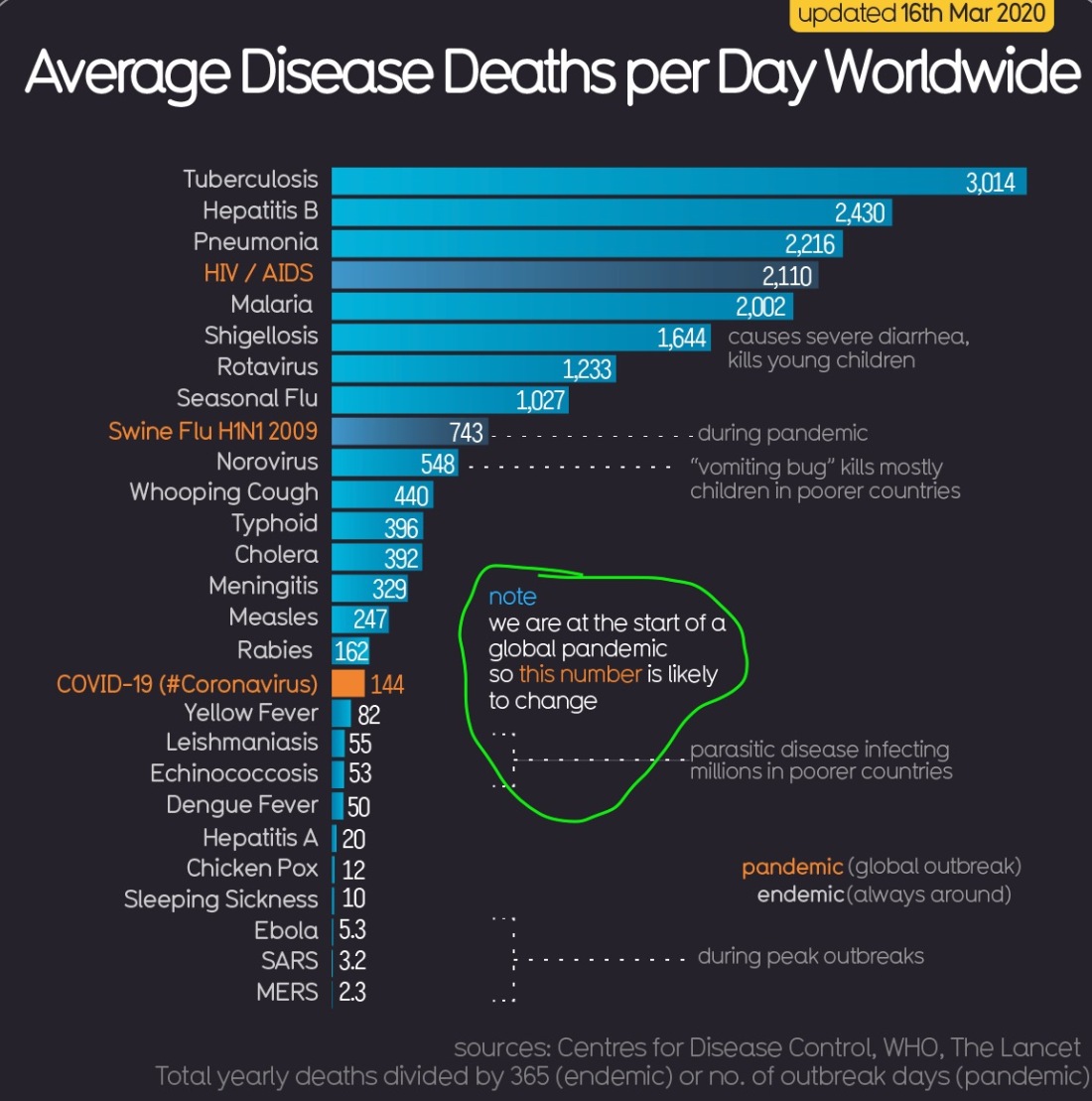
Relative to my past post, my friend Naimul – one of the self-proclaimed, “Brave data analysts of New York” – pointed out that I’d seemed to unfairly malign the accuracy of the above infographic from Information is Beautiful. My intent was not to mischaracterize, but rather simply to draw attention to just how rapidly the global death rate from COVID-19 has climbed – still, to the data analysts of New York, as of the world, for this, and my many other numerical sins (of omission and commission), I can only say: I’m sorry.

April will be the cruelest month – mixing, as it will, our memories and desires from spring’s gone by. But we live in the present, and, today, I’m going to take a step back from current events – unfolding as they continue to at breakneck pace – and try to reflect a little bit on the broader context and what we do and do not know about where we are and where we’re headed.

One thing we do know for certain is that the economic and social impact of the COVID-19 pandemic has been – both in its scale and its swiftness – almost unimaginable, and almost unimaginably devastating. Congress has now passed an unprecedented $2 trillion dollar relief bill / bailout / corporate slush fund disguised as aid; here in New York, an already ailing MTA has been hammered; and across the Atlantic, the disease has even reached the British Royals. We must all now worry for the health of the Queen.

But a great deal remains unknown about the disease itself, and to the extent that I’ve been devoting significant time to trying to project the pandemic’s course in NYC, I’ve been engaged with some of those deep uncertainties on a day-to-day basis. Estimates of the disease’s reproduction number, case fatality rate, and the extent of its spread to date all vary quite widely. In fact, we don’t even know, conclusively, whether hot weather will slow the spread of the disease or not. Setting aside the denialists – who speak from places of pure ignorance, hubris, machismo, and self-interest (to get the economy restarted, avoid taking responsibility, etc., etc.) – there has remained room for doubt about the exact nature and expected global course of this disease.

I have a love-hate relationship with Radio Open Source, but I found two recent episodes worth listening to: This one, in which one of the interviewees (Megan Murray, I think) rightly pointed out that this is not “the big one,” and this one, in which John Ioannidis makes a contrarian case regarding our responses to COVID-19 which you can read here for yourself. That same friend in the UK – Frank for our purposes – sent me this New York Magazine piece which references this draft paper out of Oxford University, and while NY Mag, as Frank pointed out, badly mischaracterizes the paper’s conclusions (suggesting that the researchers had found that “half of the population of the United Kingdom may have already been infected with the coronavirus,” when, in fact, the paper simply models a possible outcome in which that would be the case), the researchers do make clear that there are multiple different mathematically sound ways to model the behavior of the virus which would lead to similar outcomes which in turn conform to the empirical data we have so far (or had, at least, at the time of the paper’s writing) about its death tolls in the UK and Italy.

Anyway, let’s not get too lost in the weeds here. Humility demands that we all acknowledge that we all don’t know a lot of things, and there’s nothing to better instill humility than a pandemic. Some things can be figured out relatively easily though – Wuhan is a city of roughly 10 million people; China has a population of roughly 1.4 billion; in Wuhan, where drastic measures were taken to curtail the spread of the disease, between 2,000 and 3,000 people died (I’m going to use 2,500 because I can’t find an exact number for the total, but see a figure putting the Wuhan death toll alone above 2,100, and know that the Hubei province toll has been below 3,200 to date); if we multiply 2,500 by 140 (which means we’re assuming that the whole population of China has the same susceptibility to the disease as do people in Wuhan) we get 350,000. Total global population is around 7.8 billion, so if we further assume that all people on Earth are just as susceptible as people in Wuhan, and multiply 350,000 by 5.5, we get ~2 million. An average seasonal flu kills an estimated ~300,000 to 650,000 people around the world in a year, and the last unusually deadly flu pandemic (in 1968) killed between 1 and 4 million people at a time when the world’s population was less than half of what it is today. Long way of saying that, back-of-the-envelope, if the virus were allowed to spread everywhere evenly but then checked everywhere, in turn, with the strictest of measures once it hit a Wuhan-level of spread, we could expect to see a global death toll on the scale of a serious, but not a catastrophic flu pandemic.

That’s a lot of ifs though, right?

Still, that is why this is not the big one. For the New Yorkers among my readers, it might be instructive to think of the 2009 H1/N1 pandemic-that-wasn’t as akin to Hurricane Irene; there was a lot of sound and fury, but then, at least for those of us in the City (for Irene caused destructive flooding elsewhere), it turned out to be, mostly, a non-event, but also lulled us into complacency. What we’re going through now is like Superstorm Sandy. Seems pretty damn awful, right? What we could see in the future would be a repeat of the 1918 – 1920 flu pandemic that, allowing for uncertainty, infected a double-digit percentage of the world’s population; and killed at least a solid single-digit percentage of the people who became infected (including a large number of healthy, young adults) and, overall, a low single-digit percentage of the total global population. A future pandemic on that scale is like the global climate crisis, except, of course, that the global climate crisis is much much worse.

No pandemic has yet ended human history, but climate disruption certainly could.

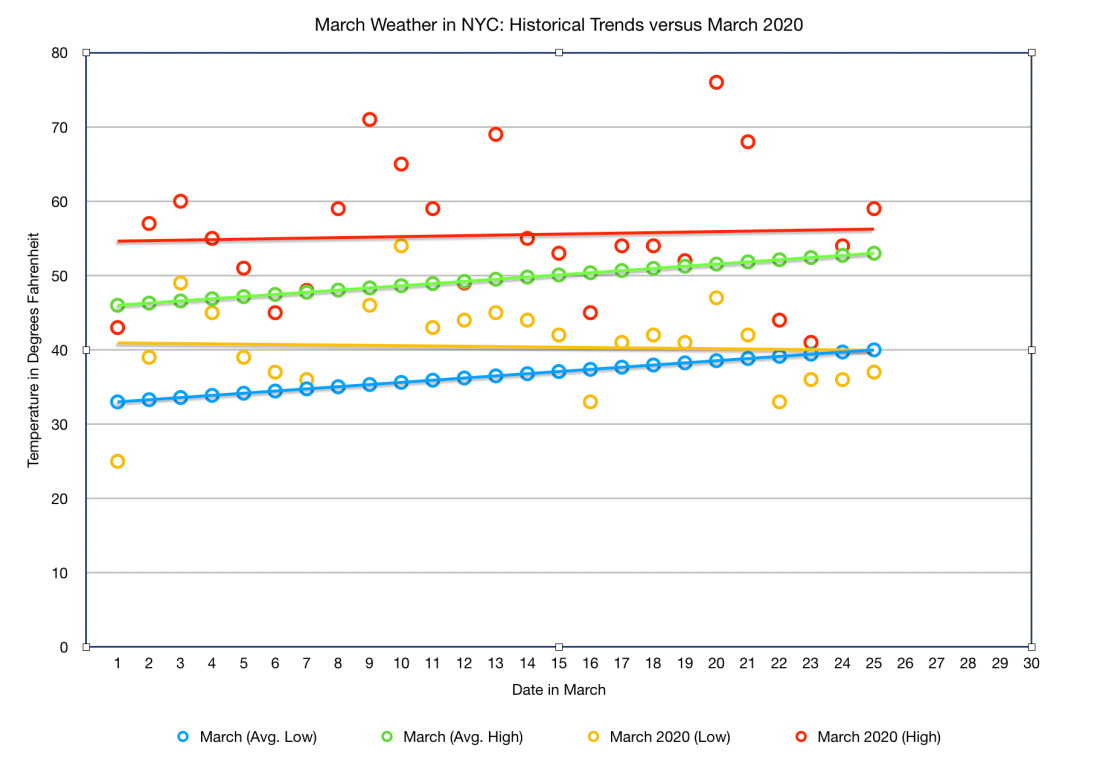
People who’ve been following my doings lately know that I’ve been making a lot of graphs. The one which follows is of a different and more quotidian sort – it’s about the weather.

Screen Shot 2020-03-25 at 5.52.13 PM.png
Average temperature values are sourced from Weather Spark and daily from Weather.com.

This graph would seem to substantiate that we’re having some pretty peculiar weather this March, though not entirely in the ways we might expect; and, of course, it’s unreasonable of me to compare the data for one year (always more likely to be erratic, and less likely to show discernible patterns) with long-term trends. But, interestingly, I’d say the peculiarity of this early spring has mostly been lost on a panicked New York population being subjected to harsh “non-pharmaceutical interventions” which – like the measles – we thought until quite recently were a thing of the past.

What if, in Wuhan, as (this is purely speculative) now in Italy and New York City, the entire population was actually infected before any significant measures were taken to combat the pandemic? Sort of like taking antibiotics once you’re body is already in the process of overcoming an infection; you take the drugs at the peak only to think it was they, and not your immune system, that made you better. This would be the herd immunity argument, and for now, we have no way of knowing if it has any value whatsoever. In Lombardy, a region of Italy with a population roughly equivalent to that of Wuhan, people continue to die in large numbers from COVID-19 (hundreds a day; remember from the infographic above, tuberculosis, the most deadly disease in the world, kills roughly 3,000 people worldwide daily), and the death toll in Lombardy – as of this writing, around 4,500 – is already at least 50% higher than that in Wuhan (though Lombardy’s population is, I’m told, on average, older, but then again, the air pollution is much worse in Wuhan). In my view, this hypothetical – in which our interventions are actually useless because they come too late; everyone is already infected; the vast majority of people show no signs whatsoever of having been exposed to the virus; and the death rate is actually a small fraction of what most people currently think it is – seems unlikely, but – given the radically different approaches to the disease being enacted, or not enacted, as the case may be, at present by countries around the world – we should soon have the results of a natural experiment to guide us out of our current confusion.

In the meantime, let me, finally, just steer the conversation once again back to climate. Commentators are prone to metaphors – which I generally find dehumanizing, though have likely myself been guilty of employing at times – that liken epidemics to floods and wildfire. But as relates to wildfires, at least, I think there’s more than a metaphorical connection to be made. In recent years, in California, in the Amazon, and in Australia, among other places, we’ve witnessed catastrophic fires of staggering proportions. It’s not that they’re entirely unprecedented in history, but their occurrence one after another all around the world certainly feels anomalous (on top of record fire year after record fire year in many different widely-distributed locations). But haven’t we created the conditions for these blazes? Through misguided land-use and forest management policies; encroachment; carelessness; infrastructural design; and, above all, through anthropogenic climate disruption and its chief signal, global heating?

Zoonoses have no doubt manifested across human history, but circumstances such as our present one have never before existed, in which human encroachment on non-human animal habitat – itself likely driven by food scarcity, urbanization, and a host of other factors – creates conditions that make zoonosis far more likely to occur at the same time that global air travel and circulation of goods create perfect conditions for the spread of contagious disease, while simultaneously, human settlement patterns (read: the way we live together cheek-by-jowl in large cities), air pollution, diseases of diet and lifestyle, etc. all make us more susceptible to this current pandemic which is, of course, dangerous not only to elders, but to those with respiratory ailments related to smoking and air pollution, as to individuals with co-morbidities like diabetes and heart disease, suffering from which is largely a function of sedentary contemporary ways of being and industrial food production. Even the way we cluster our elders in soul-sucking “homes” (as the way we travel in air-tight metal tubes through the sky or “recreate” on giant floating amusement parks with recirculated air) creates conditions very much conducive to the spread of disease.

Capitalism and climate crisis converge in our vulnerabilities, and what once would’ve generally been localized (if shattering) phenomena – a fire triggered by a lightening strike or a controlled burn gone out of control; an outbreak of a disease in a particular population that remained largely regionally confined, or took years and decades to spread widely – now become instantaneous / simultaneous global crises.

That’s probably enough for today, but if you’re looking to do something worthwhile after all this reading, please consider donating to the National Domestic Workers Alliance Coronavirus Care Fund; at least have a look at One Million Masks (I’m a little skeptical of their focus on exclusively private hospitals, as I think the need is greater elsewhere, but there’s no question that all of our healthcare workers – and healthcare support staff – should have adequate PPE); consider playing with Folding@Home’s crowd-sourced COVID-19 protein simulation (which I came to through Manhattan Borough President Gale Brewer’s daily COVID-19 newsletter); complete the 2020 US Census if you haven’t yet and it is relevant for you (like our democracy itself, it is problematic, but it takes maybe five minutes and may give you a little additional hope for the future); sign this letter in support of the New York State Nurses Association’s COVID-19 Surge Action Plan; and read this short, powerful piece by my partner – Birth Centers NOW – on the urgent need for alternative birthing sites in New York City as we accelerate into the worst of this crisis.

(For my convenience, all influenza numbers above were sourced from Wikipedia.)

The End of How-You-Gonna-Pay-For-It-ism

A strange sense of normalcy sets in, at least for those of us privileged enough not to be panicked about money and remote from the ICUs. Today is the first (sunny) day where – at least in the five square blocks of New York City about which I currently have any sense – it feels like the vast majority of the population is finally in compliance with the still-preposterously-named Stay-at-Home Order. I haven’t crossed east of 7th Avenue in weeks. The Dow Jones shoots up nearly 10% on news from DC. Maybe everything is going to be alright, after all?

Yesterday’s post was very newsy, as Mondays tend to be, but for today, I’ll simply encourage readers to go watch or listen to Democracy Now! if they’re looking for an alternative to the corporate media and/or constant online scrolling.

For my part, from sounding the alarm and projecting the exponential growth of confirmed cases in NYC, I’ve shifted my focus to trying to make sense of what we – and most particularly, our healthcare workers and thousands of gravely ill people – will face next. Sadly, I fear that, by this weekend, we’ll have seen more than 1,000 deaths in the City alone, and by next week, if this brutal trajectory holds, we may very well see 10,000. It is with such numbers as these in mind that the Governor repeats, we’ll need 110,000 beds at the peak of the crisis.

What does it all mean, though, for those of us who’ve settled in at home and sit – in relatively good health and fortune – remote from where the most urgent suffering lives? A friend works for the Army Corps and I expect must be assisting in the Javits Center effort; my partner has started to throw some of her immense energy into the push to open alternative birthing sites around the City (and State) to provide alternatives to hospital birth for healthy, COVID-19-negative people (please reach out to me directly if this is of interest to you); my friend Josh and the team at Green Top Farms continue their great work feeding the people of New York City (our second #WFHPack just arrived, in fact!); and for my part, I’m still writing, so that’s something.

I suspect we’re all feeling a little useless at the moment – all of us who aren’t anyway. For inspiration about what a better world can look like – one that we can all play a part in shaping in the coming weeks, months, and years – I turn to the DSA, which has been putting out especially excellent COVID-19 newsletters; Vijay Prashad and the Tricontinental: Institute for Social Research, that never fails to make the big, structural connections about the shape of the world and who suffers most owing to its profound injustices; to Democracy Now!, of course, which has been a touchstone for me for 15 years now, and which I’ve been moved to see continue to air from New York City, even as we descend into these harrowing depths; by Cuba – which came in for so much vitriol from corporate Democrats only a few weeks ago – but which was the only nation in the Caribbean willing to receive a British cruise ship with COVID-19 patients onboard (and Cuban doctors, a number of whom have now flown to Italy to join the struggle against the disease in that country in a remarkable act of transnational solidarity); to the World Health Organization and its COVID-19 Solidarity Response Fund to which, at the urging of Vijay Prashad in the above-linked newsletter, I donated; to efforts like this one, to scale up 3D-printing to support the medical response in the US (and even this one, through which major US corporations and the United Auto Workers are coming together to produce necessary medical equipment); by the calls of Rep. Ro Khanna and others to use the Defense Production Act already; and by the visionary leadership of Bernie Sanders, Alexandria Ocasio-Cortez, Ilhan Omar, and Rashida Tlaib (whom I was delighted to see in Zoom conversation the other night, though I think they might need a Zoom consultant! Again, please reach out, as I know someone who’s mastered Zoom in the last three weeks…).

There is a path out of this crisis, and it need not be the worst path either, and there is likewise a way forward to a different and better world, although we will have to struggle, imagine, and persevere to get there.

There is also a worst-case scenario, and looking towards the President and his Administration, we get a sense of what that looks like – trying to “Fast-Track… a Controversial Rule That Would Restrict the Use of Health Science” when we are all distracted by pandemic; using the biggest bullhorn in the world to spread, daily, misinformation (misinformation which leads to headlines like this one: “After [President] Hyped Chloroquine as a Covid-19 Cure, a Man Died Trying to Self-Medicate With a Version of the Chemical Used to Clean Fish Tanks“); and making it harder for people to access potentially life-saving treatments currently undergoing clinical trials.

Looking further afield, we see the same disaster capitalist playbook in play manywheres, but for personal reasons, I often look to India, and there, like here, we see a kleptocratic would-be strongman badly bungling the pandemic response while he, and those around him, look to enrich themselves through sleight of hand or otherwise advance their own narrow interests. In fact, today, the news stories from one place read like an echo from the other (in fact, had people in the US realized how closely our own story was echoing that of India in the twenty-teens, perhaps we wouldn’t have made the disastrous mistake in 2016 for which we are now paying such a heavy, if unevenly distributed, price) – the Cellular Operators Association of India is trying to push through a rule change, using the pandemic as a justification, to weaken net neutrality rules in India; people are panic buying malaria medications after a misleading government announcement suggested these drugs could be used as COVID-19 prophylactics (in the US, lupus sufferers, like my first girlfriend, report shortages of hydroxychloroquine); and anti-pandemic measures (along with outright violence) have been mobilized against popular protest.

Meanwhile, poor and working people – in India, as in this country – suffer, and back in DC, the President careens ever more wildly, now seeming on the verge of dismissing the head of the National Institute of Allergy and Infectious Diseases, Dr. Anthony Fauci (even the wording of the linked-to New York Times piece is so fucking galling; as if “leeway” was the President’s to give, and we’re all supposed to be living within the fantasy of his lies, but such is the current state of our political culture) and announcing plans to potentially “eas[e] social-distancing guidelines as early as next week” (the title, too, of the linked-to Wall Street Journal piece is utterly facile, as if it was the “Nation” and not the President “Ponder[ing]” these idiocies, but of one thing, at least, I’m certain: Objective reality will be headed in a very different direction in the coming days).

Another world is possible. Doug Henwood provides some empirical economic evidence of how we got here. This Green Stimulus proposal charts a path for how we can start to get there. (I went ahead and signed on to the letter, institutional affiliation: N/A.) And in reading this primer by Aaron Gordon – formerly, and still occasionally of Signal Problems – on why the US struggles to build public transit, I was struck by a single passage, which he had, in turn quoted (in part) from Alon Levy’s Pedestrian Observations, and I quote here in full:

The United States can innovate in public transportation, but only if it imitates better countries first. It needs to learn what works in Japan, France, Germany, Switzerland, Sweden, the Netherlands, Denmark, South Korea, Spain, Italy, Singapore, Belgium, Norway, Taiwan, Finland, Austria. It needs to learn how to plan around cooperation between different agencies and operators, how to integrate infrastructure and technology, how to use 21st-century engineering.

Or as Gordon’s abbreviated quotation began: “[The U.S.] needs to learn”. Indeed.

Already, here in New York City and State, I see clear signs that we all – and our elected representatives along with us – are learning extremely rapidly in the face of this crisis. That maybe there is an option between the disassociation of the outbreak voyeurism that had – through SARS, Ebola, and MERS – lulled us into a false sense of security that we, in the US, couldn’t be touched by such diseases, and the crushing reality which has now come over New York, Washington State, California, New Orleans, and will seize most of the rest of the country within a week or two. It will take effort, thought, contextual adjustment, investment, long-term commitment, and, perhaps most of all, “imitate[ing] better countries first.”

We have a lot of heartbreak left to suffer, and a lot of fear yet to endure, but I now see a way for New York to lead the way out of this, in the US, as we led the descent into it here, and if we’re lucky, smart, and hardworking, we can stand the City on solid footing of pandemic preparedness (or even better, anti-pandemic preparedness) for another century so we can get back to the urgent work – part of the struggle against the pandemic, too – of fighting for racial, social, environmental, and climate justice.


We’ve Stopped Counting the Dead

Thank goodness for this dismal weather. Freezing rain makes confinement more bearable.

From the look of the streets, sleet and freezing rain also make it easier for the New Yorkers – who otherwise have continued to be out in large numbers – to stay in; that, or the increasingly dire situation is finally registering, as not only the case count but now the number of deaths also begins to exhibit exponential growth.

This morning’s Democracy Now! has an excellent round-up of the weekend’s news, but, to summarize: The Governor was dismayed to learn what anyone living in New York has been aware of all along – that people have continued to throng New York City’s parks even as this crisis has deepened – and has given the City an ultimatum to come up with a plan to address the probem; Comptroller Stringer announced that the City is facing $6 billion in lost revenue owing to the pandemic; and, while progress continues not to be made in DC, that hasn’t stopped the Department of Justice from seeking worrying new emergency powers.

Further afield, in an ominous development, Gaza registered its first confirmed cases of COVID-19, and my heart is with people there, as on Riker’s Island, where the case number has spiked in recent days. Italy recorded a staggering / heartbreaking 793 deaths in a single day. (Note: the infographic here, shared with us by our friend Neha – one of the thousands of healthcare workers currently performing heroic service everyday in NYC –– shows, under “Average Disease Deaths per Day,” a count of 88 for COVID-19, well behind that for the world’s most deadly disease, tuberculosis, which kills more than 3,000 people a day on average; the infographic is dated exactly one week ago.) India’s authoritarian Prime Minister called for a day-long “Janata Curfew” that was capped off – following the PM’s call – with a country-wide spectacle of pot-and-pan banging that devolved, in many places, into festivities very out of step with the need for social distancing. Meanwhile – in two hints of how pandemic threatens to undermine social movements – in Delhi, a “vigilante” (no doubt a supporter of that same Prime Minister) threw a petrol bomb at the now-much-reduced and socially-distant gathering of protesters at Shaheen Bagh who have been heroically demonstrating for months against the BJP’s neofascist Hindutva agenda, and in North America, across Wet’suwet’en territory, TC Energy continues its efforts to construct the Coastal GasLink Pipeline in spite of the global crisis.

In China, progress continues to be made “towards restarting the economy and allowing most people to return to something closer to normalcy than lockdown,” while in a United States sliding rapidly into paralyzing country-wide crisis, the New York Times has followed Tomas Pueyo in charting a course towards “stop[ping] the virus” with “harsh steps”, and Politico asked a bunch of thought leaders to opine on how the pandemic “Will Change the World Permanently.

In another sign that, even with drastically ramped up testing, we are failing, New York has stopped testing people “except in cases where a test result would significantly change the course of treatment“; the Post reports that “Mayor de Blasio [has assembled an] elite ‘wartime’ coronavirus crisis team”; work is now underway – by FEMA and the Army Corps of Engineers – to convert the Javits Center into a 2,000 bed hospital complex, moving New York State 2,000 beds closer (from a baseline of ~53,000) to the projected 110,000 beds that will be necessary at the peak of the crisis here (so once that monumental work is done, we’ll be halfway there); the Federal Government may be sending essential medical supplies to New York State, but let’s see; and in the silver linings department, most New York City buses are now essentially free (while the MTA’s budget is in free-fall) and the Governor – never known to be a cycling enthusiast – is calling for the closure of some NYC streets to ease the process of social distancing.

New thing we should probably all know: Sudden loss of smell may be a sign of otherwise asymptomatic COVID-19 infection, so, please, keep your nose out for it.

Lockdown wears on all of us here, but also already starts to feel normal (as a similar state of isolation is for millions of elders). Mostly, we brace ourselves for the coming trauma, and worry that many people in many other parts of the United States do not seem to be heeding our warning calls. Stop and think about that number above for a minute – 110,000 hospital beds necessary at the peak of the crisis. Right now, New York City has ~20,000 hospital beds. New York State has ~3,000 ICU beds, roughly two-thirds of which are Downstate, and the Governor projects needing ~20,000 to 40,000 at the crisis’s peak; the State has ~10,000 ventilators (the need for which should align pretty closely with the need for ICU beds). Think about these numbers, and then work backwards. Estimates of the percentage of people requiring hospitalization vary, but 20% seems to be the prevailing number thus far; so to require 110,000 beds at once, maybe subtract out 10,000 for all the reasons for which people usually need hospital beds, and then take 100,000 and multiply by five. That would mean that the Governor is expecting a wave of 500,000 people to be / have been all infected more or less in the same week-long window. It’s my view that this may have already happened.

I’ve been working to estimate the total number of cases of COVID-19 in NYC, and to project how many hospitalizations we might expect in the coming weeks, and my admittedly-rough estimates align with those that seem to be informing the Governor’s thinking. As of yesterday (March 22nd), around 2,000 people had been hospitalized across New York State with confirmed cases of COVID-19 (and I suspect a similar number of COVID-19-positive individuals had been hospitalized, unrecognized, for flu-like symptoms, pneumonia, etc.); by this time next week, I’m confident we’ll have seen tens of thousands of hospitalizations. (I plan / hope to formally write-up these projections, but in the meantime, anyone interested can follow along on Instagram; I’ve been posting regularly on Insta stories – not a great medium for this work, but the one most readily at hand for now.)

Our healthcare system is already in crisis in New York City; we’ve been hearing harrowing stories from friends who are physicians (stories that sound a lot like this one), and the situation is similarly deteriorating in other hotspots of the pandemic around the country. A friend’s friends’ friend died in New Orleans last week. She was 39. So far, that’s as close as I’ve come to this, but it’s only a matter of time before we all come closer.

Perhaps the threat of COVID-19 to millennials in the US has something to do with vaping; perhaps with different strains or mutations of the virus; perhaps more studies are required (as this one lists a number of its own limitations); perhaps all the reportage on this phenomenon has simply been part of a public health effort to get millennials to stop behaving so recklessly. Certainly, the New York City data paints a striking picture of who is most frequently being diagnosed with the disease to date and invites consideration of why.

If you’re looking for a way to support front-line healthcare workers, the New York State Nurses Association has this petition up urging the Governor to implement their COVID-19 Action Plan. I think we’re all searching for and learning how we can contribute to this struggle, but supporting New York’s nurses is certainly a fine step. The title for this piece was drawn from the (translated) words of an Italian nurse. Where she was a week ago, we will be soon.

The Flattening Lie

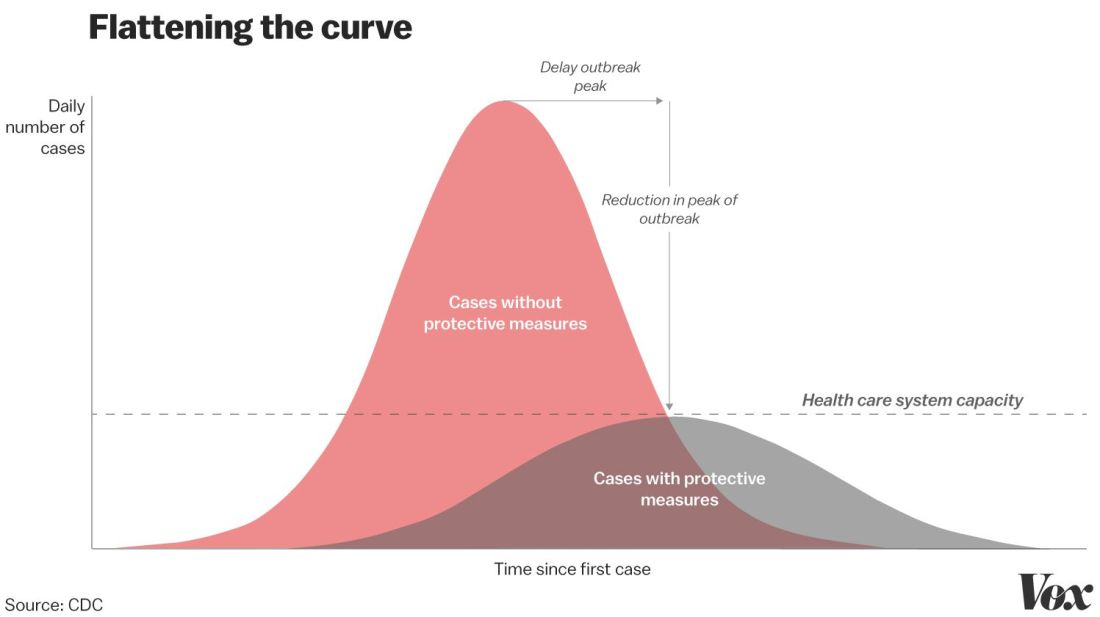
Time has been radically compressed in recent weeks in New York, so perhaps we can all be forgiven a little disorientation. Was it just a week ago that we were all talking about flattening the curve? It seems that that furor has died down as the crisis proper takes hold of us, and perhaps that’s because it was an ideology whose relevance for us was short-lived. We all believed it for a time – when we were desperate for a hope beyond hope that what was happening wasn’t happening; that it might actually be possible, after all, to confront the pandemic and still continue to conduct normal life, business as usual, with only minor modifications – but now that we’re here, maybe we’ve started to recognize the flattening craze for what it was: A lie. Or simply to forget about it. Or perhaps these words still seem like sacrilege to you?

Some brief background here before you start to think that I’ve lapsed into pandemic denialism. We all know that the President and his Administration betrayed us and committed a crime of historic proportions. We have all – New Yorkers, at least – seen with our own eyes the failures of our Governor and our Mayor (though I, for one, will admit that now that the Mayor, forced out, has exited stage left and the Governor has taken center stage, he’s proving – in this crisis which it was in large part his responsibility to avert – as forceful and energetic as he always proves when it comes time to break out the baseball cap; for this keen observation regarding the emergency headwear of choice for New York politicians, I’m indebted to my ever-perspicacious partner).

Still, there was a time – perhaps only a few days ago, a week at most – where it seemed we all became convinced that if we just flattened the curve enough, everything would be okay, or almost.

flattening_the_curve_final.jpg
It was under the influence of this image that we were all deceived. I got this image from Vox, which, as you can see, got it from the CDC.

But what if the flattened curve-versus-healthcare system capacity image looked like the following instead?

Screen Shot 2020-03-22 at 3.23.36 PM.png
This image is drawn from the now-widely-cited report of the Imperial College COVID-19 Response Team entitled “Impact of non-pharmaceutical interventions (NPIs) to reduce COVID- 19 mortality and healthcare demand”; note that the red line at the graph’s bottom represents the “[s]urge critical care bed capacity” which is to say, the healthcare system capacity in this instance. If the report’s conclusions are at all accurate, it suggests that the flattening-the-curve enthusiasm in New York was nothing more than a cruel joke.
The image above suggests that no amount of flattening – using the various measures with which we’ve all become intimately familiar in recent weeks (as you can see, they consider case isolation, household quarantine, school closures, and social distancing, among other interventions) – could or would have proved sufficient in our current crisis. Even the flattest of the curves exceeds the healthcare system capacity by orders of magnitude.

The plot continues to thicken, though, as the Imperial College London (ICL) report in turn came in for some harsh criticism from a team at the New England Complex Systems Institute (that included Nassim Nicholas Taleb) in a review which includes some dense statistical jargon, but can basically be boiled down to a claim that the ICL team made false assumptions about how the virus spread (ignoring “super-spreader” events and therefore drastically undervaluing the importance of banning large gatherings) and totally ignored the most effective strategy – a combined approach, a la South Korea, of extensive testing, aggressive contact tracing, case isolation, and home quarantine for the potentially exposed. The jargon gets a little much here, but basically, all the flattening-the-curve approaches can be grouped under the heading “Mitigation,” while the approaches taken by South Korea, China, and to a lesser extent, more recently, Italy and Spain, can be grouped under the heading “Suppression.” Mitigation doesn’t seek to limit the total number of cases (it only spreads them out to “buy us time”), while, in theory, suppression does, by radically curtailing the spread of the virus and then employing surveillance measures to prevent its resurgence.

The ICL team – wrongly according to Taleb and his NECSI co-authors – concluded that a suppression strategy would simply delay an inevitable peak in cases once drastic measures (eg, lockdown, shelter-in-place, stay-at-home, etc.) were relaxed, and included the following graph in their report:

Screen Shot 2020-03-22 at 3.31.57 PM.png
Basically, according to the ICL report, either we pay the price now, or we pay the price later. Regular readers may note a similarity to the title of a piece of mine from last week, but the meaning of my title was actual the reverse of the report’s implication. Obviously, the above does not leave policymakers any appealing options – either destroy the economy in the short-term, but still suffer pandemic later, or just suffer pandemic now with all its horrifying consequences.

Enter the Internet’s most coronaviral pandemic influencer, Tomas Pueyo (this is tongue-in-cheek, of course, as I, too, am not an epidemiologist or healthcare professional). Building on the NECSI review, Pueyo and his fellow researchers (“a group of normal citizens working around the clock to find all the relevant research available to structure it into one piece, in case it can help others process all the information that is out there about the coronavirus”) advocate for a strategy that they’ve given a corny name – which can be inferred from the image below:

1*ok3NLISRGvK-4SQyDA5KTg.png
The Medium post from which this image was drawn has been viewed ~5 million times so far.

Long story short, they argue that contrary to the assertion of the ICL report, and following the example set by South Korea – among other East Asian countries / semi-autonomous zones that learned from the experiences of SARS and/or MERS – it is possible to first suppress the virus, then contain it through ongoing measures (again, testing, contact tracing, case isolation, home quarantining, etc.) while significantly relaxing lockdown / shelter-in-place / stay-at-home orders. This, of course, should be music to all our ears, to the extent it proves correct, but it flies in the face of the flattening-the-curve common sense to which, it seems, almost all of us came to subscribe almost overnight.

This quandary, I guess, reflects both the power and pitfalls of Internet culture, and points to the difficulty of confronting a pandemic when public health budgets have been radically slashed; governments themselves seem to be turning to non-specialist online influencers to shape their own policies. Sometimes, this may result in enlightened approaches, but it is a touch worrying, to say the least. My partner shared this curriculum from “a group of students at Harvard Medical School” who “created a Response Team to organize their efforts against the COVID-19 pandemic. As a key resource, the curriculum references none other than Pueyo’s pieces, and I don’t think I’m flattering myself in suggesting I could’ve written it.

Not saying it’s the blindfolded leading the blindfolded, but clearly, there’s an urgent need for coherent, evidence-based strategies, and we should all be holding ourselves to high standards about what we do and don’t know (and how) as we strive to rapidly make sense of what we do next to avert an even worse catastrophe than that to which we’ve already committed ourselves.