His Waterloo, Our Chernobyl

Screenshot 2020-03-18 at 07.53.31.jpeg
My partner thinks these two should partner for a joint ticket, a kind of Abbott and Costello routine

It’s clear as day that our efforts to stop the COVID-19 pandemic in New York City are failing. Yesterday, I went for a short walk to clear my head. I can’t say I was shocked at the number of people who were out (I was out, after all), but by people’s behavior, I was certainly discouraged. Someone we know and love from the neighborhood had been sent out be her employer on an errand that put her at grave risk of infection; she is a very young 60, but looked just as confused as we were (for my partner stepped out with me at first before going home) that she was still working. She commutes an hour by train and bus which she characterized as, at this point, “scary” as, indeed, it must be.

Along the water, people were jogging and walking far too close to each other; I saw one person spit and another sneeze without covering mouth. Generally, I love to be in a lively place when the weather is pleasant, but I felt both crazy and claustrophobic as all of these neighbors of mine went about their business as if, somehow, the virus couldn’t be transmitted as long as you were engaged in fitness activities outdoors. Personal training sessions were still happening on one of the piers, though the kids programming seems, at least, to have mostly petered off, and everywhere you looked, people were in close quarters with one another.

We don’t get it. We obviously don’t get it.

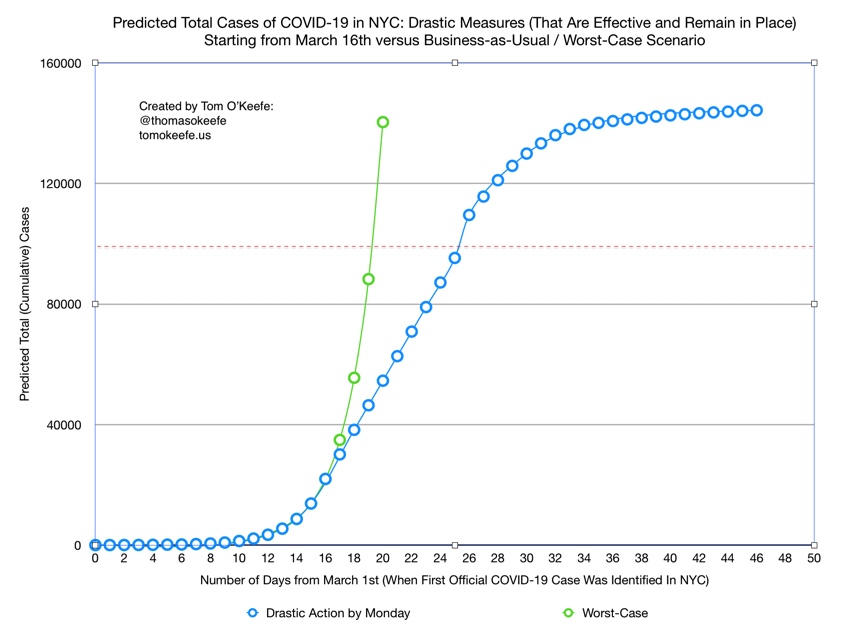
In reference to the graph below, we are certainly not hitting our post-16th best-case; the trajectory will likely fall somewhere in between the green curve and the blue curve, though I fear we’re trending towards the blue at this point (for regular updates on predictions and the official number of confirmed cases in NYC, feel free to follow me on Instagram; I’ve made my account public for the time being and have been posting and sharing stories on a regular basis about all of this):
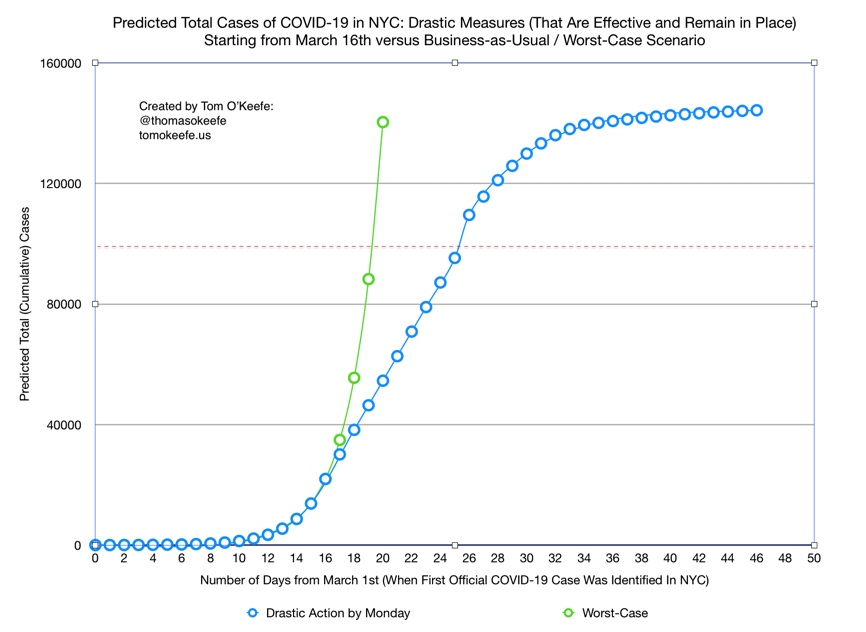
Image 3-16-20 at 1.13 PM.jpeg
For more background on how this graph was made, read this post and this one.

We’ve all heard Margaret Thatcher’s sociopathic adage: “[T]here’s no such thing as society. There are individual men and women and there are families.” Today, a great many of us who enjoy the privilege of self-isolating may be feeling, in a certain sense, that Thatcher was right – especially those who have children or have chosen to self-isolate with their parents or in-laws (or with their children or in-laws, to be cross-generationally fair). The world has receded outside and we find ourselves alone with our nuclear circles and the Internet.

As always, there are both signs for hope and for despair. I’ve been heartened and impressed to see my partner shift her entire business online in the matter of a few weeks. Every day, she says something like “today felt like a week”, or “that felt like three or four days in one”, and she’s been repeating the mantra: “It’s like starting a whole new business.” The ingenuity being shown by millions of people around the country and the world in the face of crisis is truly inspiring, as is the solidarity, and we can hope that beautiful new models and movements are today taking root.

On the flip-side, there is our President. The “His” in this piece’s title could easily refer to our bickering Mayor and Governor, but most of all, the pronoun refers to the man in DC. Now he is claiming that he foresaw the pandemic and rating his Administration’s response a perfect “10” while attacking Cuomo for not having done enough. It’s a fucking joke, of course, and my hope is that this will prove a bridge too far, but it’s been clear for some time that – beyond deny, ignore, downplay, dismiss, and above all things, don’t test – the strategy of the President and the heinous cabal of sniveling Rapturists with whom he’s surrounded himself will be to blame the Chinese, claim this was biowarfare, and daily try to rewrite history through an endless stream of lies. (Incidentally, if you don’t like liars, you probably shouldn’t support Joe Biden.) They could yet lead us to war in their desperation to avoid and evade responsibility for the debacle of our COVID-19 response, but my hope is that, while some of the President’s base may stand by him, with this disastrous, economy-ravaging, population-endangering set of colossal bunglings, he will, at last, have lost the support of most of the rich and upper-middle-class people whose allegiance to the man with the spray tan was, from the start, always least forgivable. To be deceived by propaganda, or eager to “give the finger to the establishment” is one thing, to vote for kleptocracy in the name of a lower tax bill, quite another. (And remember, the President was warned by his predecessor that something like this was even likely, and definitely possible.)

A few scattered thoughts as per usual: If you’re currently living under some state of lockdown, now is not a good time to have an emergency. You’re under lockdown because your locality’s healthcare institutions are in crisis, so please try to take good care of yourself and not to, say, accidentally, in your boredom, hurt yourself at home. This admonition, of course, goes doubly for all the people out there who do not enjoy the luxury of self-isolation and may face various physical risks in their jobs (as I’ve mentioned in two recent posts, New York’s booming construction industry doesn’t yet seem to have slowed down in the face of contagion), and triply so for the people in our prisons, jails, and immigration jails who are at great risk of injury and illness, and yet enjoy little freedom to protect themselves.

Finally, if you live in a place that has not yet faced the worst of this pandemic, please, please take this seriously. In New York, we are paying the price for not learning from the suffering of Milan, just as Milan is paying the price for not having learned from the suffering of Tehran, Seoul, and Wuhan, and we outside East Asia are all paying the price for not looking to the global leadership of Singapore, Hong Kong, and South Korea, among others, in following best practices to prevent pandemic spread of novel pathogens like this one.

For context, the reported case fatality rate (that is, the death rate of people confirmed to have been infected) in Italy so far has been roughly 8%, while in South Korea, it has only been 1%. Healthcare systems matter, and so to do early detection and social measures instituted at scale and taken seriously by the entire population. People who haven’t read the harrowing story of the “super-spreader… patient 31” in Seoul should go read it now; for those of us in New York, I fear we’ll recognize chilling resonances, both with the origins of the Westchester cluster and with the now-unfolding situation in Hasidic enclaves in Brooklyn.

Please, avoid our arrogance and complacency and spare yourselves the near worst-case scenario into which we are now, here, descending. I’m continuing to hear accounts of people elsewhere in the United States (and even still here in the City, which is truly mind-boggling and nothing short of idiotic) who persist in seeing this as overblown and “no big deal”; it is not, and let me paraphrase a friend who lives in the UK (and is facing his own deep concerns about the bungling of the Johnson Administration there and the coming explosion of cases in that country) in pointing out that many people in the US look to Italy and think, oh, it’s underdeveloped. That can’t happen here. And to quote him directly now: “They think of Sicily and think Italy is… Old Europe. But Milan probably has a better healthcare system than New York.”

Please take this seriously. You fail to do so at your own peril and the rest of ours.

Predicting the behavior (in spreading through a human population) of a virus is one thing, but foreseeing complex human dynamics at a global scale quite another, and as I wrote yesterday, my energy is increasingly focused on: 1) mitigation strategies; 2) the needs of populations now subjected to immense shocks and stresses (especially those most vulnerable); and 3) strategizing for a just and sane post-pandemic world.

In the near-term, we should know soon in NYC if our fundamental systems and infrastructures will hold. I’m hearing worrying rumbles from friends of disruptions of food supply chains, but I remain – if not quite confident – more-than-cautiously optimistic that, although our elected executives have mishandled almost everything thus far to a supreme degree, they, and the true leaders who abound in this City, and the hard working people across the City and State who keep the lights on and the water flowing and the food on all of our plates will pull through this and make it possible for all of the rest of us to do the same.

Stay strong, stay sane, and death to fascism. Here’s to a better future.

Some Basic Best COVID-19 Practices

My partner asked if I could write up a list of best practices for the weeks and months ahead. Rather than do this all myself, I’m going to borrow heavily from good lists that are already out there, chief among them, the Flatten the curve – COVID-19 site. Drawing from that site first, I recommend the obvious, by simply copying its table of contents (which I have lightly formatted for clarity):

There is hope. Do: 

    • Wash your hands
    • Stay connected, but avoid crowds
    • Lower your overall risk with everyday choices
    • Get your flu shot (and if you’re 60+, pneumonia vaccine)
    • Cancel all non-essential face-to-face medic[al] visits
    • Cancel all non-essential travel anywhere
    • Stock up on food and essentials – Early, gradually, and responsibly
    • If you can work from home, do so as much [as possible]
    • Get a flu buddy (aka ‘pandemic pal’) and make back-up plans for care of children, pets, and those in need of special assistance
    • Pick your battles; reduce non-essential social interactions
    • Keep your home clean and develop routines for coming back
    • Look beyond yourself
    • Prepare a hot zone in your home just in case someone falls ill
    • Spread the word and lobby your reps for vital research

Do not:

    • Do not just wait to see how this plays out. Speed is the key
    • Do not touch your face
    • [Believe in] false… “remedies”
    • Do not attend non-essential public gatherings
    • Do not hoard masks
    • Do not shake hands; get creative with zero-contact greetings
    • Do not touch public surfaces with your fingers; get creative
    • Do not go to work if you are in any way sick
    • Do not go to the doctor without calling ahead
    • Do not spread misinformation
    • Do not be careless
    • Do not be racist
    • [Do] Be present, do not binge the news

I strongly recommend you go read the whole site as it offers thorough and clear-eyed recommendations, and would only add that: 1) at least in New York City, we should all be operating under the assumption that we have been exposed to the virus and could very likely already be contagious, even if we are not outwardly sick; and 2) if you are low risk (that is young, healthy, not immuno-compromised, not suffering any respiratory ailment, etc.), then you should absolutely not be visiting anyone (say your parents, grandparents, neighbors, etc) who is in any way high risk (older, immuno-compromised, chronically ill, suffering a respiratory ailment, etc.) without getting their explicit permission and taking extensive precautions, and maybe not even then.

I’ll further recommend that people read Brad Feld’s excellent posts, #LeadBoldly to #StoptheSpread of COVID-19 and Please Celebrate St. Patrick’s Day At Home, the former of which recommends, among other things, that leaders:

    • Immediately change our organization’s policies to “work from home” for all employees where possible, including leaders.
    • Do everything we can to support our frontline workforce, our first responders and our healthcare workers, as they show up for work and fight this on the frontlines.
    • Ask our employees to stop hosting or attending voluntary/social public events of ANY size
    • Free up time on our calendars to support our state and local communities as we move through this crisis

And that we all:

    • Stop hosting or attending ALL voluntary/social public events of ANY size
    • Stop patronizing bars, restaurants, and gyms. That said, please do what you can otherwise to support small businesses and their employees during this tough time — buy gift cards from local restaurants to use later this year, support small online retailers, etc. (More to follow on specific initiatives to support small businesses — please send us your suggestions).
    • Provide support for frontline workers, first responders and healthcare workers, as they fight this on the frontlines
    • Treat one another kindly in the stressful time

Additionally, this post from Greg Gottesman (to which Feld links – who knew VCs would be so ahead of the curve in their thinking on pandemics!) is nice, and I especially like his suggestion to “Buy local if you can” and “Purchase gift certificates from your favorite restaurants,” and would only caution that, to the extent that you “Donate/volunteer at local food and blood banks,” you fully follow the recommendations laid out at the Flatten the Curve site (which, I admit, may make it hard to volunteer in the first place).

Now or Never: A Generation’s Call to Action

Today, New York is a city of construction workers, delivery people, drivers, and government employees. Quiet, the streets definitely are, but democratic “shelter-in-place” or authoritarian “lockdown,” this is not. While the middle-class hunkers at home – stealing out only for fugitive dog walks, jogs, or to (mindful of social distancing practices) run an errand – and the rich have mostly departed, for reasons complex and yet in many instances bluntly obvious, out in public, the working class remains.

Perhaps our measures to date will be sufficient to avert a dire crisis. Perhaps they will not. We should know by the end of this week. Yesterday, I reflected on the vertiginous week we’d just lived through. Today, in addition to this longer piece, in which I start to look ahead to what comes next, I’m also posting a brief explanation of the graph below, which shows the divergence between a worst-case scenario and a best-case in NYC as projected from yesterday, and an equally brief outline of best practices for the coming weeks, as requested by my partner.

Image 3-16-20 at 1.13 PM.jpeg
Click here for an explanation of the method and assumptions that were employed in the creation of this graph.

Now, regarding the future: Does anyone really have any idea at this point? The optimists hope we’ll be through the worst of it in NYC by the end of April; the pessimists expect that we will likely be dealing with this pandemic globally for at least the next year or two, and that in its acute phases, it may trigger social and political collapse in some countries; and Governor Cuomo just announced that the pandemic may peak in New York State in roughly 45 days (which comports with my graph above, more or less, though I hope I’m not his source).

One thing is certain though, this global crisis is a call to action for all, and especially those of us in the younger generations – a call to action because the pandemic has laid bare what our elders have bequeathed to us: Not only global climate crisis and a biosphere lurching towards collapse, but also – now, all-too-obviously – institutions and political systems hollowed out by nearly a half century of neoliberalism. A lesson should’ve been learned after 2008, but rather than look with humility on an order that had failed and redirecting, the powers that be doubled down on a failed ideology, and in so doing, thus opened the door to the global rise of neofascism and authoritarianism which we, today, confront.

People may quibble with my interpretation, but the nice thing about pandemic and global climate disruption alike – if one can say such a thing – is that they don’t quibble and don’t negotiate. Greece may have crumbled under pressure from the Troika, but COVID-19 is not subject to the human logic of economic coercion or violent threat. In the future, people will be able to look back and rightly judge the stupidity, venality, and dishonesty of many of our contemporary elected executives as relates to climate matters, but we have been granted the rare opportunity – courtesy of a humble virus – to witness, in real time, all of the lies laid bare, all of the monumental arrogance, humbled, and ourselves along with it. How can we not be humbled, after all, by something so simple that has brought the entire world to its knees in a matter of weeks?

Where do we go from here? We’re hardly beginning to find out, but in this moment, I see two clear imperatives beyond mitigating the harm and working towards ending the pandemic:

1) To start thinking yesterday about what people will need to get through the coming months; and

2) To devote the unwonted time which many of us now have on our hands to discerning lessons and strategies we can carry forward from this crisis as we strive to make a better world.

With regards to the first imperative, the needs of the poor, the sick, the incarcerated, the unemployed (newly, or otherwise), the undocumented, the indigenous, and the otherwise marginalized should be front and center. Just as those without scruple will no doubt be looking, in New York, to take advantage of the distraction and confusion of the present moment to pursue illegal construction, sneak through pernicious legislation, and the like, we can expect opportunistic actors (governmental, corporate, or otherwise) to attempt to seize this “opportunity” to force forward unpopular and unjust agendas. In short, we’ll have to look out for disaster capitalism, and I’m thinking in particular, for example, of the struggle of the Wet’suwet’en against an ill-conceived and unjust pipeline project and how easily a shelter-in-place order could become a weapon of war against land and water protectors.

Even those less marginal who enjoy the luxury, as I do, of weathering this microbiological storm mostly in the comfort of our own homes will face challenges though, and we should be considering how we build new infrastructures/support systems/best practices around mental health, as many people confront for the first time circumstances of prolonged confinement that incarcerated individuals understand all to well. It’s been nice to see the proliferation of mutual aid work, the flood of people looking to repurpose their skills towards confronting the pandemic, and the creative ways caring folks everywhere are seeking to look out for elders, kids, their neighbors, and each other – even the rediscovery of the art of the phone call can be counted among the pandemic’s silver linings.

On the second imperative, as a friend put it – and I’m paraphrasing – anyone who has definite ideas about what comes next has no idea what they’re talking about. That seems right to me, but even now, we should be monitoring with great care the authoritarians and would-be-autocrats around the world. Only their state of shock and their unsurprisingly-shared propensity for denialism have spared us immediate attempts at power grab from these strongmen, and we can expect plenty of ugliness from DC, Delhi, London, and Manila, among other places. Whenever this ends, and it will eventually, we will encounter a very different world, the shape of which we need to try to foresee lest we get caught off guard by those with agendas opposed to our own.

Otherwise, I’m left so far with a scattershot of notions. As I’ve written before, the pandemic will certainly reinforce the dominance of internet companies (Amazon has announced it’s hiring 100,000 new workers to deal with the pandemic-related surge in deliveries, and as many of us move our entire work and social lives online, I can only imagine the glut of sales, downloads, and user data that dominant Internet platforms and relative newcomers – Zoom, chief among them – will enjoy), and may, we can hope, result in the permanent demise of cruise ships. Perhaps – as we should have, and perhaps were already starting to under the influence of climate crisis – we will start to rethink our relationship to tourism and air travel with significant consequences for an industry which, in the US, is now seeking a $50 billion bailout. I expect we’ll see the partial demise of the just-in-time supply chain – which seemed like such a good idea, until it didn’t – and lots of onshoring, at least for products deemed essential, as we reassess the security of global supply chains. Hopefully, we’ll also reassess the very nature of what is essential and what matters to us. How can we not? We’re living through a rare and world-turning event, and I think my friend Andrew is right in opining: “There will be before COVID-19, and after.”

I expect we’ll see a dip in flu cases after the pandemic finally subsides, as new habits and lingering fear lastingly transform our behavior, and that many of us will carry scars from the disfiguring necessity of social distancing. As a doctor friend put it: “If it makes you feel crazy, you’re doing it right.” That’s right, and it does, and it hurts, and we should acknowledge that. In the name of the greater good, we’re being forced to pervert and reject much of what makes us human, and the pain of these coming months will be followed by the lasting ache of their strangeness.

Barring the widespread social and political collapse that some people fear, I’d say the concern which sits forefront in my mind is how we rebuild public space and public goods in the wake of this catastrophe. Right now, we rightly fear what is shared, but it would be a tragedy if going forward we turned our backs away from everything that is beautiful in our public parks and public transit, our town squares and varied meeting places, our bars and restaurants – these are ancient institutions, and for a reason, and I’m confident we will return to them, but in the face of ongoing climate disruption and neofascism on the march, only concerted global effort by the majority of us – a majority who want to live in peace and justice, and I think increasingly recognize that the choice is actually socialism or barbarism, or, to sidestep, once again, the risk of ideological discord, that we either choose public wealth and private sufficiency, or the world burns – and only concerted global effort will ensure that that burning does not happen.

I thought about starting this piece with this quip, but instead I’ll end with it:

Do you know what isn’t profitable? Pandemic preparedness. Do you know what’s great in a pandemic? You tell me.

And a sober reflection:

Those of us lucky enough to see the other side of this will all know people, probably quite a few people, who die from this.

We’re 50 years into a failed project, and maybe it’s a 50 year fight back out of it, but for the sake of a future – especially for my generation and the generations behind us – it’s a fight worth fighting, and a life’s work worth living. For now, we have to simply take care of ourselves and each other until we come out the other end of this, but as we do, and with the time we have, we should be laying a foundation upon which to build the new world we long for.

Worst-Case Scenarios and Less-Worst…

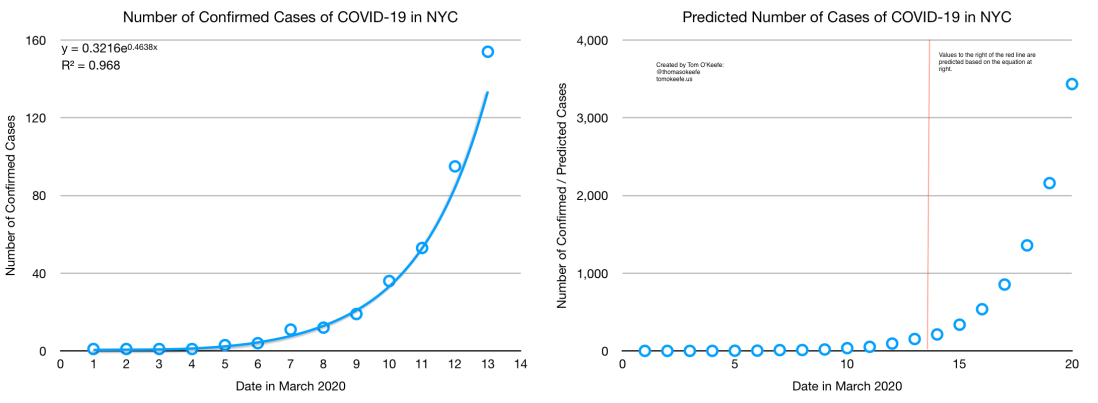
Yesterday, I posted the graph below on Instagram. To briefly explain methodology and assumptions employed in creating it, I’ll first suggest that interested readers go check out this predecessor post, Going Viral: Why New York City Will Soon Be Shut Down in Five Graphs, that explains how I came up with the original (exponential) growth curve for projected total COVID-19 cases in NYC.

As is my new practice, I’m going to explain all the math in the caption, so anyone not interested in the math can simply ignore the caption and enjoy the picture.

Image 3-16-20 at 1.13 PM.jpeg
An explanation for how I created the exponential growth curve above can be found in this post. If you have a look there at the graph derived from the JAMA Wuhan data, you’ll see that for the eight days following the introduction of “drastic measures,” the number of new daily cases (total, rather than confirmed) basically levels off. The graph shows a gradual downslope and an inexplicable spike, but my understanding is that that had more to do with the timing of the reporting and the Chinese government’s preferred optics than the actual trend. Thereafter, there is a roughly linear decline in the number of new cases for ~10 days (I use 11 here to err on the side of caution), followed by a long, shallow tail; here, I have the number of new cases decrease by 10% per day for 10 more days to carry us to April 15th. Of course, there’s no reason that the spread of the disease should progress exactly in NYC as it did in Wuhan (and, in fact, the progression, at least from the time of institution of some drastic measures, will likely be much worse here, given the laxity of the steps we’ve taken to date), but given the lack of available data and models, I’m doing what I can.

New York Is Closing. What Next?

That happened fast. Work hasn’t stopped yet on the Chipotle mansion, and New Yorkers are still briskly giving directions to strangers this morning (plus drivers seem to think that the state of emergency has made stop signs optional) but a frightening new reality can be felt setting over the City. It’s been hard to keep pace with the brutal and breathtaking speed of this pandemic, and I believe it’s left almost all of us wondering and a bit mind-boggled. Was it just last week? Was it just yesterday?

Part of the problem is that, as with climate change, in a way, even in the present – here in a New York City increasingly reeling and today, for the first time, waking up to public schools, restaurants, and bars closed – we are living in the past. Much of the City’s population is in a state of shock, having finally been traumatized out of their denial, but think how much worse their shock would be if they realized not how bad it looks, but how bad it is. As with climate change – wherein greenhouse gases emitted over decades and centuries accrue in the atmosphere to work there slow transformation of Earth’s everything – so too, with SARS-CoV-2 (hereafter: the virus), we have already, in the past, committed ourself to a future that looks very much different and worse than the already daunting present. With respect to climate change, the lag is years and decades. With respect to COVID-19 (hereafter: the disease), merely days and weeks.

Still, it is useful to reflect. I first learned about the outbreak of a novel coronavirus in Wuhan in early January from one of Bill Bishop’s (excellent) newsletters. Through the month of January, I remained convinced that – like SARS and MERS before it – this new disease would be contained. Only at the end of January did I begin to worry, as I learned that – unlike SARS – this disease was contagious even when people were asymptomatic, so the fever checks that had worked so well in 2003 were not working so well in 2020. By early February, I’d accepted that this was not like the seasonal flu, and that there was a very real risk this disease would be coming to New York. Still, I in no way foresaw quite the ferocity of its onset – or at least, I didn’t foresee what it would feel like, this tidal wave of human suffering. By mid-February, my partner was preparing for the potential implications to her business of pandemic reaching the City, and I was gradually stocking up on essentials against the possibility of events the shape of which resembles those of our present. By late February, I was certain that the disease was already here and circulating.

Then it arrived in earnest – which is to say, officially – on March 1st, and there followed an eery period that to me felt like the storm before the calm. A collective and growing frenzy before the long, quiet, and bitter months that now stretch out before us. How did it come to this? Was it only a week ago?

It was, and my recent posts show a record of my evolving perspective. On February 27th, I foregrounded the similarities between pandemic and climate crisis, but continued to focus, as is my practice, on the latter. Generally, I only write one post a month. In recent months, it’s been more like two or three, as I’ve been preoccupied with the Democratic primaries and the 2020 US presidential election. Then starting on Sunday, March 8th – as it became clear to me that our elected executives were, through hubris, incompetence, and unpreparedness, massively bungling the response, and that New Yorkers, at large, remained largely in denial – and since, I’ve been writing in a feverish rush.

On the 8th: “Am I afraid of the disease personally? Not particularly, but I certainly don’t want to get sick. Do I fear its potential consequences? I’m terrified. And you should be too.”

On the 9th: “In the absence of widespread rent forgiveness and active efforts by state and local governments to support people and businesses hit hard, economically, by the spread of the disease, I fear we can expect to see a massive wave of small business closures and wage-starved New Yorkers struggling or unable to cover their basic expenses… Given that… the opportunity to actually contain the disease has long since been missed, our task now is harm reduction – to slow the spread so that the burden on our healthcare (and economic and social) systems doesn’t become overwhelming, and to work to limit the risk to the people who face the gravest dangers from the virus. As yet, I’m seeing very few signs of a coherent, widely socially-embraced strategy for confronting, here in New York, the pandemic. Fundamentally, the challenge now can be reduced to math… so, certainly, every little bit counts, but if we don’t succeed through disease tracking, quarantine, and widely-adopted social measures to slow the spread of the virus, we can expect this to get much much worse in the near term.”

And later that same day: “I’m also continuing to hear people compare this to the flu. I’ve previously done my small part to debunk the idea that [this disease]… is akin to the seasonal flu, but if people are referring to the flu pandemic of 1918-1920 (that infected something like one quarter of the world’s population and killed a low single digit percentage of the same), then, perhaps, they are closer to correct. We can hope for a different and less dire outcome in this instance, but only to the extent that we take the disease and our efforts to reduce the harm it is causing seriously.

On the 10th: “To date, New York City public schools remain open, but an increasing number of private schools and universities have closed/gone to all online classes, and the City has made clear that part of its reasoning in keeping schools open is that closing them puts such a heavy burden on many families. This refusal to close schools strikes me as the municipal version of waiting to go to the doctor until you’re so sick you end up in the emergency room, and I fear that failure to take significant measures now will lead to more suffering (and an even heavier burden) later. But this is a polarizing subject, and I continue to hear many well-informed individuals opine, basically: What’s the big deal? Why is everyone overreacting? And, to be fair, if schools were to be closed, but everyone continued otherwise behaving as normal, the impact on slowing the disease’s spread would likely be limited.”

On the 11th (in response to Super Tuesday II results): “Short and sweet tonight, as my focus has obviously been on the pandemic, our flat-footed response to it, our failure to grasp the urgency of acting now before it spreads more broadly, and what we can learn from our response to [this pandemic] about our failures to adequately confront global climate crisis, but I’ll just add my voice to the chorus: If Biden is the Democratic nominee, I fear he’ll be eaten alive in the general election. If he loses, I’m almost certain the Democratic establishment will, once again, blame Bernie Sanders for the loss rather than look in the mirror.”

On the 12th: “Cancellation of the Parade will be to [this] disease… and Mayor de Blasio what cancellation of the Marathon was to Hurricane Sandy’s aftermath and Mayor Bloomberg – the moment of reckoning when an elected official confronts and publicly acknowledges the fact that we are no longer in a business-as-usual scenario – and I expect/hope that closure of the public schools will follow, though, in the meantime, significant damage has probably already been done by keeping them open. And why did we keep the schools open? Because they provide essential meals for hundreds of thousands of young people everyday, and otherwise-unaffordable childcare for hundreds of thousands of working New Yorkers. But is that the way it should be? What if we had functioning social welfare systems? A public health system that was properly valued and funded? Universal childcare and paid sick leave? Medicare for All? Would we still be facing the predicament we now face? Great that New York State is offering state employees two weeks paid leave if they are “quarantined or in isolation due to #Coronavirus,” but what about creating opportunities for people to avoid getting sick in the first place?

And later that same day: “Next week will be one of the worst weeks of the century, thus far, in New York City. It is almost a mathematical certainty. Math and science teachers, at least, may have reason to rejoice, however – to the question: When am I ever going to use this in real life? They know have the answer: To understand a pandemic well enough to stop it.

Sadly, we have not understood a pandemic well enough to stop it. In fact, we’ve done almost everything wrong. The fuck-ups (for that’s what they are) started at the top – with our racist, kleptocratic, ignoramus of a president and the lackeys, yes-men, and sycophants with whom he’s surrounded himself – but in New York City, we can safely say that all of our elected executives have partaken of them. As usual, Governor Cuomo has got the better of Mayor de Blasio in the theatrics of executality – appearing decisive and self-possessed as he orders out the National Guard and employs barely-paid inmate laborers to produce New York brand hand sanitizer – while the Mayor has seemed uncertain, overwhelmed, and ineffectual, and still does. Neither of them has done a good, or even an adequate job, though.”

On the 13th: “Leadership would have entailed taking preventive actions as it become clear, in January or early February, that …the disease… would not be contained in China, and taking urgent, commensurate action once it was determined that… the virus… was circulating across the United States, and in New York State and City. I’m a private individual with no expertise in public health, but I do have a basic understanding of math, favor progressive independent media (Democracy Now! was sounding the alarm in early February that this would very likely turn into a global and national health crisis), and pay attention to what goes on in the world beyond our borders. From the moment it became clear – with the identification, early last week, of multiple people with the disease in Greater New York City, multiple people, for whom it was unknown from whom they had contracted the disease – national, state, and municipal governments should have looked to Italy, especially, and realized that without drastic, immediate action, we were in for a disaster.”

On the 14th: “What the climate crisis is laying bare slowly and the current pandemic, quickly, is the profound state of decay in the United States. More than 40 years of neoliberalism and our increasingly parasitical form of capitalism have hollowed out what was once, but is no longer, the richest and most powerful country in the world. Rich, how? Powerful, in what way? Yes, we still have the largest nuclear arsenal and the world’s most-over-funded military, but to what end? To prop up the petro-capitalism that is destroying our collective hope for a future? We have become like the alcoholic and abusive old patriarch, the over-the-hill slugger who still has a mean right hook, but has grown slow and clumsy and is falling apart inside. Age claims all of us, but for those who only believe in force, what they have lived by, so, too, by they die, even if at their own hands.

We have monumental work ahead of us. We should confront and overcome the fast crisis of the pandemic, and then, with the same remarkable sense of urgency, at last address the slow, defining, once-in-a-civilization crisis/opportunity of global climate crisis. It could mean a world less broken than the one that we currently inhabit, but – like confronting [this disease] – it will take concerted effort from all of us.”

And that evening: “Panicking never helps, so please don’t panic, but by the end of next week, New York City will likely be shut down.”

COVID-19 Confirmed and Predicted Cases in NYC as of 14th March 2020.png
Also from the 14th

And yesterday: “If these numbers are anywhere near correct, then we could be looking at ~100,000 total cases… in New York City by next weekend. New York City has ~20,000 total hospital beds and 5,000 ventilators. Given that ~20% of… patients require hospitalization, and approximate 5% of patients require intensive care, we could be at or beyond the capacity of the City’s medical system by this time next week. This is why the idea of flattening the curve has become ubiquitous in recent days; unfortunately, we’ve likely missed the opportunity to flatten it enough to avoid a real crisis, but what we do in the coming days will determine how bad that crisis gets. Every day we delay, this gets worse.”

Screen Shot 2020-03-15 at 9.13.24 AM.png
And this from the 15th

And now? We have a long, slow, grueling struggle ahead of us, the ramifications of which, around the world, it is impossible to foresee. I do not think it is advisable to compare it to war, as this is a struggle that has to be conducted collectively, with love, in community (which, given the call for isolation, is supremely ironic and will no doubt reinforce the dominance of the data monopolies), and centering the individuals, populations, and communities hardest hit by the health, economic, and social impacts of the pandemic. These past two weeks have been dizzying. The next two will be more so, and we have to brace ourselves, and do our best to stay healthy of body, strong in spirit, and sane and loving to ourselves and each other as we come through this.