Going Viral: Why New York City Will Soon Be Shut Down in Five Graphs

If that title seemed half funny, this post, unfortunately, will not. Panicking never helps, so please don’t panic, but by the end of next week, if not well before, New York City will likely be largely shut down. Here’s why, in five graphs. If you don’t care about the math, please skip the captions.

Confirmed Cases

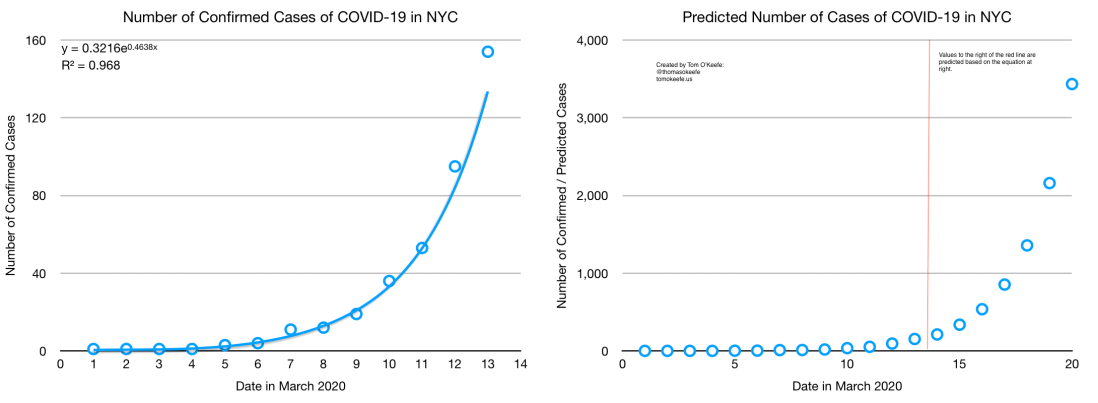
The first two graphs show the number of confirmed cases in NYC according to the official figures released by the City and State, and the predicted number of cases going forward based on an exponential regression. Friday’s data was the last to be incorporated into these. I would’ve updated them with Saturday’s data, but the predicted value according to this model for Saturday was 212.45 and the official figure released was 213, so I’m leaving everything as is.
COVID-19 Confirmed and Predicted Cases in NYC as of 14th March 2020.png
As I captioned in a previous post: “Note the near perfect match – on the left – of the data for confirmed cases in NYC through yesterday (Friday, March 13th, 2020) with the best-fit exponential growth curve, and the ominous implications of that match – on the right – suggesting that rather than the 1,000 confirmed cases Mayor de Blasio warned us to expect by next week, we could easily see three or four thousand. Yes, more drastic measures have started to be taken, but if we assume – fairly, in my view – that no meaningful action was taken at scale to stem the spread of SARS-CoV-2 (the novel coronavirus) in NYC until yesterday, and given that the incubation period of the virus is ~5-6 days, then we shouldn’t expect to see any noticeable drop in new confirmed cases owing to our, and the City’s efforts, until around this time next week. Hang on. Stay safe and stay sane. And, please, be good to yourself and each other. We’ll come through this together.” (This graph was created by Tom O’Keefe. Feel free to use it however you like, but please do give credit. Thanks.)

The Wuhan Data

Sadly, it gets worse. Accordingly to the following graph from a study by the Journal of the American Medical Association (JAMA) of ~45,000 cases of COVID-19 in Wuhan, the number of confirmed cases (here: “By date of diagnosis”) lags but roughly mirrors the number of total cases (here: “By date of onset”) by roughly a week.

Screen Shot 2020-03-14 at 6.56.15 PM.png
This is from JAMA. The assumption that I go on to make below is that, given that the rates of change of total and confirmed cases roughly mirror each other – but with the graph for total cases leading the confirmed cases by roughly a week (I use 8 days) – and that their starting values are the same (zero cases), the graphs for total and confirmed cases should also be the same up until the point where drastic measures break the exponential growth. If anything, the number of total cases climbs more steeply until the drastic preventive measures – in this case, the “shut down” of Wuhan, a city with a population greater than that of the five boroughs – take effect, but I treat the rates as if they are identical.

Using the pattern from the Wuhan data, I extrapolate predicted NYC values. There’s no saying that the pattern in New York has been exactly the same as that in Wuhan, but, in both cases, municipal, provincial/state, and national governments were caught totally unprepared by a novel pathogen, and – in spite of having had two-plus months lead time and the advantage of their example – I wouldn’t say we’ve done any better in handling this here than our peers in Wuhan did there.

That said, let’s apply this same approach to the New York numbers. This gets very ugly.

The Business-as-Usual / Worst-Case Scenario

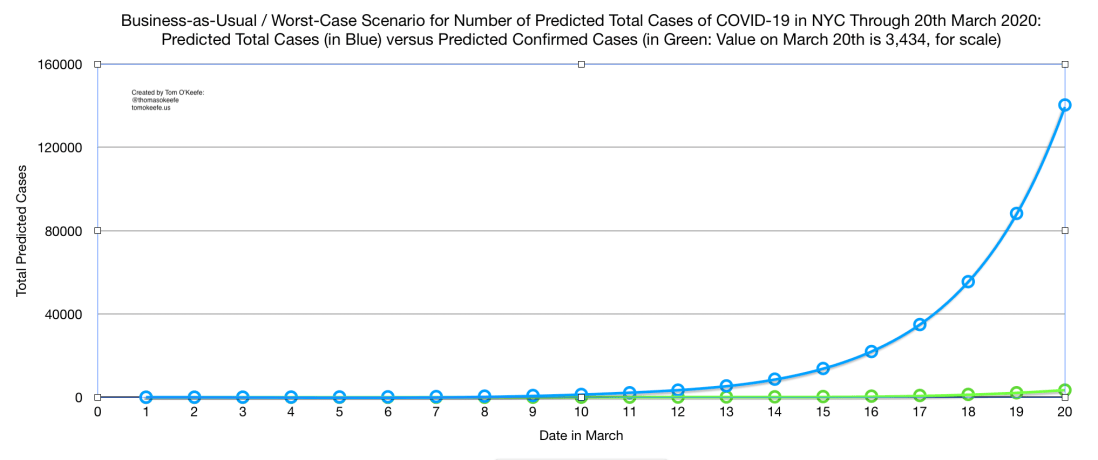
This graph is based on the assumption that we have done and will do nothing significant to limit the spread of the virus before March 20th. Obviously, that is not true, and so this graph should be treated as an upper-bound showing just how bad things could have become. Sadly, while we have taken a number of measures, based on the scene I saw (on my walk to the water yesterday evening) at bars and restaurants, a great many people are continuing to treat this as usual business.
 

Screen Shot 2020-03-15 at 9.13.24 AM.png
The green curve shows the predicted number of confirmed cases. The blue shows the predicted number of total cases under a Business-as-Usual / Worst-Case Scenario. I’ve made multiple assumptions here – chief among them: 1) That, like in the Wuhan data, the number of total cases and number of confirmed cases mirror each other (and can be modeled with identical – save for horizontally-translated – graphs) and that this trend continues indefinitely until human intervention or population size limits the exponential growth; 2) That there is an 8-day lag in confirmed cases relative to total cases; 3) That measures taken in New York City to date have done nothing to stem the exponential spread of the disease (which is almost certainly, we can hope, untrue) – but all founded on the best available data of which I’m aware. (This graph was created by Tom O’Keefe. Feel free to use it however you like, but please do give credit. Thanks.)

If these numbers are anywhere near correct, then we could be looking at ~100,000 total cases of COVID-19 in New York City by next weekend. New York City has ~20,000 total hospital beds and 5,000 ventilators. Given that ~20% of COVID-19 patients require hospitalization, and approximate 5% of patients require intensive care, we could be at or beyond the capacity of the City’s medical system by this time next week. This is why the idea of flattening the curve has become ubiquitous in recent days; unfortunately, we’ve likely missed the opportunity to flatten it enough to avoid a real crisis, but what we do in the coming days will determine how bad that crisis gets. Every day we delay, this gets worse.

The Less Bad News

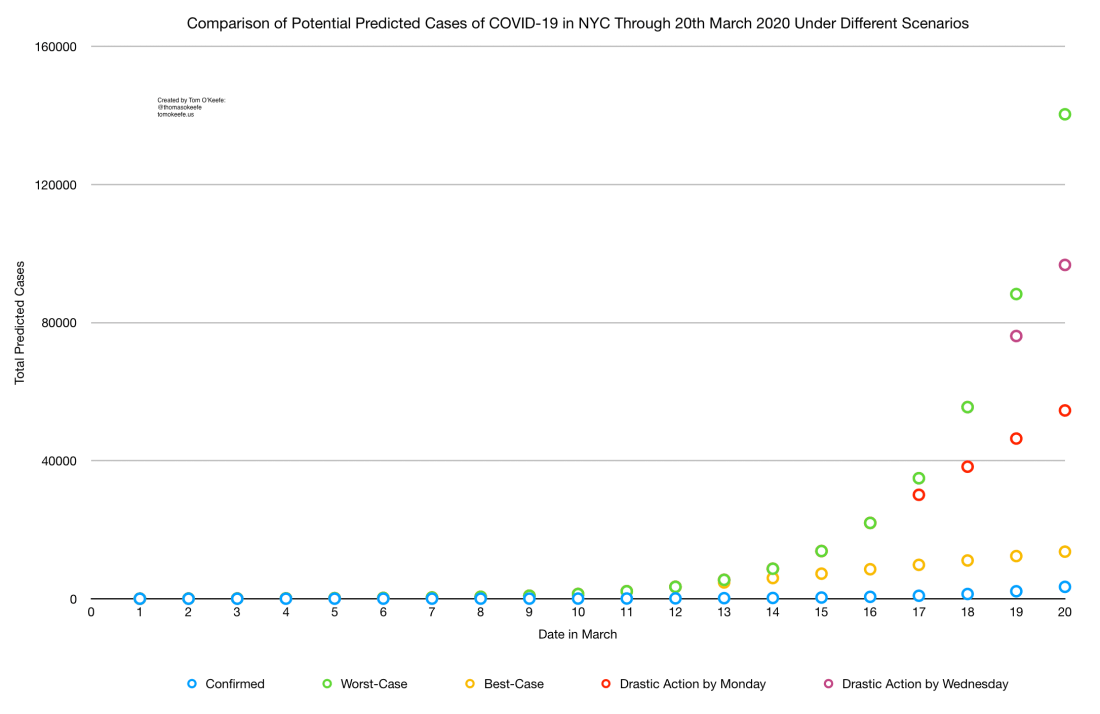
It hardly feels like good news to say that we could only have tens of thousands of cases of COVID-19 in New York City by the end of next week, but, for sake of comparison, this final graph shows four different scenarios, plus the predicted number of  confirmed cases (here in blue) from our second graph which, as in the fourth graph, now looks very small.

Briefly, below:

  • Green plot points show the worst-case scenario from above (~140,000 cases by Friday, March 20th);
  • Purple plot points show a scenario under which drastic measures are taken starting on Wednesday, the 18th (~97,000 cases by the 20th);
  • Red plot points show a scenario under which drastic measures are taken starting on Wednesday, the 16th (~54,000 cases by the 20th);
  • While the yellow show what could have happened had we taken drastic measures (as opposed to half measures) starting on Friday, March 13th (leading to only ~14,000 cases by the 20th).

Note that the red plot points are identical to the green through the 16th, and purple plot points are identical to the green through the 18th, while yellow points diverge from green after the 12th.
Screen Shot 2020-03-15 at 9.37.50 AM.png
As above, the key flaw here (other than for the predicted confirmed cases in blue, which I suspect will prove reasonably accurate to the extent that testing continues apace) is that each of the sets of plot points for total predicted cases is based on a scenario that assumes steps taken, up until the point when “drastic measures” are introduced, have had no effect. In reality, we live in a more muddled context, and the true outcome will likely be intermediate and determined by a complex interplay that is beyond my limited capacity to model.

Obviously, whereas in Wuhan, an authoritarian government moved to almost totally lock down an entire megacity, here many people and institutions have taken significant actions, which will no doubt steer us away from an absolute worst-case outcome, but as of this writing, public schools, mass transit, bars, restaurants, gyms, daycares, etc., etc., etc. remain very much open in New York and much of the population is demonstrably not taking recommended hygiene and social distancing measures. Where, exactly, the curve will fall for our particular circumstances is well beyond my ability to predict, especially given the shocking paucity of publicly-available data and the overwhelming number of unknowns (not least among them: Will the testing capacity actually be ramped up significantly, and would that bear on any of my assumptions above?), but what is beyond doubt is that we are in for some very hard weeks ahead, and that without  bolder action by the City government, and more universal commitment to confronting this crisis from the City’s population, this situation will get much much worse before it starts to get better.

If ~140K is the upper-bound, and ~15K would have been the lower had we taken commensurate action starting on the 13th, that leaves a wide range of potential outcomes. Much power to shape what happens remains in our hands, but we’ve now forfeited the opportunity to avoid a deep crisis.

Postscript: To see a (more) flawed previous version of this post, click here.

And a note on usage: “confirmed cases” refers to those cases that have been confirmed by a positive test for the disease, whereas “total cases” refers to all cases (confirmed and unconfirmed) extant in the population. Obviously, it is much harder to know the latter than the former. Above, we first predict the number of confirmed cases until the 20th. We then extrapolate further from the predicted number of confirmed cases (in case “Predicted Confirmed Cases” was confusing) to make an estimate of what the number of total cases will be.

Going Coronaviral: New York City Will Be Shut Down By the End of Next Week

Note: To read an updated and improved version of this post, please click here. It has more accurate numbers and clearer explanations, and I recommend you read it instead.

If that title seemed half funny, this post, unfortunately, will not. Panicking never helps, so please don’t panic, but by the end of next week, New York City will likely be shut down. Here’s why, in four graphs.

COVID-19 Confirmed and Predicted Cases in NYC as of 14th March 2020.png
As I captioned in a previous post: “Note the near perfect match – on the left – of the data for confirmed cases in NYC through yesterday (Friday, March 13th, 2020) with the best-fit exponential growth curve, and the ominous implications of that match – on the right – suggesting that rather than the 1,000 confirmed cases Mayor de Blasio warned us to expect by next week, we could easily see three or four thousand. Yes, more drastic measures have started to be taken, but if we assume – fairly, in my view – that no meaningful action was taken at scale to stem the spread of SARS-CoV-2 (the novel coronavirus) in NYC until yesterday, and given that the incubation period of the virus is ~5-6 days, then we shouldn’t expect to see any noticeable drop in new confirmed cases owing to our, and the City’s efforts, until around this time next week. Hang on. Stay safe and stay sane. And, please, be good to yourself and each other. We’ll come through this together.” (This graph was created by Tom O’Keefe. Feel free to use it however you like, but please do give credit. Thanks.)

Sadly, it gets worse. Accordingly to the following graph from a study by the Journal of the American Medical Association (JAMA) of ~45,000 cases of COVID-19 in Wuhan, the number of confirmed cases (here: “By date of diagnosis”) lags but roughly mirrors the number of actual cases (here: “By date of onset”) by roughly a week.

Screen Shot 2020-03-14 at 6.56.15 PM.png
This is from JAMA.

Put simply, the trends or the curves look more or less the same (if anything, the number of actual cases climbs more steeply until the drastic preventive measures – in this case, the “shut down” of Wuhan, a city with a population greater than that of the five boroughs – take effect), so we can approximate the number of actual cases by simply extrapolating the predicted number of confirmed cases a week ahead. There’s no saying that the pattern in New York is exactly analogous to that in Wuhan, but, in both cases, municipal, provincial/state, and national governments were caught totally unprepared by a novel pathogen, and – in spite of having had two-plus months lead time and the advantage of their example – I wouldn’t say we’ve done any better in handling this here than our peers in Wuhan did there.

That said, let’s apply this same approach to the New York numbers. This gets very ugly. (See correction below! Owing to a math error I made, this turns out to be at once an underestimation of the worst-case scenario, and an overestimation of the likely outcome. The corrected estimates are still terrifying.)

Screen Shot 2020-03-14 at 7.05.37 PM.png
(Correction: This graph was based on a faulty assumption. Better estimates can be found in this updated post.) The green curve shows the predicted number of confirmed cases. The blue line shows the predicted number of actual cases (that is, the total number of cases, confirmed or unconfirmed). Note, for today, the model predicted 212.46 confirmed cases and subsequently announced official number was 213. (This graph was created by Tom O’Keefe. Feel free to use it however you like, but please do give credit. Thanks.)

I’ve made multiple assumptions here (about the trend of confirmed cases going forward and the relationship between confirmed cases and total actual cases, most saliently), but all founded on the best available data of which I’m aware. If these numbers are anywhere near correct, then we could be looking at ~100,000 actual cases of COVID-19 in New York City by next weekend. New York City has ~20,000 total hospital beds and 5,000 ventilators. Given that ~20% of COVID-19 patients require hospitalization, and approximate 5% of patients require intensive care, we could be at or beyond the capacity of the City’s medical system by this time next week. This is why the idea of flattening the curve became ubiquitous in recent days; unfortunately, we’ve likely missed the opportunity to flatten it enough to avoid a real crisis, but what we do in the coming days will determine how bad that crisis gets. Every day we delay, this gets worse.

If it’s helpful, and for people to prove me wrong in case I am, below are the NYC data and predicted values upon which the graphs are based.

Screen Shot 2020-03-14 at 7.33.50 PM.png
Sorry for not rounding. I was in a hurry.

Postscript: Correction. I caught my own error before someone else could. I conflated rate of change in the JAMA graph with the trend itself. Just ran the numbers again (leaving the erroneous spreadsheet – only the “Estimated Cases” are incorrect – above from the original post, and will try to share corrected spreadsheet in the morning). For better estimates and clearer explanations, please read this post instead.

Screen Shot 2020-03-15 at 9.37.50 AM.png
It hardly feels like good news to say that we could only have tens of thousands of cases of COVID-19 in New York City by the end of next week, but, for sake of comparison, this final graph shows four different scenarios, plus the predicted number of  confirmed cases data (here in blue) from our second graph which, as in the fourth graph, now looks very small.
Briefly:
Green plot points show the worst-case scenario from above (~140,000 cases by Friday, March 20th);
Purple plot points show a scenario under which drastic measures are taken starting on Wednesday, the 18th (~97,000 cases by the 20th);
Red plot points show a scenario under which drastic measures are taken starting on Wednesday, the 18th (~54,000 cases by the 20th);
While the yellow show what could have happened had we taken drastic measures (as opposed to half measures) starting on Friday, March 13th (leading to only ~14,000 cases by the 20th).
Note that the red plot points are identical to the green through the 16th, and purple plot points are identical to the green through the 18th, while yellow points diverge from green after the 12th.


Crises, Fast and Slow

COVID-19 Confirmed and Predicted Cases in NYC as of 14th March 2020.png
Putting this together took me about 10 minutes. Note the near perfect match – on the left – of the data for confirmed cases in NYC through yesterday (Friday, March 13th, 2020) with the best-fit exponential growth curve, and the ominous implications of that match – on the right – suggesting that rather than the 1,000 confirmed cases Mayor de Blasio warned us to expect by next week, we could easily see three or four thousand. Yes, more drastic measures have started to be taken, but if we assume – fairly, in my view – that no meaningful action was taken at scale to stem the spread of SARS-CoV-2 (the novel coronavirus) in NYC until yesterday, and given that the incubation period of the virus is ~5-6 days, then we shouldn’t expect to see any noticeable drop in new confirmed cases owing to our, and the City’s efforts, until around this time next week. Hang on. Stay safe and stay sane. And, please, be good to yourself and each other. We’ll come through this together.

Day 3 of the NYC COVID-19 State of Emergency. A Short piece today.

What the climate crisis is laying bare slowly and the current pandemic, quickly, is the profound state of decay in the United States. More than 40 years of neoliberalism and our increasingly parasitical form of capitalism have hollowed out what was once, but is no longer, the richest and most powerful country in the world. Rich, how? Powerful, in what way? Yes, we still have the largest nuclear arsenal and the world’s most-over-funded military, but to what end? To prop up the petro-capitalism that is destroying our collective hope for a future? We have become like the alcoholic and abusive old patriarch, the over-the-hill slugger who still has a mean right hook, but has grown slow and clumsy and is falling apart inside. Age claims all of us, but for those who only believe in force, what they have lived by, so, too, by they die, even if at their own hands.

I’ve written elsewhere at great length in critique of US militarism, settler-colonialism, and our country’s foundational history of slavery and genocide (although I acknowledge the hypocrisy of my own position and have no ready-made solutions to offer); there is no nostalgia in my assessment for a by-gone golden era, nor any denial of the immense social progress that has been made in the last 50 years in this country.

What do we do, though, when our social welfare programs, limited as they are, are under constant assault; our infrastructure has, in 2013 and 2017, received from the American Society of Civil Engineers, a D+ (perhaps they’re grading us harshly though to generate more work for themselves? Even the worst student needs an advocate); our hard-won victories are being steadily eroded by would-be theocrats; and it seems the very idea of the public, let alone public goods, is under assault by a nexus of interlocking interests that encompasses Silicon Valley libertarians, right-wing ideologues in Washington, and privatization-hungry New York finance and real estate tycoons? This, in my view, is why we need a Green New Deal and Medicare for All, or their equivalent; it’s why we should elect Bernie Sanders our next president, and why Joe Biden, and – of course, above all – the incumbent must be stopped.

We are coasting – at least some of us – in this country on a few centuries of (ill-gotten) gains in the form of institutions, systems, and infrastructures, but every year we wait to address global climate crisis, the situation grows more dire and our collective ability to confront it is further undermined, and every day that we delay taking sufficient measures to address the pandemic, the inevitable reckoning grows more catastrophic. Perhaps these are obvious statements, but I think the connection is a crucial one. Based on historical precedents, all pandemics eventually end (we’re still here, after all). Sometimes recovering from them takes years, sometimes, decades or centuries, but the prospects in this case – in spite of our current scenario, grim and growing grimmer – are reasonably good. We are in for hard weeks and months ahead, but will likely have moved on from this crisis almost entirely within a year or two depending on how deep the accompanying economic implosion proves to be. Most immediately, countries that handled this pandemic poorly – the US chief among them – should take away some valuable lessons about preparedness for future pandemics that are certain to come. This is the third major outbreak of a novel coronavirus in less than 20 years, and we should expect outbreaks of similar emergent (human) diseases in the coming years.

If we fail to internalize the greater lesson, though – regarding our own vulnerability and the lasting harm that has been done since we abandoned the New Deal (or, taking a broader view, in the last 500+ years of ecological rift) – we will have missed a great opportunity to recognize, in this fast crisis, patterns and strategies to be employed in averting the worst impacts of the slow one. Lost in the pandemic furor in recent weeks was a new report from the European Space Agency. Its conclusion? Ice sheets on Greenland and Antarctica are melting six times faster than they were in the 1990s.

We have monumental work ahead of us. We should confront and overcome the fast crisis of the pandemic, and then, with the same remarkable sense of urgency, at last address the slow, defining, once-in-a-civilization crisis/opportunity of global climate crisis. It could mean a world less broken than the one that we currently inhabit, but – like confronting COVID-19 – it will take concerted effort from all of us.

I Know What a Leader Looks Like – These Men Are Just Bureaucrats

Day two of the official state of emergency in New York State, and, to my knowledge, public schools remain open. As I wrote last night on Instagram:

The colossal mismanagement of this pandemic by all of our elected executives is a scandal of epic proportions. When the Mayor comes out and declares that this may be a 6-month long ordeal and indulg[es] in war metaphors, we should ask him: Where the fuck were you two weeks ago and why are schools, subways, and, until today, even sports arenas open as usual? Through utter incompetence and negligence, the Mayor, Governor, and President have consigned all of us to a grinding few months ahead. We should and must demand better… Next week will be a very hard one in New York, but to my friends, loved ones, and fellow New Yorkers, and everyone struggling in the face of this crisis around the country and world, I send only love and strength.

I know what leaders look like; I’m fortunate to be surrounded by them in my life. The President, the Governor, the Mayor? These men are not leaders. They’re a kleptocrat, a technocrat, and a bureaucrat, and at least two megalomaniacs. At best, they’re grandiose functionaries, at worst, just actors haplessly playing parts.

Leadership would have entailed taking preventive actions as it become clear, in January or early February, that COVID-19 (hereafter: the disease) would not be contained in China, and taking urgent, commensurate action once it was determined that SARS-CoV-2 (hereafter: the virus) was circulating across the United States, and in New York State and City. I’m a private individual with no expertise in public health, but I do have a basic understanding of math, favor progressive independent media (Democracy Now! was sounding the alarm in early February that this would very likely turn into a global and national health crisis), and pay attention to what goes on in the world beyond our borders. From the moment it became clear – with the identification, early last week, of multiple people with the disease in Greater New York City, multiple people, for whom it was unknown from whom they had contracted the disease – national, state, and municipal governments should have looked to Italy, especially, and realized that without drastic, immediate action, we were in for a disaster.

Instead, our elected executives rightly cautioned against panic, promulgated good common sense measures for individuals to take, and otherwise, basically took a wait-and-see attitude. Well, now we’re seeing. Though I note that some people still seem to be saying something like: I don’t see what the big deal is. I’m not sick, and I don’t see too many sick people. And besides, even if I do get sick, I hear it’s not really that bad anyway.

Here’s what’s going to happen: The disease has, on average, a 5-6 incubation period. Odds are, it was circulating in New York well before the first case was identified on March 1st. Even if we take late February (when the Westchester lawyer would have contracted the virus) as the start of the disease’s spread here, we see that the number of cases has been growing exponentially (with confirmed cases nearly doubling in NYC just yesterday), and given the subsequent positive diagnosis in the five boroughs of people who had not traveled to “high risk” areas or had contact with any known sufferers of the disease, it’s clear that there must be cases (I think a great many cases) that have gone unidentified. This should come as no surprise, given that we’ve barely been testing, but coming back around to the incubation period, given our utter lack of commensurate action in the past week, and the geometric expansion in the number of cases, we can expect many new people to start showing symptoms over the weekend and next week. This is why the Mayor – in all his grandstanding and posturing – suggested that we could have “1,000 cases” by next week. It is my view that we already have well more than 1,000 cases, and simply haven’t bothered diagnosing them, and that part of the path forward to avoid a worst-case scenario is holding our thus-far-bungling elected executives to account, but its certain that testing for and identifying cases as many more emerge is essential.

Unfortunately, just as our current President managed to attack Hillary Clinton from the left on much of her horrible, right-wing, neoliberal record (on mass incarceration, welfare, and militarism, among other issues), we now see – outrageously – Rudy Giuliani attacking Mayor de Blasio for his mishandling of the crisis. It’s a sad state of affairs, but will likely get worse on the political front as the Administration in DC continues its xenophobic and racist attempts to label the pathogen a “Chinese virus”, its disaster capitalistic profiteerism becomes more brazen, and its exploitation of the crisis to do harm to its political enemies (and our society’s most marginal people, as is its M.O.) intensifies.

Those who have read some in New York City’s history know that we have a long tradition of pandemic and panic going back to the outbreaks of cholera, smallpox, and yellow fever that characterized much of the first three centuries of the settler-colonial project here. Then, as now, the rich decamp for their country estates while the poor are left to fend for themselves, and as those who are able to depart for the Hamptons, Connecticut, Maine, what-have-you, a sense now settles in that – in the name of keeping New York “open for business” – those of us who remain in the City have been committed, by our elected executives (who are not leaders) to a long, grim struggle against this pandemic.

Why have they done this, these men who are not leaders? I can’t say exactly, and although it’s easy to point to hubris and incompetence, along with a touch of bad luck (say, in the monumental faltering of the once-world-leading CDC), perhaps the reasons are deeper: That the Mayor’s wife evidently plans to run for Brooklyn borough president; that he’s been using his power to lay the groundwork for her run; and that he fears that closing schools would be widely and wildly unpopular among the New Yorkers who would form the base for her election, so is trying to make others force his hand before doing so. Who knows. I’m not here to hatch rumors, but it is painful, heartbreaking, and hard to understand, this rapidly unfolding train wreck.

But, coming back to what’s likely going to happen: Large numbers of people will start to fall ill in the coming days and weeks. As has happened in Italy, our hospitals and clinics will begin to be overwhelmed by the number of severely-ill individuals. This will create a rolling crisis of our healthcare system and convert these hospitals and clinics (and the makeshift facilities that are likely to spring up in schools and community centers) into new loci of disease transmission, putting healthcare workers and other patients at great risk infection. People giving birth, or seriously ill, or facing non-pandemic-related emergencies will face uncertainty, at best, regarding their ability to safely receive care at these over-strapped facilities.

Meanwhile, in the name of keeping New York “open,” our not-leaders have now consigned us to much of New York City being closed. Admittedly, they faced a Catch-22: To keep New York open, they had to close it immediately for a short time. Now – having missed the window for urgent action – owing to New York having been kept open, we’ll be closed and paying the price for a long time.

You can imagine what the rippling social, economic, and political effects will likely be. New York, too, has a long history of cruel recessions that leave much of its population desperate and begging the state, city, and non-profit sector for aid. As the pandemic spirals out of control nationally, and with anti-science kleptocrats at the helm in DC, its hard to imagine we’ll see much help, and as state and municipal budgets become increasingly strapped, well… That’s for another newsletter and perhaps for writers more informed than myself.

For now, we should be battening down the hatches and doing everything in our individual and collective powers to slow the spread (yes, flatten the curve) of the disease as the hour is very late, and, even in a best-case scenario, we’re in for some extremely hard times. Oh, and if you’re wondering what an actual leader looks like – a leader whose policy positions speak to exactly the most urgent needs we face in the teeth of this crisis – look no further than Bernie Sanders.

Unfettered Capitalism, But No Pandemic, Please

Next week will be one of the worst weeks of the century, thus far, in New York City. It is almost a mathematical certainty. Math and science teachers, at least, may have reason to rejoice, however – to the question: When am I ever going to use this in real life? They know have the answer: To understand a pandemic well enough to stop it.

Sadly, we have not understood a pandemic well enough to stop it. In fact, we’ve done almost everything wrong. The fuck-ups (for that’s what they are) started at the top – with our racist, kleptocratic, ignoramus of a president and the lackeys, yes-men, and sycophants with whom he’s surrounded himself – but in New York City, we can safely say that all of our elected executives have partaken of them. As usual, Governor Cuomo has got the better of Mayor de Blasio in the theatrics of executality – appearing decisive and self-possessed as he orders out the National Guard and employs barely-paid inmate laborers to produce New York brand hand sanitizer – while the Mayor has seemed uncertain, overwhelmed, and ineffectual, and still does. Neither of them has done a good, or even an adequate job, though.

This morning, the Mayor announced the closure of two schools (two! And co-located to boot) in the Bronx out of a total of 1,700 New York City public schools. The public schools will eventually close owing to the pandemic, but, in the meantime, keeping them open has no doubt done immense harm. As I’ve written before, we’re sailing into a perfect viral, climatic, electoral, political, and economic storm (the Census starts today, and I was pleased to receive our Census form in the mail), and in the nearly two weeks since the first COVID-19 (hereafter: the disease) case was confirmed in the City, not only have schools remained open, but lovely (and very early, climate crisis-driven) spring weather had much of the population thronging bars, restaurants, events, parks, public spaces of all sorts; concerts, shows, sporting events went on as scheduled; airports, train stations, and mass transit continued to operate as usual; and only in a panicked flurry in the last 24 hours or so have a series of major closures, suspensions, and cancellations made clear that the emergency has finally hit home: The St. Patrick’s Day Parade is cancelled; the Met, closedBroadway, shuttered; NBA, NHL, and MLB seasons, suspended; March Madness, cancelled; and, effective 5 PM this evening, on the Governor’s order, “no gatherings of more than 500 people will be allowed, excepting schools, hospitals, mass transit, and nursing homes.” Those are some big exceptions, though!

Since feeling compelled to dive into the SARS-CoV-2 (aka, “the coronavirus”, but hereafter, simply: the virus) conversation, I’ve emphasized that we’ve tried to have our cake and eat it, too. We want unfettered capitalism, but also no pandemic, please. It’s inane, but it’s true, and now we’ll pay the price for our collective inanity.

I’m no public health expert, but, given that most of us are now spending a lot more time at home, I’ll recommend some resources that I found helpful: Coronavirus Disease (COVID-19) – Research and Statistics from Our World in Data; this Medium post (which is, perhaps, a bit histrionic, but is thorough and accessible); Albert Wenger’s short blog post and the Flatten the Curve site (perhaps the best of all these resources; the only thing moving faster than the virus at the moment may be the jargon associated with it), to which he links; and this Twitter thread from Jason Van Schoor if you’re not yet convinced that the crisis is real (and for a sense, by way of the dire situation in Northern Italy, of what to expect here soon).

The next two weeks are going to be tough ones here in New York, just as recent and coming weeks have been and will be tough across much of China, Iran, Italy, South Korea, France, Germany – the list could go on for a long time – and in Washington State, California, and elsewhere around the United States, as well as on a few ill-fated cruise ships. (For many reasons, the cruise “industry” is one that should be let to die.) Whether the next two months are also devastating is up to us. We’ve done almost everything wrong to date, but the virus has an average incubation period of 5-6 days and illness generally lasts a few weeks, so a month of doing everything right, or at least much less wrong, can radically turn the situation around. Right now, there are many people already infected and contagious in New York; unwittingly, they have already been infecting others; as has happened in other hard hit countries, we will see a sharp spike in cases as all of those already-sick people become obviously so. This is a sunk cost, viral debt, damage already done, and the goal now must be to break this cycle as quickly as possible, which will likely require drastic action at the individual, institutional, municipal, state, and national levels.

Climatic debt has accrued over decades and centuries and is now coming due in the form of skyrocketing atmospheric greenhouse gas concentrations and all the concomitant inclemencies; infrastructural debt accrues over years and decades, and has long been eating away at the solvency of our built everything; infectious debt, on the other hand, can build to stock market-devouring levels in a matter of mere days and weeks. (Nearly a third of the “value” on the Dow Jones has evaporated in a month, and it has only been three months since the first reports of the disease’s spread started to come out of China.)

The US response has been a clusterfuck, undeniably, as has been our response here in New York State and New York City. It doesn’t have to continue to be though, and therein lies our challenge for the weeks ahead. For the months and years ahead, our challenge is much greater still – to reverse the 40+ years decline of our infrastructure and public goods; the (rapidly accelerating) 200+ year descent into global climatic and ecological disaster; and – before neofascism consumes us – to chart a new course for our politics towards the possibility of a just and sustainable future (which is why I’m backing Bernie Sanders for president, and hope to see him dismantle Joe Biden in the debate on Sunday).

For now, I have a backlog of Jacobin, Nature Climate Change, and the like to work through, and pulled down a used and by-me-unread copy of Giovanni Boccaccio’s Decameron as fit for purpose these days. Thank goodness our current pandemic is no bubonic plague, but I imagine I’ll learn something nonetheless. I plan to read 10 pages a day and if we’re through this by the time I finish, I’ll count our efforts – from where we’re now bottoming out – a success. My copy is 562 pages long.