If a Pandemic Spreads, and No One Tests for It, Does It Still Exist?

60514149830__94E51AAE-C01A-4DA6-99DB-759B68A999AE.jpeg
Through the hard times and the good, the river is always with us

According to the Johns Hopkins Center for Systems Science and Engineering, there are more than 400 confirmed cases of COVID-19 in the US at the time of this writing (the evening of Saturday, March 7th, 2020). According to the CDC’s website, there are 164. Why this discrepancy? As the MIT Technology Review summarized: “The first testing kits from the Centers for Disease Control had a simple fault, and red tape prevented other labs from creating their own.” This recent article from The Atlantic outlines the extent to which Federal/CDC incompetence has only deepened in the week since the first community transmission was confirmed in the US. Based on this genetic analysis of the SARS-CoV-2 (to which I’ll hereafter refer as simply: the virus) spreading in Washington State, STAT opines that “Washington State risks seeing [an] explosion in coronavirus cases without dramatic action”; Governor Jay Inslee declared a state of emergency in Washington State a week ago; Governor Gavin Newsom declared a state of emergency in California Wednesday evening; and now, here in New York State, Governor Cuomo has declared a state of emergency today as the total number of identified cases of COVID-19 (hereafter: the disease) in New York has roughly doubled for each of the past three consecutive days.

As a doctor friend of mine put it, succinctly, “It’s a giant fuck up.”

I’d take things one step further and say: we’re fucked, but it’s a little more complicated than that. From the time that the spread of the disease was recognized in Wuhan in December (and corporate media in the US launched a massive campaign of gloating about undeniable Chinese mismanagement of the outbreak), we should have been preparing for its inevitable arrival in the US. Instead, teens (and the US Internet) engaged in a lot of overblown hysteria, even more racism than usual was perpetrated, and we, collectively, went about our business as usual. We had three months to prepare, and evidently, we did almost nothing. If my pronouns are necessarily a bit vague here, I don’t think that makes them any less accurate, as all signs now are that we’re deep into a full-blown national epidemic and only barely realizing that it’s upon us.

What have our responses been? As I wrote previously, hysteria and profiteerism. N95 masks and Purell are sold out everywhere (and were selling for obscene markups on eBay until the platform banned their resale “to Stop Coronavirus Price Gouging”); everyone is evidently watching Contagion; and shares of Zoom Video (ticker symbol: ZM) have risen (against the implosion of US financial markets amidst virus-driven hysteria) in the past week, as have shares of Zoom Technologies (ticker symbol: ZOOM; an unrelated Chinese company) along with them. Many Americans reported that they would not drink Corona beer, while “the company that markets Corona beer in the U.S., shot back… the question: If 38% of Americans say they wouldn’t buy Corona beer “under any circumstances,” how are sales up 5% in the U.S.?”

None of this changes the fact that “more than half” of US states have reported cases of the disease, and the official numbers no doubt reflect a drastic – trusting my gut, as our President has been on these matters lately, I’m estimating a minimum of 10x – undercount. Meanwhile, including the incumbent, three (white, male) candidates for president, all in their 70s, are crisscrossing the country addressing large crowds and shaking hands with countless strangers as a pandemic especially dangerous to elders rips through the population. The 2020 Census – which will determine a great deal about the future of our democracy – starts this week, and – on top of all the Administration’s vicious, racist attempts to undermine it – people are now afraid to interact with strangers or leave their homes. Our authoritarian-minded President has thus far embraced his oft-invoked spirit of denialism relative to the disease, but he could just as easily announce his own state of emergency and assume all the emergency powers that would entail. In short, we face the most consequential election of my lifetime as we pass the do-or-die mark in our desperate struggle against global climate, ecological, social, and political crisis, and we’re sailing in a leaky ship into a perfect storm.

Am I afraid of the disease personally? Not particularly, but I certainly don’t want to get sick. Do I fear its potential consequences? I’m terrified. And you should be too.

To dispel a few more myths before I conclude (given that I myself misjudged this situation at first, in my expectation that it would, like SARS, be contained), this disease is not “just like the flu”; estimates have put the death rate in this unfolding pandemic anywhere from 1.4% to 3.4%. (Not to give any credence to the President’s “hunch”, but I suspect the actual rate is at the lower end of this range owing to how many mild cases of the disease have simply been missed. In the US, it took the deaths of a dozen or more elders in a nursing facility near Seattle to rouse us from our complacency, and I suspect that further genetic analyses will confirm that the virus was spreading in New York, California, and elsewhere well before its spread was recognized.) The seasonal flu, on the other hand, typically has a death rate around 0.1%, though it’s worth noting that the strain of flu that was responsible for the pandemic 100 years ago had a death rate closer to that of our present virus. [Note from March 12, 2020: I mistakenly referenced here the crude mortality rate for the influenza epidemic (~2.7%), but it’s case fatality rate was likely much higher (probably closer to 10%); in the case of COVID-19, estimates of the case fatality rate range, as mentioned herein, between from ~0.6% to 3.4%. Apologies for this error – although the core point stands; our present pandemic is far more dangerous than the seasonal flu – and thank you to our friend, Dr. N.H., for passing this along.]

I’ll let the headlines speak for themselves in mentioning excellent coverage of the pandemic by The Intercept (Cronyism and Conflicts of Interest in [President]’s Coronavirus Task Force), Democracy Now! (“Pence Is Not a Medical Expert”: Is the… Admin Ready to Stop a U.S. Coronavirus Pandemic?), and Laurie Garrett in Foreign Policy ([The President] Has Sabotaged America’s Coronavirus Response).

As with climate crisis, so with pandemic: We’ve waited until it’s too late to do anything at all, and now that the crisis is upon us – and as the rich and the kleptocrats, for the most part, shelter themselves and ask how, from this, they can profit – we’re panicking and scrambling to salvage from the worst-case scenario, something less bad. It’s a worthy goal, and (on the climate side), what I see as my life’s work. But relative to the virus, we should at least be realistic. If we were serious about containing it, we would have confronted capitalism month’s ago, at least in a limited way. Air travel, cruise ships, and tourism more generally have all been major, often intersecting, vectors for the global spread of the disease. Why did we continue flying, cruising, and touring as the virus rapidly circumnavigated the globe?

Here in New York, most of us continue to go about our daily lives. Is there something brave about this? Or something idiotic, or at least foolhardy? I think we need to confront the fact that we’ve already made a choice: That although this disease is quite different than the seasonal flu (in that it is something like 10x more deadly, and that, unlike the flu, it does not seem to impact children much at all; like the flu, however, it is contagious even when people are asymptomatic), we will treat it in much the same fashion. We will take basic precautions – including handwashing, covering our sneezes, and perhaps even temporarily avoiding social practices like hugging and shaking hands – but we will otherwise continue to go about our daily lives. We certainly won’t subject ourselves (or be subjected by our elected officials) to anything like the draconian city-wide quarantines which were mandated across much of Hubei Privince by the (authoritarian) Chinese Communist Party. As a byproduct, many people will die – most, but not all, of them those with underlying risk factors related to age, immune compromisation, or respiratory infirmity – and many more will get sick, but, in the end, this disease is not ebola, and this film, as we’re imagining it, is not Outbreak, or 12 Monkeys, or even Contagion. If anything, this pandemic is a sign of the new normal, so perhaps our approach is reasonable after all? Harm reduction, but let’s not kid ourselves that we can stop it?

Reasonable or not, it’s the bed we’ve made, so now we sleep in it. My hope is that, from the experience of one global crisis, those of us who do not fall victim to the disease will learn valuable lessons – about how to confront future outbreaks, and about the need to act before it is too late – and redouble our efforts, starting yesterday, to confront the other global crisis, much larger still, of Earth’s climate and ecology, which looms over the very possibility of a human future.

Postscript: My partner pointed me to this Business Insider piece suggesting that extensive testing in South Korea indicates a death rate as low as 0.6%, likely owing to their capture of the mild cases mentioned above, but perhaps also to the excellence of their response and health systems.

The Climate Plan

60393035442__EF4B0256-3BF4-45E2-9154-AD68A173B413.jpeg
Death to fascism

It seems we’re now living in a pandemic.

As COVID-19 spreads, I have an eerie feeling of watching, in fast forward, the global response to the climate crisis to date. The denials and macho posturing, followed by the panicky responses, are coming from much the same quarters, and I have to confess that – as with anthropogenic climate change – I was slower than I’d like to admit in acknowledging the level of threat posed by this disease. Just as Irene lulled us into a false sense of security about Sandy here in New York, the lessons of SARS and MERS-CoV led me to believe that COVID-19 would be, in the end, contained. Increasingly, it seems like that will not be the case, and as hysteria and profiteerism move to center stage, we witness a disconcerting spectacle that calls into question our social, institutional, and political capacities to deal with the global crises engendered by neoliberal corporate globalization: Suddenly, air travel is our enemy (as if it wasn’t already, from a climate perspective) and just-in-time supply chains look like so many weakest links strung together around the globe…

My focus here will not be a hot take on the novel coronavirus, however; credit to Bill Bishop’s Sinocism, I’d heard before the news broke globally that the virus was spreading in Wuhan (a city that I visited and loved as a collegiate teenager who’d barely had the opportunity before that to leave the United States), and courtesy of the excellent coverage on Democracy Now! of the unfolding crisis (featuring Laurie Garrett), this turn towards pandemic does not come altogether as a surprise.

No, in recent months I’ve written about a broad vision for the 2020s, and some basics of climate math I think we should all now understand (as well as in support of Bernie Sanders and the struggle against rising fascism in India, and against the idea that re-election of our current US president is inevitable, which – given that he’s the most deferrable incumbent since Herbert Hoover – it is not), and today, my focus will be on the idea of a climate plan: You should have one. Your family should have one. Your place of work should have one. Your place of worship should have one. Your school should have one. Your borough, city, and county should each have one. Your state should have one. Our country should have one. Fortune willing, the world should have one.

Obviously, these are very different scales at which to act, and yet this is the exact sort of strategy that a global crisis demands. Without thoughtful, coherent, and timely action at the highest levels of government (and corporate administration), life becomes harder for all of us, but in view of the scale and complexity of the challenge of confronting a global pandemic or an unprecedented human-driven disruption of the climate, it is necessary that we seek out and engage all the levers of power available to us.

And what does a climate plan look like? The unsatisfying answer is: It varies.

For an individual, it may be informal, and simply involve a constant audit and evolution of habits and practices, and a process of negotiation with oneself about what is and is not necessary (from the aforementioned flying, to various forms of over/consumption). For a household or a small institution, perhaps it becomes slightly more formal and entails consideration of materials flows, procurement processes, sources of energy and water, waste streams, and the like. For a city government, the concerns will be much the same, but the level of complexity multiplied many magnitudes over.

As for a country, at least in the United States, it might look a lot like what the Green New Deal can and should become.

I’m keeping this short and to the point because this is an idea that requires a great deal of fleshing out, but its essence is simple: We should all be doing as much as we can at every level that we can to avoid global catastrophe and give ourselves a fighting chance for a hopeful future. We face a once-in-a-civilization challenge, but we’ve also been presented with a once-in-a-civilization opportunity. If we don’t fail, perhaps the world we shape will even be graced by a new sort of beauty. If we do, we will reap the whirlwind of our own negligence.

Postscript: If you’re looking for some starting points on what a climate plan might look like, this previous post may be helpful.

The Myth of Invincibility: On the Most Defeatable Incumbent Since Herbert Hoover

The US President went to India to meet the Indian Prime Minister. Both men are fascists, and the state visit has, of course, been a spectacle of violence. Just as the US president commented in 2017 of Frederick Douglass, “[He] is an example of somebody who’s done an amazing job and is getting recognized more and more,” in visiting what is colloquially known as the Gandhi Ashram in Ahmedabad, he failed to mention Gandhi in signing the guest book.

More to the point, the US President is visiting India, and at exactly this moment, Hindu fascists have unleashed a wave of deadly violence across Delhi. To quote from an Equality Labs update entitled “Delhi is burning. Fascists are aligning. It’s time to get ready.”:

Our hearts are with the people of India… Muslims are experiencing an unprecedented level of violence. Four people have been reported murdered, with hundreds being tortured and attacked by Hindu fascists. There have been several shooters across [Delhi], and it is uncertain what the next period will bring.

Our contemporary struggle against fascism knows no national boundaries, and the world’s two most populous democracies are teetering on the brink of lapse into outright authoritarianism. I have written at length elsewhere about the many profound flaws of the United States and India, but here, in the spirit of Astra Taylor’s Democracy May Not Exist, But We’ll Miss It When It’s Gone, let me simply focus briefly on the existential urgency of winning in 2020.

Every day, I hear from somebody that our current president will win reelection, and yet isn’t he among the most defeatable incumbents in our country’s history? What is it that makes all of these New York liberals so convinced that this kleptocratic buffoon will win again? He is a pathologically-lying, self-dealing billionaire who has cut taxes for the super-rich while cutting services for most everyone else and is running against a wildly-popular candidate with a 40-year track record of fighting in defense of the working class.

Bernie Sanders has an unprecedented nation-wide grassroots movement behind him and is “dominat[ing]” the Democratic primary field (the New York Times’s word) in spite of the opposition of almost the entire Democratic establishment and corporate media. He has the youth vote. He’s been endorsed by a number of the most inspiring young politicians in the United States.

What exactly makes our current president, who didn’t seem to know who Frederick Douglass was (let alone that the latter had been dead for more than a century) so undefeatable? I will not say he is an idiot, because I do not believe he is. He’s a remarkably effective self-promoter and manipulator, and he’s failed to deliver on almost every promise he made. Don’t forget, he’s the the least popular US president since Herbert Hoover, and that is how we should be talking about him – as the most defeatable incumbent since Hoover – and not as the (very fake) colossus he’s made himself out to be.

You’ll say the economy is strong, but is it really? When roughly 40% of Americans report they couldn’t lay hands on $400 in a crisis without borrowing or selling something; income inequality continues to worsen; and exceedingly low unemployment numbers mask the fact that workforce participation rates have lingered at levels lower than they’ve been since women entered the US workforce in proportional numbers. Why are so many people dying deaths of despair around the US (see the opioid crisis) if times are so damn good?

The despair you’re feeling is voter suppression at work. This was the strategy the now-President’s campaign employed in 2020: They want you to be “depressed”, to believe that there is no good option, but there is a great option! For the first time in my life, we have not only one, but two viable progressives running for the Democratic nomination, and one of them has a clear path to victory. Your conviction that we will have four more years of this bully is only your fear of fighting back talking. What we are struggling for now is the possibility of a future, and should we lose in 2020, that possibility will grow markedly more remote. We here in the US should look to India to see what happens when people are too craven, befuddled, or well-propagandized to stand up to an authoritarian who is dead set on destroying a democracy. On hollowing out its institutions. On scapegoating the most marginal in its society. Such leaders should not be given second terms.

Yes, we’re up against the Electoral College, and Citizens United, and the Republican voter suppression machine, and a whole host of other factors – chief among them a Democratic establishment that may actually prefer to see Bernie Sanders lose than risk seeing their hold on power in the Party weakened; a corporate media (including its “liberal” wing) that has flown into unhinged hysterics at the prospect of a Sanders nomination; and a liberal middle class now confronting the fact that it might be more comfortable with fascism than moderate European-style social democracy.

So, for those of you who may be vacillating, or feeling your resolve slacken, let me attempt to reinsert your backbone: We have to win in 2020. There is no other option. If slightly higher taxes are your concern, have a look at this graphic (from that same New York Times, no less), and then remind yourself that it is good to live in a society with functioning infrastructure and a generous safety net, and that the marginal difference is a small price to pay for not losing our democracy.

Again, what’s at stake is the possibility of a future. Look to our borders. Look to our war zones. Look at the weather (another 50+ degree Fahrenheit February afternoon in New York today). Then look into your hearts. Real progress is being made at state and local levels across the country, but without Federal action, any hope for climate action at scale is doomed, and without a profound change at the national level, the suffering wrought by our internal and external wars – which are deeply rooted in our country’s history and ruling bipartisan consensus – will continue.

Death to fascism. Here’s to a better future. We have a world to remake, and this has to be the decade.

The Math

60072514073__4B3190D6-17E7-4468-ACA4-0946C1E38867.jpeg
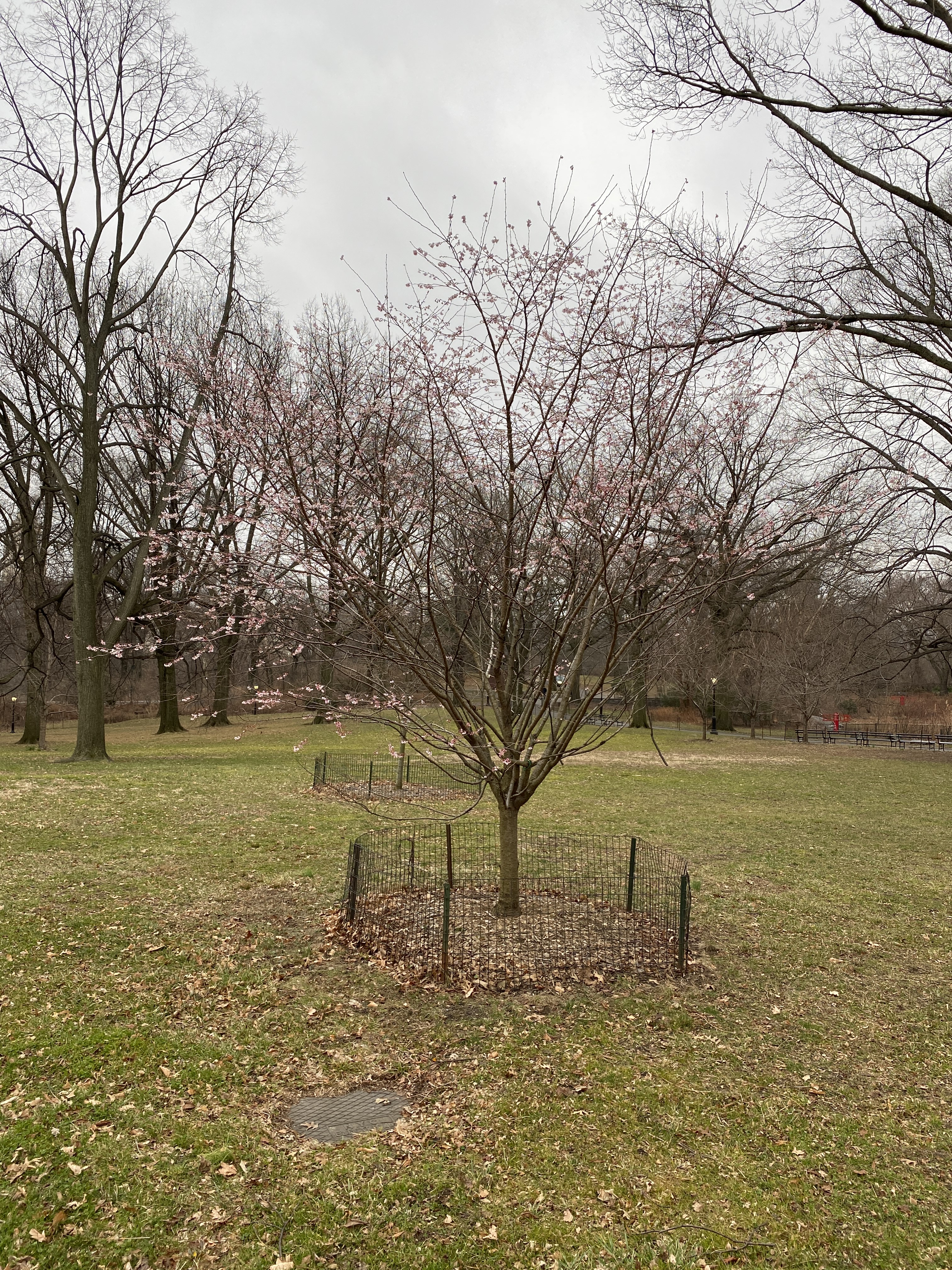
Spring in February in New York: Like many things that feel good in the moment – smoking, binge eating, the contraction of venereal disease – it should fill us with fear for the future

In the 50s in New York consistently through January and into February, and I, for one, am terrified. A silver lining of this lovely weather – and the unprecedented storms, wildfires, droughts, heatwaves, etc. – is the increasing impossibility of failing to recognize that the climate crisis is upon us. Utter ignorance, of course, presents little obstacle to many recent converts to climate urgency who are now certain that a carbon tax is on the only solution, or that all that New Green Deal money should go into carbon capture and storage research, or that the world is fucked and we are all going to die anyway, so why bother?

But I too was late in my climate awakening, and can attest that one of the chief barriers – beyond the staggering complexity of the involved phenomena – to beginning to really think about anthropogenic climate disruption (there’s also a lot of specialized vocabulary) or make sense of the IPCC reports (and a ton of acronyms; the preceding one means Intergovernmental Panel on Climate Change), but one of the chief barriers is simply the math.

We should all be familiar with at least the basic math when it comes to the climate crisis, and to that end, a primer:

Greenhouse Gases (Atmospheric Concentrations)

Immediately, we encounter the overwhelmingly complexity. To attempt to cut it down to size, a greenhouse gas is a substance (like carbon dioxide) that traps heat in Earth’s atmosphere. It does so by preventing energy that entered Earth’s atmosphere (in the form of sunlight) from exiting Earth’s atmosphere (in the form of infrared radiation). This trapping of heat has to do with the molecular structure of the gases in question.

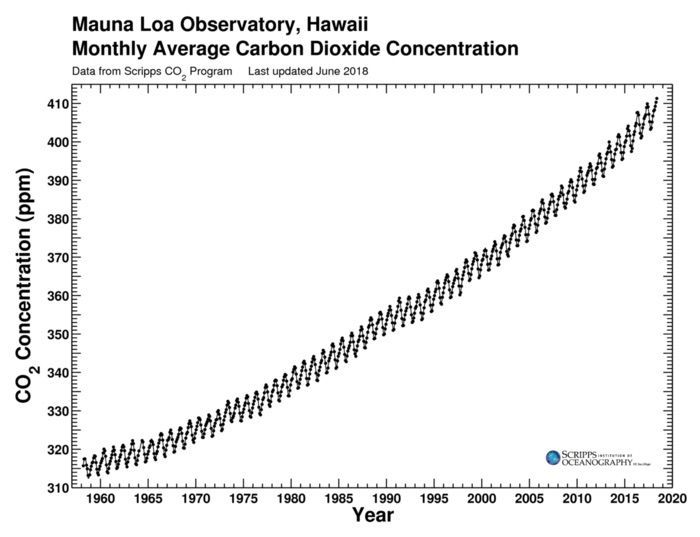
As the graph below shows, atmospheric carbon dioxide levels have risen from ~315 parts per million (or ppm) in 1960 to nearly 415 ppm today. I glance at this tracker from NOAA’s Earth System Research Lab every morning.

b546cb12-a273-4f7a-90f2-a2eec56fcb98.jpg
This is called the Keeling curve, for Charles Keeling. It shows the trend in measurements of atmospheric carbon dioxide levels as measured at the Mauna Loa Observatory which sits atop a sacred volcano in the midst of occupied and colonized indigenous land. I copied this version of it from National Geographic’s website.

Evidently, for the ~12,000 years (called the Holocene) leading up to the Industrial Revolution, atmospheric carbon dioxide concentration remained pretty steady at around 280 ppm.

Carbon dioxide is not the only, or even the most powerful greenhouse gas though; in fact, methane, nitrous oxide, and various fluorine-containing compounds (known primarily as refrigerants, although they have many uses) are all far more powerful, but thankfully far less prevalent atmospheric warming agents. According to the EPA, once a very reliable source on such matters, in 2010, carbon dioxide accounted for roughly 75% of global anthropogenic greenhouse gas emissions, while methane accounted for ~15%, nitrous oxide for ~5%, the fluorine-containing compounds for ~2%, with the balance made up for by other less common substances and my rounding.

As we all know, carbon dioxide is generated by the combustion of fossil fuels (or of wood, including of vast forests), although our land-use choices – cutting down or planting trees, how we farm, etc. – also impact carbon dioxide emissions levels. In the U.S., leaks from natural gas extraction, processing, and distribution facilities and animal agriculture (ruminant burps and farts) are the primary sources of methane, although human flatulence must also have its role to play. Nitrous oxide emissions originate primarily from our use of synthetic fertilizers, while the fluorine-containing compounds seem to mostly be released in relation to the production, use, and disposal of freezers, refrigerators, and air conditioning units, though I’ll admit to having a limited understanding of these substances.

I believe this is already at risk of becoming too complicated, so suffice to say that methane is at least 20-30x more powerful as a warming agent over the short term (20 to 100 year time horizon) than is carbon dioxide, and nitrous oxide is something like 300x more powerful over the same. Today, methane concentrations in Earth’s atmosphere are approaching 2 ppm while nitrous oxide concentrations are around 300 parts per billion (or 0.3 ppm), and concentrations of the various fluorine-containing compounds are, thankfully, measured in parts per trillion, although they are, in many instances, far more powerful warming agents than even nitrous oxide.

Greenhouse Gases (Total Amount)

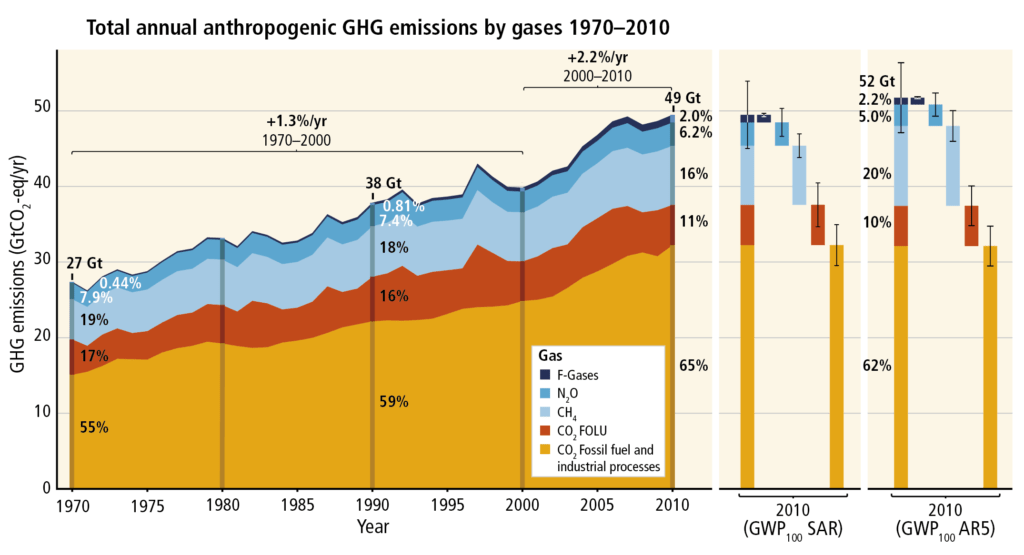
In 2010, total anthropogenic greenhouse gas emissions totaled ~49 gigatonnes of carbon dioxide equivalent. Carbon dioxide equivalent is arrived at by considering the global warming potential of a substance (for example, the “20-30x more powerful” mentioned above for methane) and the amount of that substance that was emitted – kind of like saying a dozen is equivalent to twelve, except in this case, you’re talking about how many carbon dioxide molecules say one methane molecule is equivalent to when it comes to warming.

Fig-1.06_rev1-01-1-1024x555.png
This is from the the IPCC’s Fifth Assessment Report (generally abbreviated AR5) from 2014.

Coming back to that number, ~49 gigatonnes of carbon dioxide equivalent (or CO2e, though I’m going to mostly keep avoiding acronyms), that just means 49 billion metric tonnes of carbon dioxide, which is the same as saying 49 trillion kilograms, which is basically the same as saying 50 trillion kilograms.

For 2019, the Global Carbon Project has estimated that total carbon dioxide emissions alone were ~43 gigatonnes, and while I’m struggling to find an estimate of the carbon dioxide equivalent emissions for 2019, I suspect they fell not too far shy of 60 gigatonnes.

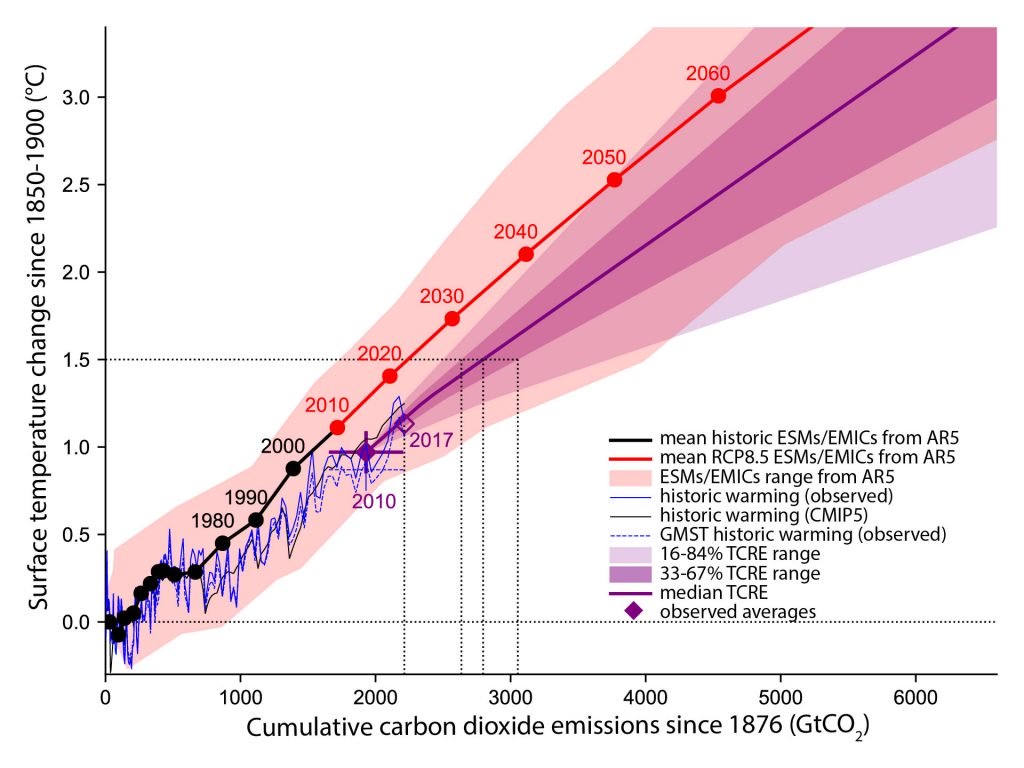
Finally, it’s important to have a sense of the total historical anthropogenic emissions. It’s surprisingly hard to find good graphs (perhaps because the underlying data is so mind-boggling). Please don’t be daunted by the graph below – what it shows is that, up to 2010, cumulative anthropogenic carbon dioxide emissions were ~2,000 gigatonnes, so roughly 50x what was emitted globally last year. That should tell us just how much we are currently emitting, that 50 years like last year would come close to equaling the global historical total of carbon dioxide emissions.

Further, the graph shows that from 2017, there remained somewhere between ~500 to at most perhaps 800 gigatonnes of carbon dioxide budget to keep the total global mean temperature increase to 1.5 degrees Celsius or below. Carbon dioxide and other greenhouse gasses have continued to be emitted at ever higher rates in the meantime, and I think it’s fair to say that the current carbon dioxide budget may be as low as ~300 gigatonnes to stay below 1.5 degrees of warming, which gives us about seven more years like 2019. (Actually, we might have less than that, but I’m erring on the bright side.)


figure-2.3-1024x768.jpg
This is from the IPCC’s Special Report: Global Warming of 1.5 ºC – to quote: “The 2010 observation of surface temperature change (0.97°C […]) and cumulative carbon dioxide emissions from 1876 to the end of 2010 of 1,930 GtCO2 […] is shown as a filled purple diamond. The value for 2017 based on the latest cumulative carbon emissions up to the end of 2017 of 2,220 GtCO2 […] and a surface temperature anomaly of 1.1°C based on an assumed temperature increase of 0.2°C per decade is shown as a hollow purple diamond. […] Note these remaining budgets exclude possible Earth system feedbacks that could reduce the budget, such as CO2 and CH4 release from permafrost thawing and tropical wetlands.
Some Brief Review

Key takeaways thus far:

  • Atmospheric carbon dioxide concentrations are ~415 ppm;
  • Atmospheric methane concentrations are ~2 ppm;
  • Atmospheric nitrous oxide concentrations are ~300 ppb (or 0.3 ppm);
  • Methane, nitrous oxide, and fluorine-containing refrigerant compounds are far less plentiful in Earth’s atmosphere than is carbon dioxide, but are far more powerful short-term warming agents (I’m intentionally eliding the long-term for now, as we first just have to stop the bleeding and survive this century).
  • During the Holocene, atmospheric carbon dioxide concentrations were steady at ~280 ppm;
  • Annual total greenhouse gas emissions have been steadily climbing since ~1870, and are now around 40+ gigatonnes per year of carbon dioxide and 50-60 gigatonnes per year of carbon dioxide equivalent;
  • Total historic anthropogenic carbon dioxide emissions have been ~2,400 gigatonnes.
  • Allowing for the immense uncertainties involved in trying to predict the future behavior of the Earth, there remains a carbon dioxide budget of perhaps ~300-600 gigatonnes (at the rosiest) to remain in the vicinity of 1.5 degrees Celsius warming, with the caveat that feedback loops (like the thawing of Arctic permafrost, the collapse of a major Antarctic ice sheet and its aftermath, etc.) confront researchers with profound uncertainties about actual future outcomes.
  • If you’ve been paying attention, you’ll note that I’ve avoided mentioning greenhouse gases other than carbon dioxide relative to the carbon budget. You’re absolutely right. Short answer: Go read the whole IPCC Special Report, as it does, indeed, address “non-CO2 radiative forcing”!

Some Closing Remarks

The United States is responsible for ~25% of cumulative historical carbon dioxide emissions. In recent years, total U.S. greenhouse gas emissions have been ~6 gigatonnes carbon dioxide equivalent per year and ~5 gigatonnes carbon dioxide. Similar historical and present-tense blame/responsibility can be attributed to the E.U./major European powers, Russia, and to a lesser, but growing, extent China and India.

As always, the complexity of the technical, social, and political challenges involved in imagining and then achieving progress towards a more just and sustainable world are immense, and in some sense, the numbers are beside the point. If we all started living (very) differently tomorrow, the problem could be solved – or at least the deepening of the harm could be arrested – and we could dispense with all these technocratic technicalities. As it is, though, having some basic facility with the top-line numbers can be helpful; in fact, I’d say that we all should have such facility, and that failing to know climate basics at this point reflects a total abandonment of the love we need to show for ourselves, each other, and the planet.

Postscript: 350.org is named for the concentration (350 ppm) of carbon dioxide that the organization’s founders considered the highest “safe concentration of carbon dioxide in the atmosphere.” In fact, even 350 ppm – and definitely our current concentration (which is, again, in the vicinity of 415 ppm) – very likely corresponds, based on ice core records, to a global mean temperature multiple degrees Celsius warmer than that of the Holocene. If we care about ourselves, we should work – among a great many other things – to stay within the ~300 gigatonne carbon dioxide budget. If we care about a livable future, we should also be setting our minds and hearts to how to remove this vast excess of greenhouse gases from the atmosphere, which again, entails imagining and working for a better and very different world.

Post-postscript: for background on why staying below 1.5 degrees Celsius of warming is so important (if also increasingly unlikely), see the aforementioned IPCC report, or this round-up of its conclusions from the World Resources Institute.


Bernie Sanders is the Devil

Bernie Sanders is the Devil.

I had a conversation this afternoon with a loved one of mine who reads the New York Times, and Bernie Sanders is the Devil.

I’ve just had it with these Bernie Bros. And Bernie Sanders is the Devil.

Bernie Sanders may have been endorsed by AOC. And Pramila Jayapal. And Sean King. (Among many, many others.) He may have drawn a crowd, with AOC, of 26,000 in Queens. But his only supporters are the White Bernie Bros (who cost Hillary Clinton the 2016 election), and Bernie Sanders is the Devil.

Hillary Clinton may have supported destroying Libya and, de facto, handing it over to warlords. The War in Iraq. The 1994 Crime Bill. She may have failed to campaign in Michigan during the general election (and there may have been outright Jim Crow tactics employed to suppress the Black vote in Detroit); run a terrible campaign; and only secured the Democratic nomination through a highly-corrupt (one might almost say rigged) Democratic primary process, but Bernie Sanders is responsible for her loss (and the President it gave our great nation), and for that reason, among others, he is the Devil.

Bernie Sanders is the Devil. That is why he can be hands down the most popular politician in the United States and still barely get covered in the corporate media, until, in desperation, with Sanders leading the polls in the lead-up to the Iowa Caucus, that media at last turns on him in the open, because he is the Devil.

Bernie Sanders might barely pass for a moderate social democrat in the Scandinavian countries at which US Americans so love to marvel, but he is, nonetheless, the Devil.

The Democratic Party may be imploding (have already imploded?) as the Democratic Establishment seeks frantically, in a McCarthyite frenzy, to pin responsibility for its abject failure (in 2016; all across the country; in the Courts; morally) on anything (Russia! Please Russia!) or anyone (primarily Bernie) other than itselves. Not on its utter abandonment of the working class. Or on its wholesale neoliberalization. Or on its promulgation of false solutions to economic distress; inequality; racial injustice; the climate crisis.

Bernie Sanders is the Devil. In truth, I never really liked him personally. But I never met him personally either.

Bernie Sanders is the Devil, and he’s also very old. Even older than the other leading candidates, who are all old (in our gerontocracy, Amy Klobuchar, at 59, seems downright youthful!). In our white supremacy, he doesn’t look any whiter than our other leading candidates, who are all white. (Andrew Yang can’t even get a mention these days.) He doesn’t look less white than Joe Biden, who, um, “come[s] out of the Black community.”

Bernie Sanders is the Devil, which is why, devil that he is, he tempted Elizabeth Warren in private with his outrageous claims (claims which stand in clear contradiction to his own public statements, his past actions, and, in fact, his whole record) that courageous CNN was left to heroically publicize, sans evidence, only coincidentally, the night before the final (and CNN-broadcasted) Democratic debate.

But I think you get the point. Bernie Sanders may (still) be the most popular politician in the United States. He may stand the best chance of defeating the omnicidal buffoon in the White House. He may have, by far, the most consistent record of principled commitment to social justice of any of the remaining Democratic candidates; and the most compelling vision for confronting the climate crisis; and the clearest position in support of, among other things, Medicare for All. He may be the best available answer to all that ails a Democratic Party that has abandoned everything it once stood for in an unwinnable race to the bottom with a Republican Party increasingly intent on the destruction of the human species.

He may be all that (and a bag of chips, to use an expression not half as dated as every other sentence that comes out of the current Democratic “frontrunners” mouth), but he’s a socialist, and so the Devil, and for that reason, must be stopped. The New York Times told me so.

So just remember, about Bernie Sanders (aka, the Devil): “Nobody likes him, nobody wants to work with him, he got nothing done.” I look forward to the CNN interview when, challenged with this assertion, Bernie Sanders defends his record, only to have the interviewer turn to Hillary Clinton (waiting in the wings) to ask, “And when Bernie was getting nothing done… ?”

But this isn’t about Hillary Clinton and getting the War in Iraq, and the PATRIOT Act, and regime change in Libya done. This isn’t about Elizabeth Warren, who, among the current candidates, is the person I would second most like to see become our next president, and who will have my full support should she win the Democratic nomination. This is about Bernie Sanders, the socialist Jew from Brooklyn who for 40 years has been a voice of relative sanity in the wilderness of our toxic politics.

Bernie Sanders. The Devil. That’s who.

Postscript: No matter that the 2016 Sanders campaign sparked nationwide movements that number among the few authentically hopeful signs in our national politics. Devil!

No matter that Sanders actually vigorously campaigned on behalf of Clinton after losing the 2016 Democratic primary. Devil!

No matter that even Sanders is a creature of the military-industrial war machine, and has his own crimes in Iraq for which to account. Devil…