A Vein of Toxicity

Don’t look for me to mouth Xi Jinping Thought soon (or ever), but President Xi – as quoted in translation by Sinocism shared sensible words recently on the struggle to contain COVID-19 in China. As he put it, “(We) must not let all our previous work be wasted.” Great point.

Meanwhile, in the US, Democracy Now! reports that, “A draft Federal Emergency Management Agency report forecasts that daily coronavirus deaths in the United States would rise to 3,000 people a day by June 1 […] a 70% increase over the current figure” in view of the ongoing, premature reopenings currently being carried out at the state-level across the country. The Administration in DC has been flying fighter jets over major US cities to “honor” healthcare workers though!

The US President has fired another key oversight person (this time the HHS Inspector General) as part of his ongoing efforts to shield himself from any scrutiny. The firing came just as a whistleblower was “in the process of filing what promises to be a damning […] complaint” after being “forced out of his job because he refused to cave to [Presidential] pressure to adopt scientifically unproven treatments for Covid-19.”

So much for my dream of a resurgent progressive ticket for the US 2020 presidential election: Joe Biden and Elizabeth Warren co-wrote an op-ed “about oversight of the coronavirus relief programs.” I’ll be happy if she turns out to be his VP choice, although I have doubts about the wisdom (let alone, the fitness or competitiveness) of an all-old, all-white ticket.

Still, there are bright spots. I don’t know anything about Tim Bray, and had never heard of him until his recent resignation as a VP at Amazon-the-Company (which I plan to designate thusly in the future, because the rainforest is the Amazon, and it matters far more than a monopolistic e-commerce platform), but his resignation post makes good reading, and I encourage you to peruse it in full (it’s relatively short) beyond the following excerpts – on toxic culture:

Firing whistleblowers isn’t just a side-effect of macroeconomic forces, nor is it intrinsic to the function of free markets. It’s evidence of a vein of toxicity running through the company culture. I choose neither to serve nor drink that poison.

And worker power:

At the end of the day, it’s all about power balances. The warehouse workers are weak and getting weaker, what with mass unemployment and (in the US) job-linked health insurance. So they’re gonna get treated like crap, because capitalism. Any plausible solution has to start with increasing their collective strength.

On the other side of the inspiring-despicable spectrum, Axios warns the obvious: “[Y]ou shouldn’t hold your breath for the next coronavirus stimulus bill” because Republicans got almost everything they wanted already in the first three and a half rounds of “relief”, and now are primarily concerned with indemnifying corporations against COVID-19-related liability (say for the deaths of all the workers who have already died and of all those who will die in the coming months), while Democrats – having so far got very little of what the people they (and the Republicans) are supposed to represent might have wanted – are now calling, with very little leverage, for aid to state and local governments and a whole slate of other important progressive budget priorities for which they failed to adequately fight in March and April when it mattered most.

And yet, in spite of our current low political ebb, objective reality may be gravitating towards sanity and justice. (I say may, because much of the world could also just as easily tip (further) into fascism.) A few items for your consideration follow, starting with the words of J.D. Scholten:

Decades of prioritizing outsourcing and enabling market dominance has destroyed the local and regional culture of our food system, and ruined self-sufficiency, just like supply chains for medical equipment or defense products or almost everything else.

Obviously, the pandemic has laid bare just the deep structural problems to which Scholten points. Meanwhile, Axios (in its Generate newsletter in particular) asks: “Is it possible that global oil demand will never exceed pre-pandemic levels again?” We should certainly work to make that the case.

The pandemic has thrown not only agribusiness and fossil fuel industries into turmoil, but also the airlines, the cruise ship industry, and a number of other climate-crisis main offenders. In this fact, there is opportunity, and progress made should be progress kept.

Looking deeper, at both the individual level – at which a growing body of research suggests that gas-powered home appliances (like our gas stove) may actually be quite harmful to human health – and the global level – at which this new research article suggests that “Absent climate mitigation or migration, a substantial part of humanity will be exposed to mean annual temperatures warmer than nearly anywhere today” (with the implication that many of the currently-most-densely-populated places on Earth may be largely uninhabitable by humans 50 years hence) – the case grows stronger by the day for urgent, drastic, global climate action.

At the same time, the crisis of the moment (the pandemic) and of the millennium (global climate disruption) intersect many which-ways, but most immediately, in whom they most direly impact and in the types of global coordination that are required to meaningfully address them. The approach of fire and hurricane seasons in the Northern Hemisphere only further illuminates the type of catastrophic convergence that exists between these two very differently paced crises.

The Rosa Luxemburg Stiftung has a good webinar up entitled “Seeing Red: Internationalist Visions Toward a Green New Deal“; not to knock Thea Riofrancos – who is a coauthor of this clarion call for “A Green Stimulus to Rebuild Our Economy“– but I was most moved by the contributions of Walden Bello and, most especially, Grace Blakeley, the latter of whom declared:

[T]he question we have is not simply arguing for a greater deployment of resources in order to [help] our economy. The argument that we really have to be making is that – this is already happening. States and monopolies are already controlling what goes on in the economy, what goes on in most of our lives, but they’re doing so in a way that benefits them. They’re not doing so in a way that’s democratic, and they’re certainly not doing so in the interest of working-class people. They’re doing so in the interest of the ruling classes.

To complement Blakeley’s keen insights, I close with words from the problematic, but – at least, regarding monopoly – helpful Matt Stoller:

It’ll take a few more months to realize where we are as a society. Right now our political leaders still assume that we should try and preserve the status quo as best we can, without realizing that protecting that status quo means arguing about who gets to own or profit from a corporation when there is no underlying economic activity.

And that means we have to come to a new political arrangement of what kind of society we want to live in.

As I asked a month ago – and have been asking for a long time, and will continue to ask, as I’m sure many of you have been and will continue to as well: “In what type of society do we want to live?”

My thoughts in response haven’t changed much: “The work before us is to come up with a life-affirming answer to that question – what type of world? – and to build diligently, for years and decades, towards what that new and better world will be.”

I’ll only add, quoting Blakeley again:

What this demands is democratization of the economy. […] [T]hat power, which does exist, can be used to plan things in a way that’s democratic, that’s sustainable, and in a way that benefits the interests of working people. [But t]hat requires organizing […] actually shifting the balance of power in society.

Here’s to that.

Just-in-Time Emergency

Strange days, strange weeks, and strange years ahead.

As New York City lurches toward potential receivership [fittingly paywalled], the time has at last come for me to feature Fear Citythe excellent book on New York’s 1970s fiscal crisis by Kim Phillips-Fein.

Neoliberalism is a contested and hazy term, but many histories of it start with the September 11th, 1973 coup that toppled the socialist government of Salvador Allende in Chile (resulting in Allende’s death), and the “restructuring” of the Chilean economy – under the “guidance” of Milton Friedman and the so-called Chicago Boys – by the brutal dictator Augusto Pinochet, whose regime left thousands of Chileans dead, tens of thousands imprisoned, and hundreds of thousands in exile.

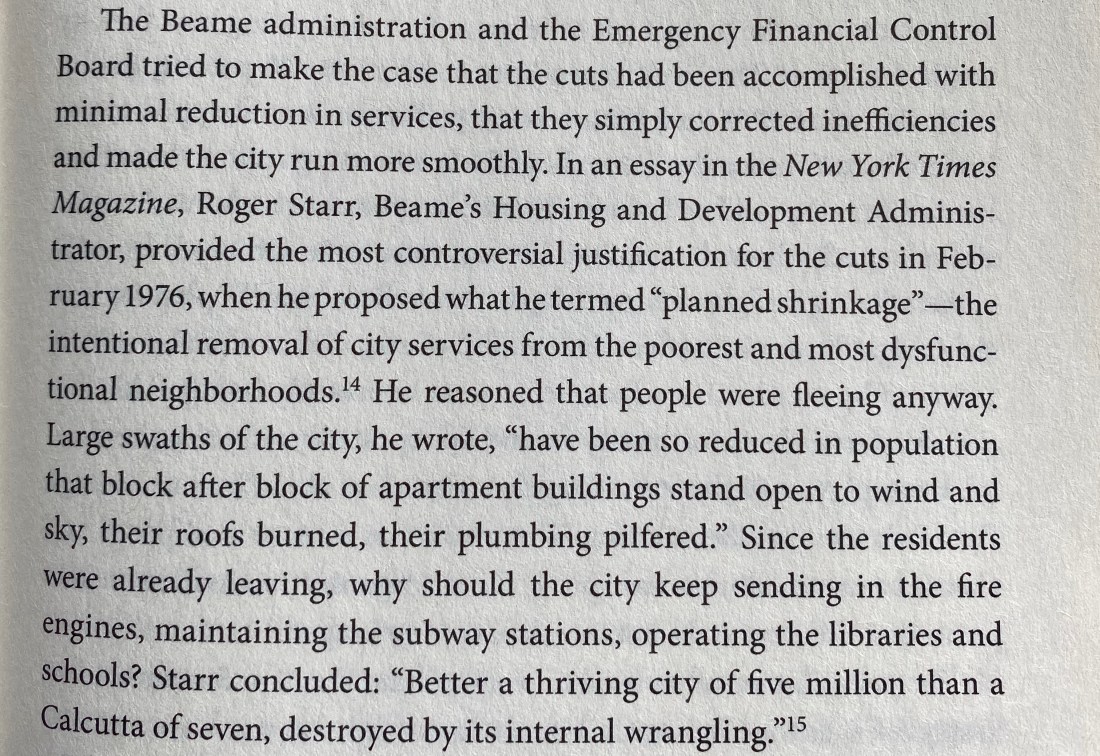
But if Chile was the laboratory of neoliberalism, New York City was arguably the site of its first domestic implementation in the United States. Enter Phillips-Fein. With no further ado, all the images that follow are drawn from pages 205 through 215 of Fear City, except the last, which is from page 306.

IMG_5482.jpeg
(Social Democratic) Paradise Lost

The City once had “four hundred publicly funded day care centers […] which offered free or subsidized child care to poor and working-class families”; only by realizing what we’ve lost can we make sense of what we stand, through struggle, to gain.

IMG_5483.jpeg
Austerity Targets the Poor

What has played out in many countries around the world since the 1970s – often at the hands of the US and bodies like the IMF (which the US largely controls) – played out first in New York City where austerity during a fiscal crisis was used to attack public goods.

IMG_5484.jpeg
What Class Warfare Looks Like

In general, the poor suffer most when austerity is waged on the people.

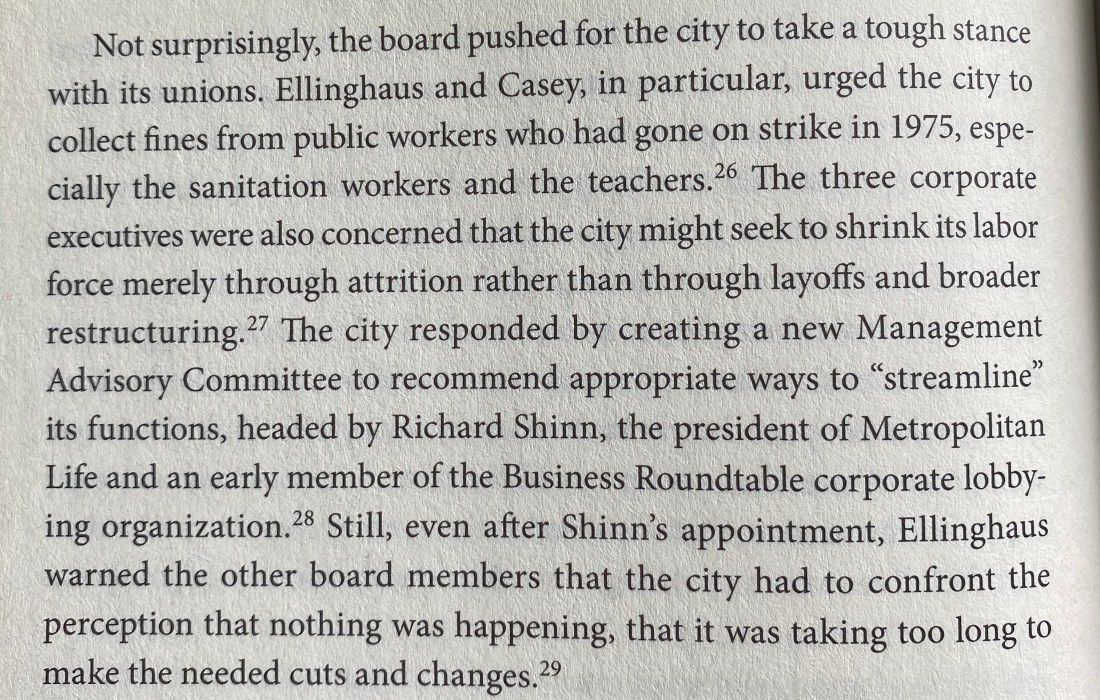
IMG_5485.jpeg
Enter The Emergency Financial Control Board

We should be studying what happened in the 1970s lest those in power – who still include some of the very same individuals – try to pass off the same lies and excuses in destroying public goods while protecting private wealth.

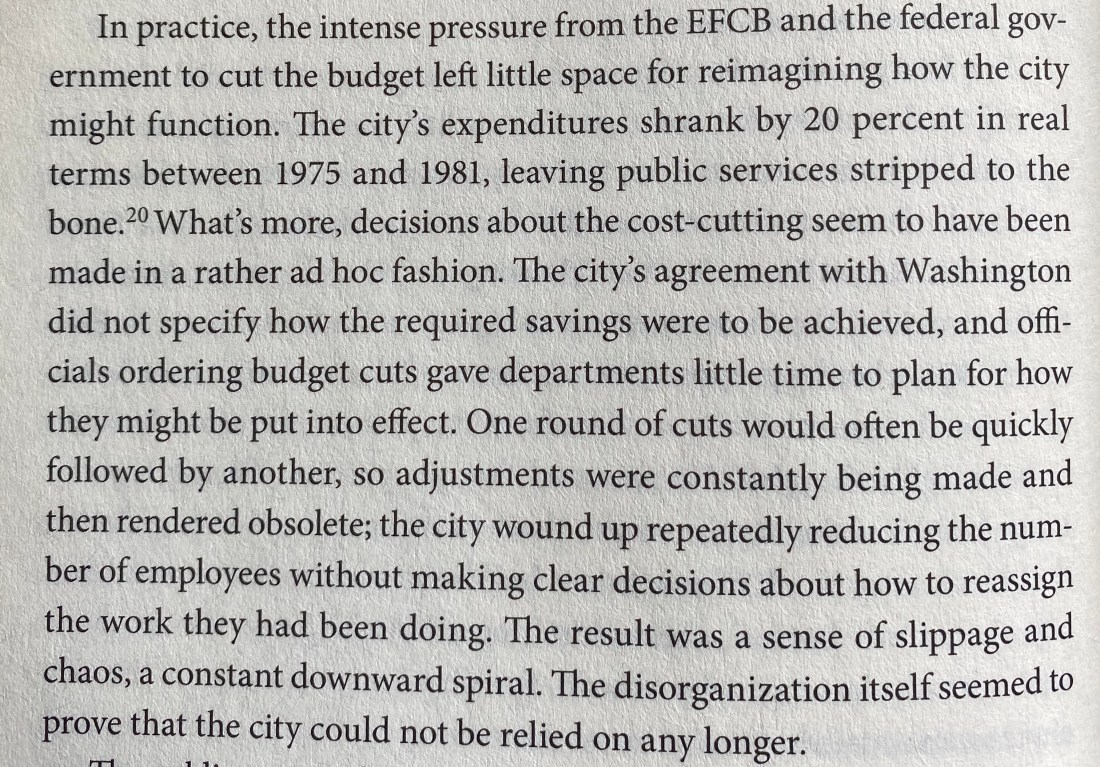
IMG_5486.jpeg
Imagination Dead, Imagine

We should be working very hard to avoid any “constant downward spiral” in the coming months and years. Resisting the vicious logic (and practice) of austerity will be central to that fight.

IMG_5488.jpeg
Insulation from Politics

The Emergency Financial Control Board, which still exists under a slightly different name, was essentially an instrument to bypass politics and public oversight/accountability. It looks very much like the the Financial Oversight and Management Board currently in control of Puerto Rico’s finances (which was instituted in 2016 under President Obama through the dishonestly-named PROMESA law, and is, I read, widely referred to in Puerto Rico as “La Junta”). You can see entities like these as legal vehicles to accomplish de facto corporate coups.

IMG_5489.jpeg
Austerity Is War By Other Means

Today, we use the phrase “disaster capitalism” to characterize much of what was “accomplished” in the mid-1970s in New York – such as undermining public sector unions – under the guise of fiscal “reform”; any long-time New Yorker knows that our public sector unions can, indeed, be very problematic. The solution to these “problems” though, is not more corporate control over our politics and economy.

Screen Shot 2020-05-04 at 2.51.58 PM.png
The Definition of Neoliberal

As should be quite evident, many of the things we’re fighting for today – in the form of universal health and childcare, free public college, etc. – are akin to programs that existed in New York City in the not-so-distant past.

IMG_5492.jpeg
“Little Sense”

This excerpt speaks for itself, but I’ll reiterate: “There was little sense on the board of the potential problems that might result from curtailing services or programs aimed at poor people.” Definitely sounds like these individuals were well qualified for the monumental undertaking with which they were tasked, and yet, this is exactly what happens (and should be expected to happen) when totally unaccountable and out-of-touch individuals are given immense power with no oversight.

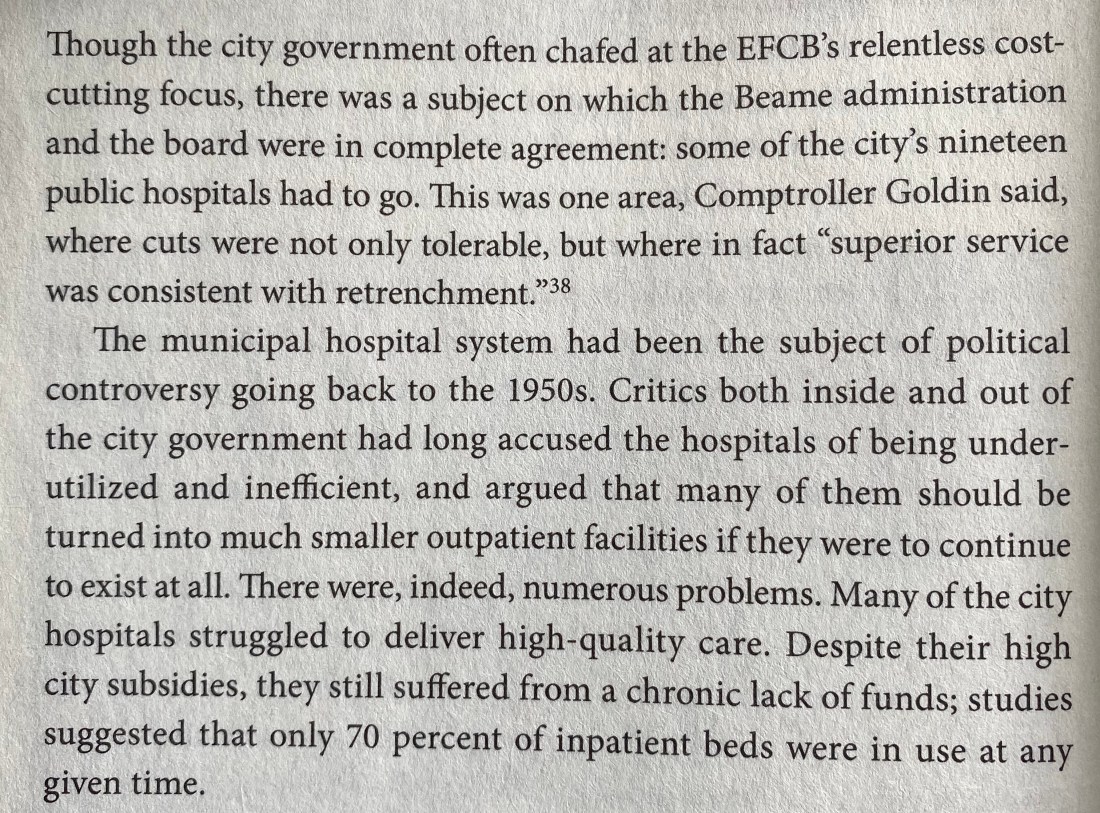
IMG_5493.jpeg
Hospitals Have To Go

It might have been nice to have more hospitals about two months ago…

Screen Shot 2020-05-04 at 3.14.20 PM.png
The More Things Change…

Regular readers will recognize that the dynamics spoken to above reflect almost exactly those which were present at the start of the 20th century in New York’s emerging consolidated private academic medical centers.

IMG_5495.jpeg
“Once You Close an Institution, It’s All Over”

Its’ much easier to destroy institutions than to create them. Or, as Joni Mitchell put it: “You don’t know what you got till it’s gone.”

IMG_5496.jpeg
“Health Care Is a Right”

“straints by men who are not answerable to an electorate,” concludes Dr. Holloman’s quote. As you can see, the fiscal crisis, as it was handled in NYC, pitted representatives of communities and public goods against corporate interests that had commandeered the City’s government. We live the lasting impacts of those events today.

IMG_5497.jpeg
The Problem Is Racism, Among Other Things

Not advocating violence, but it is easy to understand the desire to punch certain individuals in the face.

IMG_5498.jpeg
The Grit Fetish and Our “Postindustrial Urban Triumph”

As Phillips-Fein wrote in a passage not excerpted above:

The hospitals were a key line of defense against symptoms stemming from the ongoing health crises in the city’s poor neighborhoods – asthma, lead poisoning, cancer, heart disease, venereal disease, tuberculosis, sickle cell anemia, violence, and mental health problems. A program of “reform” that centered primarily on closing hospitals would mean turning away from the city’s real health needs.

Critics will point out that there was no pronounced spike in mortality in NYC following the fiscal crisis, but I prefer to see that simply as a testament to the massive public health victories won in the 19th and early 20th centuries. Even during a time when people’s lives were made more grinding and Hobbesian-ly nasty and brutish, they were not – because even the poor still had, for the most part, access to clean water, functioning plumbing (connected to a modern sewer system), etc. – made particularly short. This is no achievement towards which a rich society ought to aspire (and the mortality trend during the last quarter of the 20th century was no doubt also influenced by improved air quality, driven by hard-won environmental regulations, and secular shifts in habits, for example relative to diet and smoking), but it does bespeak the remarkable power of public health and fundamental infrastructures of hygiene.

Finally, as mentioned above, the ECFB – renamed, with the end of the “Emergency,” simply the New York State Financial Control Board – still exists. It’s board consists of the Governor, the Mayor, State Comptroller DiNapoli (who has resisted, for years, calls to divest the state pension fund from fossil fuels), City Comptroller Stringer, and two private individuals – “who are appointed by the Governor […] and who serve at the Governor’s pleasure”: Billionaire asset manager, Lawrence Golub, and asset manager of unknown net worth, John Levin. A third gubernatorially-appointed seat sits vacant at present.

That’s six old white guys and a notional seventh who could very well very soon have the near-term fate and future of the City in their largely unaccountable hands. Add to that the incompetence on display at City Hall and the autocratic style of governance reigning in Albany – where the Governor seems to increasingly have his way in all matters budgetary – and we have to question: How democratic is our democracy when so few men wield so much power with so little oversight and with so much consequence for us all?

This is not how New York City should be governed, and yet, it is how it is. Apologists for austerity – the same people who, for decades, have been ranting about the national debt and asking Bernie Sanders (and others), “But how you gonna pay for it?” – will roll out their lame, time-worn lies as we continue to resist the calls for deep budget cuts, but after we’ve witnessed the spectacle of Congress and the Fed materializing something like $10 trillion in a matter of weeks, are we going to give credence to these old lies anymore?

The money is there, because the power, resources, and human capacity are there. The question, then, is not: Is there money? But: What is there money for? If we don’t want barbarism, there needs to be money for socialism, or social democracy, or just plain sanity. For ublic health (including pandemic preparedness), a Green New Deal or its equivalent, universal healthcare, childcare, and education. Whatever you want to call it when a society is structured to care for its members, take heed of the future, and live in balance with the non-human world around us upon which we all depend. I say all this, because the old white guys with their meat cleavers are coming for what remains of our social welfare programs, and it’s up to us to beat them back and finally turn the tide on neoliberalism before it spills over into (global) neofascism and all is lost.

Reports and Reports and Reports

Yesterday, Governor Cuomo announced the results of the state’s “completed antibody testing study, showing 12.3 percent of the population have COVID-19 antibodies” in New York State, and 19.9% in New York City. I’m going to round that 20% if nobody minds.

The NYC number comports with previous estimates, so I don’t see any urgent need to update the numbers, other than to point out that adding up the State’s figures for “Confirmed” deaths (13,538) with the City’s figure for “Probable” deaths (5,387) with my own figure for “Still-ignored” deaths (~4,500) yields ~23,500 COVID-19 deaths in NYC to date which would put the IFR – based on this calculation: 23,500/1,600,000, and using 8 million as the rich-people-absent-adjusted NYC population – at ~1.5%, which is higher than I would’ve expected.

I know I keep promising to write about Kim Phillips-Fein’s excellent book, Fear City – and I will, I promise (though I hope perhaps this long drum roll has stirred your interest in her work in the meantime), but today, I’m both feeling like I felt two months ago – namely, scared by the utter inadequacy of our collective response to this crisis – and wanting to get outside to enjoy the sun with my partner, even if that’s just on the fire escape or something.

Briefly, the streets of the West Village are full. People are wearing masks if and when they please. Lots of people are sitting out on stoops in groups with to-go drinks in a festive mood. It’s not quite a parade environment, but it’s verging on a street fair. I hope I’ve made it clear in recent months that I’m not an ideologue when it comes to personal responsibility and the pandemic. We succeed or fail in this together, and if you did or didn’t wear a mask once – well, who cares? Not me – but when I look around outside right now, it is clear to me we are failing.

In Wuhan, a city of comparable size to NYC that faced a comparably devastating outbreak, it took 75 days (so ~ two and a half months) of strict lockdown to fully suppress the wave of COVID-19, and from what I gather, their measures were much more stringent than our own, and included removing infected people from households to prevent within household/family spread. (Meanwhile, we’re having block parties.) The Chinese Government has obviously also acted aggressively to put in place public health/non-pharmaceutical fundamentals: Testing, contact tracing, isolation and quarantine, etc. I see promising signs here in New York, but it is in no way clear to me that we are doing half of what’s necessary, and yet here we are, acting as if we’re already on the other side of this.

We’re not, and – if I’m not quite “terrified” as I was on March 7th – I’m certainly afraid of where this is taking us. This interview (which starts around the 2 min. mark and resumes at the 31 min. mark) with Dr. Jim Kim – the co-founder of Partners in Health and former head of the World Bank – outlines with remarkable clarity exactly what governments that have successfully confronted COVID-19 to date have done as well as what it is we have failed to do, as yet, in this country. I recommend listening to it.

Among other things, Dr. Kim points out how foolish it is to speak of having “defeated” the virus; in fact, in his view, a key to continued success in confronting the virus is understanding that it is never defeated – at least not until the global deployment of a successful vaccine, or total eradication of the disease worldwide, and even in either of those instances, vigilance would remain necessary.

Ali Alkhatib has a great piece up entitled “We Need to Talk About Digital Contact Tracing” which, in my view, pretty thoroughly dismantles the case being made for the Apple-Google digital exposure/contact tracing API. Read it, please. It’s great.

Lots of people are criticizing the IHME model at this point, which just keeps getting things wrong, while – contrary to overly sanguine perspective that have often been propped up by the IHME model’s overly sanguine numbers – this report, from the Center for Infectious Disease Research and Policy at the University of Minnesota asserts that “this pandemic will not be over soon and that people need to be prepared for possible periodic resurgences of disease over the next 2 years.”

Imagine it’s not 24 months but 26.2 miles – well then, you don’t win a marathon by sprinting to mile marker two, three, or four, and you certainly don’t win it by walking the first quarter and then getting drunk with your friends while smoking a cigarette. Our response has been a national embarrassment. It will very likely mark the end of US world dominance (which, in many respects, could be a very good thing, but my emphasis there is on the conditional), and it will certainly have, and is already having absolutely devastating consequences for tens of millions of people in this country.

I found this “graphical guide” from the journal Nature to the “race for coronavirus vaccines” helpful; it’s refreshingly simple and straight-forward, and you might enjoy having a look.

Finally, I’ve mostly stayed away from the kerfuffle over the latest film from Michael Moore, but to the extent that anyone is still taking Moore seriously, I recommend reading this piece from Josh Fox (the director of Gasland) entitled “Meet the New Flack for Oil and Gas: Michael Moore,” and with the lede: “Planet of the Humans is wildly unscientific, outdated, full of falsehoods, and benefits fossil fuel industry promoters and climate deniers.” Then read this piece from Bill McKibben himself (who is apparently the villain of Moore’s film) from which a gem within the following paragraph stood out to me:

To be clear, I doubt that [building cynicism to undercut the climate movement] was Moore’s goal. I think his goal was to build his brand a little more, as an edgy “truth teller” who will take on “establishments.” (That he has, over time, become a millionaire carnival barker who punches down, not up — well, that’s what brand management is for). But the actual effect in the real world is entirely predictable. That’s why Breitbart loves the movie. That’s why the tar-sands guys in Alberta are chortling. “People are going ga-ga over it,” Margareta Dovgal, a researcher with the pro-industry Canadian group Resource Works, told reporters. The message they’re taking from it is “we’re going to need fossil fuels for a long time to come.”

And finally, in continuing to draw the connection between the crises of pandemic and of global climate disruption, I encourage people to read Kim Stanley Robinson’s recent New Yorker piece, from which I quote:

The virus is rewriting our imaginations. What felt impossible has become thinkable. We’re getting a different sense of our place in history. We know we’re entering a new world, a new era. We seem to be learning our way into a new structure of feeling.

Robinson – whom I heard speak at Columbia just weeks before COVID-19 hit NYC (on a panel from which I don’t believe the disease was mentioned once) – has put it nicely, and I hope his plain-spoken look to the future speaks to many readers as we seek to get through the coming weeks and months (and two years) while also looking ahead to the work ahead of us in this decade and this century.

Getting Fooled Again, Again

We were on the roof yesterday when the nightly cheering broke out, and I have to admit: It was very moving. Out our windows, the phenomenon feels localized, but from the roof – with the city spread out in every direction more or less as far as the eye can see – it felt like that outpouring of presence went on for miles which, every evening, it no doubt does.

Later, inside, after dinner, I took a last look at my phone. Pre-pandemic, I’d years prior stopped spending much time on any social network, but under the pressure of self-isolation (and at my partner’s urging with respect to sharing this writing), I’ve been on Twitter in particular of late. It’s a mixed bag, of course, but, net, it makes a person sad, and last night, the parting salvo came from a stranger imploring me to “Get [my] shit together” for having supported Hari Kondabolu – one of my favorite standup comedians – in pushing back against the #IBelieveBiden campaign.

So it goes. But I couldn’t help thinking that, beneath the feel-good veneer of all that rooftop and out-of-window cheering lurks the fractured venom of a very sick and confused political culture. People only think they’re cheering for the same thing because there’s no opportunity to interact, or – more optimistically – only at the most basic level of love of place and desire for an end to trauma are we truly united. On our block, too, after all, a neighbor plays Sinatra every night (on a car sound system cranked loud with the doors wide open), and I know it lifts most every spirit with ears to hear.

Would that the case were different, as – although my online interlocutor seemed quite intent on casting me as an unhinged… um… right-wing reader of The Intercept? Frankly, I couldn’t make out what he thought my position was, other than that #IBelieveJoe, I didn’t (though his politics were made very clear by his bio, which read, in part: “Lover of Blues Brothers, C.S. Lewis, MCU, and all things awesome,” and his preferred mode of discourse: Shouting, was made very clear by his actions) – it’s painful to find oneself so truly marginal to a culture.

Meanwhile, the pandemic rages on, but COVID-19 is nowhere near the leading cause of death globally. Around the world, on average, roughly 50,000 people die a day from heart disease, another 30,000 from cancer, and 10,000 from respiratory diseases. Disaggregating COVID-19 from all of the causes of death (heart attack, kidney failure, stroke, etc.) which it can precipitate, official figures have the disease steadily causing ~5,000-6000 deaths per day globally for the past month. If we accept that these figures reflect a drastic undercount, and that the actual death toll is probably at least double what these numbers suggest, then that would make COVID-19 the third leading cause of death in the world at the moment, though by far the leading daily infectious source of mortality (given that tuberculosis kills, on average, ~3,000 people per day).

New work from the COVKID Project suggests far more children all already infected in the US than was previously suspected, though supports the prevailing notion that the risk to kids from COVID-19 is low; however, even with low risk, if tens of millions of children become infected, thousands of them will die.

A brief survey of the caustic implications of all this fear and death will be instructive: DSNY has indefinitely suspended its residential compost program; people on actual house arrest find it hard to go outside because of remote monitoring devices; under scrutiny for sheltering his political allies in the nursing home industry from prosecution, Governor Cuomo has found a scapegoat (unsurprisingly, a nursing home not in Park Slope or Albany, but in Washington Heights); the Metropolitan Detention Center – the same federal jail in Brooklyn which was in the news in early 2019 for keeping hundreds of people locked up for at least days with no heat in the midst of a brutal cold snap – has been destroying medical records to cover up the extent of COVID-19’s spread within its walls; in Louisiana, “[la]wmakers voted by mail” to “[roll] back an expansion of mail-in ballots for people concerned about the coronavirus”; in North Dakota, a “tiny airport […] scored enough money under the federal stimulus law to cover its expenses for 50 years” while “one of the country’s busiest airports, JFK International in New York, got barely enough aid to make it through three months of operations”; in DC, the one-woman Congress that is Nancy Pelosi announced that state and local governments are seeking $1 trillion in the next bailout, which makes you wonder what she was up for the previous three and a half rounds of corporate giveaways; in the United States, Aleksandar Hemon – who lived through the bloodshed that accompanied the collapse of the former Yugoslavia – opines, “Trump’s Nationalism [Is Advancing] on a Predictable Trajectory to Violence. His Supporters Will Kill When They’re Told To”; from Delhi, we see convincing examples that Hemon is probably right; in India, as yet another politically-motivated legal vendetta against the truth demonstrates, the space for freedom of speech continues to narrow; and, in this country, the corporate media (and most of the population) continues to look the other way (if not celebrate in spiteful glee) this Administration’s First Amendment-eviscerating persecution of Julian Assange.

It is a sad round-up of the state of affairs: Austerity, mass incarceration, corporate cronyism, a concerted Republican war on progressive cities and states, Democratic ineffectuality and complicity with Republican nihilism, the rise of fascism, the gutting of civil liberties, and the utter failure to commit to even the most modest steps to address climate crisis. Bloomberg has a cheerful piece up pointing to a projected “unprecedented 8% decline in global carbon dioxide emissions this year” owing to the pandemic and predicting that this trauma will accelerate the global shift towards renewables, but, put differently, it would take at least an equivalent percentage reduction in global emissions each year for the rest of the decade to reach even the very modest Paris climate goals, and look what this took. Not an altogether sanguine sign in my view given 40+ years of global inaction on global warming/climate change/climate crisis.

Catalyst – the scholarly imprint of Jacobin – had an excellent article in its fall 2019 issue entitled “The Economic Origins of Mass Incarceration” that I’d encourage everyone to read as we confront the risk of new waves of austerity and the immense human suffering brutal budget cuts would entail. (Tl;dr, if you don’t read these sorts of things: Yes, the US is very racist, but the emergence of our contemporary system of mass incarceration can be best explained not by a racialized war on drugs, but by the response to an actual, empirically-documented spike in violence that started in the 1960s and was caused by major structural shifts in US political economy, a response which was characterized by failure to invest adequately at the Federal level in social welfare programs (which are expensive), which in turn led states and localities to “deal with” crime in a punitive fashion (which is also expensive, but is far cheaper than providing a comprehensive social safety net for all)).

Call me a killjoy – especially after my concerted efforts yesterday to call for imagining a future different from the ugly visions we’re being fed by the corporate media – but it’s not enough to cheer the “heroes” while Cuomo, McConnell, and others mortgage our futures and foreclose possibilities for desperately necessary action on climate, healthcare, etc., etc. (videlicet, see the Green New Deal). It’s not enough to stand opposed to our scary and mean-spirited President, but then turn into exactly the sort of howling-mob member who backs that President when your own candidate is credibly accused of sexual assault. We knew at least from the spring of 2019 that Biden bore some version of this liability, and attacking survivors or people of conscience who stand by them may be a winning strategy (Kavanaugh is on the Supreme Court now, after all), but it’s not one for which I’ll stand.

To end on a brighter note, I’ll turn again to David Dayen who writes:

[There] is a new militancy in U.S. politics. It has some roots in the wildcat teacher strikes that began in West Virginia in 2018. But there’s increased urgency and precarity right now, and a lack of responsiveness from Washington. Unions were born out of such despair in the Gilded Age, and rose to their peak after the New Deal. The rumblings in workplaces and apartment complexes have the ability to change our politics rapidly, to constrain lawmaker action, to force changes.

I know we’re conditioned to believe that only set of interests in America can have a voice. […] But it’s not necessarily true in times of crisis. People power is not just a slogan. Today, people are on the streets working to make it real.

Here’s to that, but we don’t get to the streets by first succumbing to propaganda. A funny thing has been happening, though: Whenever I type the WHO, autocorrect gives me The Who instead. And good for them! Can you imagine being so iconic that your band name outcompetes UN agencies in the not-mind of an algorithm? Let me nod to those once youthful renegades then: We shouldn’t get fooled again, and part of not getting so is staying awake, even when it hurts.

Bathed in Ideology

As part of DiEM25 TV, Srećko Horvat has a nice video series up called “Virus Mythologies” in which he examines the various novel ideologies of pandemic. In previous posts, I’ve drawn conclusions similar to some of his (about social distancing and pot banging, among other phenomena), but he does so at more length, with more philosophical insight, and – perhaps most crucially – with far more funny videos. I recommend you check out all four of them.

Umm, speaking of ideology – or something like it – the Pentagon released UFO videos (footage of “unidentified aerial phenomena” in official US military parlance) to almost no fanfare during the week. Most notable to me in understated coverage of the previously-leaked videos was the central role of a former Blink-182 frontman in trying to uncover what truth is out there. (Fun fact: As someone who works with teenagers, I can confirm that very few of them, at least in New York City, are aware that the music that accompanies the long-since-passé “Illuminati Confirmed” meme is simply the X-Files theme track. Given that the fetishization of youth has been a defining ideology of the post-World War II period of empire and mass consumerism in the US – perhaps now ending – maybe we can hope to move into something more like cultural adulthood, whatever that might mean, as we move beyond the pandemic, though as The New York Times cautions regarding the above mentioned UFO videos: “Don’t Hold Your Breath.”)

Lots of talk about Derek Thompson’s pessimistically optimist piece for The Atlantic, “The Pandemic Will Change American Retail Forever.” His thesis boils down to this: It’s all cyclical; it’ll get worse before it gets better; but in the long run, this will lead to a rebirth of cities from the low ebb of peak neoliberal homogenization, displacement, gentrification, etc. Fine. Nice piece. Whatever. But what sets apart thinking like Horvat’s from the dross we’re fed from our high-brow, mainstream-liberal publications (feel free to scare quote all of the preceding adjectives if you like) is the invitation to imagine a different sort of world. Thompson is very likely right – or at least, he might prove right if we don’t have a nuclear war, or a civil war, or an especially devastating superstorm, or some combination thereof, before his clockwork predictions can play out, or if we don’t collectively set a brighter path for the future instead – but why can’t we dream of and then work for different outcomes. Must things first bottom out before they start to improve?

Perhaps the answer is yes, for structural reasons, and we simply can’t hope not to suffer through a bad decade. (Tomorrow or Sunday, I’ll feature excerpts from Kim Phillips-Fein’s excellent Fear City in reflecting back on the start of the neoliberal era in New York City.) But look, Italian cities are going car-free in response to the changes brought on by COVID-19; Vilnius, the capital of Lithuania, “has announced plans to turn the city into a vast open-air cafe by giving over much of its public space to hard-hit bar and restaurant owners”; New York itself has come a very long way with respect to public health and wellness (as I’ve written about extensively with respect to the cholera outbreak of 1832, the flu pandemic that coincided with the end of World War I, and the creation, here, of a whole then-world-leading public health system in the early decades of the 20th century); and Slate has some ideas about how US cities could follow these Italian and Lithuanian examples.

Sadly, those of us who were calling for a Green Stimulus have already largely lost, at least for now. The disaster capitalists had plans in place; they acted swiftly; and most importantly, they had power and we did not. Where does that leave us? Sitting at home. Sometimes, it’s hard not to despair, but the world moves very quickly – especially today –  and refusal to accept canned versions of our foretold, so purportedly inevitable fate is part of keeping open the possibility of a different future. On March 15th, it was inevitable that New York City was sailing into a very rocky few months. As of today, it’s inevitable that the world is sailing into a very rocky hundred years. But we have choices about how we confront the inevitabilities entailed by pandemic or climate crisis mishandled (including the choice to learn from past mistakes so as to avoid repeating them), and we should refuse to allow ourselves to be so easily propagandized regarding the “necessary” shape of what’s to come.

Last night, I watched this surprisingly sweet and upbeat livestream featuring Senators Bernie Sanders and Elizabeth Warren, and Representatives Pramila Jayapal and Mark Pocan discussing “their shared priorities for the next coronavirus relief package.” Now, admittedly, this is a little fanciful of them, given that we’ve already had three and a half relief packages, none of which have come out terribly well, and yet, there was something funny and moving about listening to the four of them speak from their homes. In contrast to Joe Biden, who struggles to complete coherent sentences in his rare national television appearances and now stands credibly accused of sexual assault, Sanders seemed confident, relaxed, in command of the facts, authentically in touch with the grief and hardship rocking this country, and – as he joked, facilitated, and elaborated – at ease with the peers whom he’d assembled to Stream the Bern with him. Given the strained dynamic between Sanders and Warren in the waning days of their respective campaigns, I couldn’t help but wonder: Is this some type of hedge towards a progressive 2020 ticket that may still rise from the dead at the (virtual) Convention to come? We’ll see, but if ever there was a time for two aging (somewhat) leftists to sweep to power with a commanding mandate to chart a new course for the country, now is it.

As struggling small farms are sacrificed at the altar of Sonny Purdue’s bottom line; New York City doormen die by the dozens; and prisoner deaths spike (in New Jersey – where prison authorities are barely testing – as across the country) against the backdrop of the ACLU’s warning that “COVID-19 could claim the lives of approximately 100,000 more people than current projections stipulate if jail populations are not dramatically and immediately reduced”; Congress has quietly voted to increase the budget for its own concierge health clinic.

The volcanic rage is real and growing in this country. As has been obvious for some time, and the CDC confirmed this week, official figures regarding the national death toll are drastically understated. As mediocre nepotists like Jared Kushner brazenly declare the Administration’s catastrophic handling of the pandemic “a great success story” and “truly extraordinary,” while at the same time, reckless decisions at the national, state, local, and individual level around the country threaten to force us headlong back into a COVID-19 death spiral, we can only expect that rage to escalate.

What will it look like when it erupts? I hope for and work towards an eruption that looks less like the neo-Nazi-style rallies we’ve witnessed in recent weeks across the US (rallies which to me, as a child of Boise in the 1980s, are all too familiar from news coverage of the Aryan Nation rallies in Hayden Lake) and more like the upwelling of justified anger from a population disabused of its illusions and intent on finally breaking the back of the corporate two-party consensus that has, for more than 40 years, been gradually dismantling every public institution and rolling back every victory working people have won in this country.

On the path out of pandemic, we need not Three Percenters with AR-15s, but well-reasoned and deeply-knowledgable good sense like that in evidence in this short podcast from the New England Journal of Medicine “on Loosening Covid-19 Restrictions.”

On the path out of neoliberalism, the path beyond (fossil) capitalism and towards a just, sane world, we’ll need more voices than I can muster here. Right now, in New York City, New York State, the United States, and most places around the world, we are losing. Breaking the stranglehold on our minds of life-denying ideologies is a first step towards starting to win.

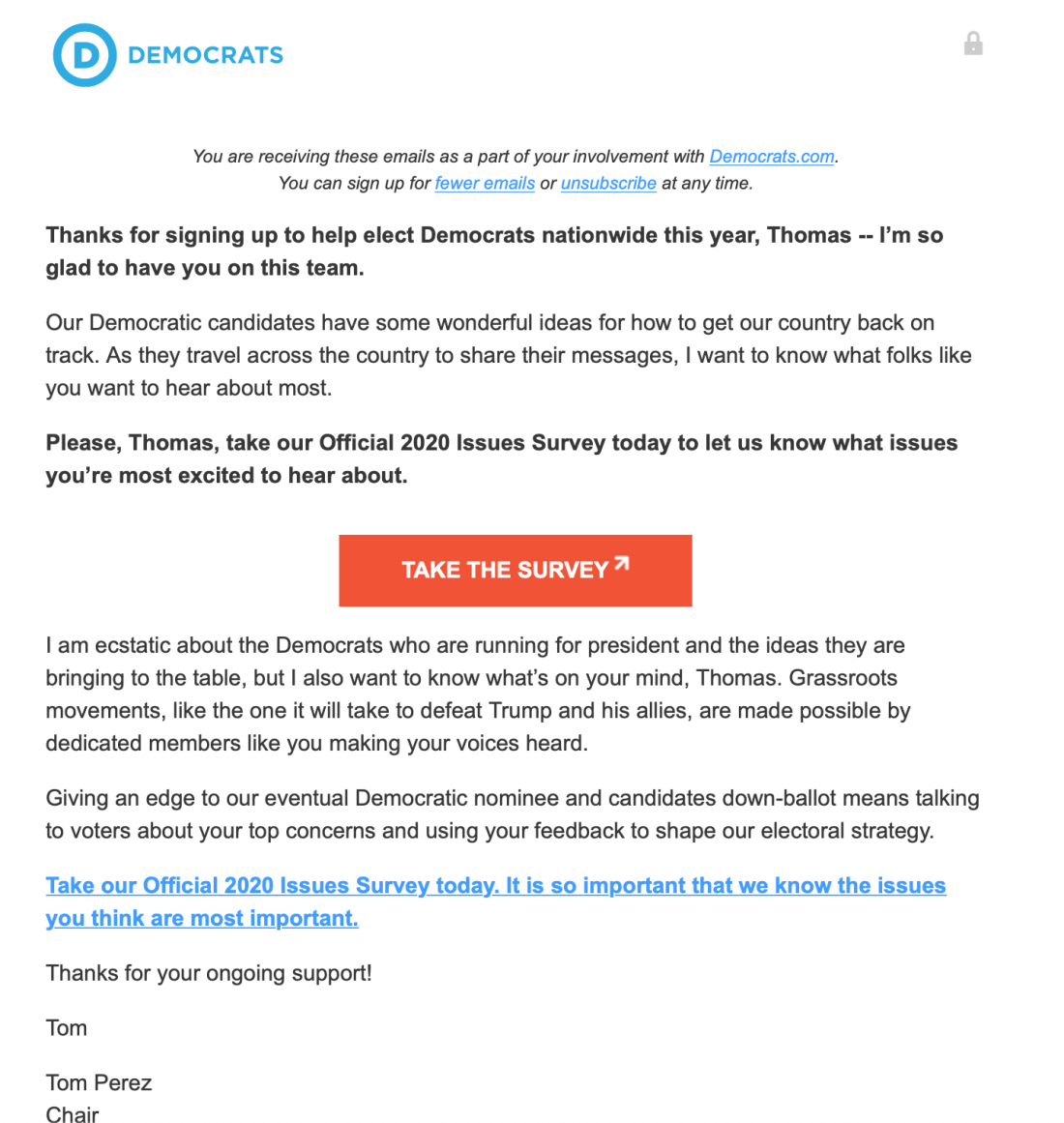
Postscript: What could it possibly mean that Tom Perez, Chair of the DNC, allowed his name to go out at the bottom of this email yesterday? Maybe just that the DNC is as far behind reality as it seems, or doesn’t have very good proofreaders, but I’ll let you be the judge:

Screen Shot 2020-05-01 at 5.49.46 PM.png
Candidates, TP? As of weeks ago, I was under the impression you had a one-man race and a doddering presumptive nominee already forced down our throats…